


Li Qing, Blessing Moment
-
Hou Hanru
30 years ago, many Chinese artists were excited by the unprecedented speedy urbanization across the country. Not only in metropolitan cities like Shanghai, Guangzhou, Beijing and Shenzhen, but also middle-small cities, and even countrysides, one was seeing incredible urban expansions and transformations, brilliantly resumed as Cities of Exacerbated Difference (COED), a concept invented by Rem Koolhaas and his research team, observing and theorizing the radical urban boom across the Pearl River Delta, and by extension, reaching out to the entire Asia Pacific Region. This trend was forming a key driving force in the process of globalization at the turn of the millennium. However, times have changed and we are now finding ourselves in an increasingly contradictory and complex situation: on the one hand, neoliberal capitalism has become the dominant norm of economic and social life across the globe; on the other hand, we are entering the most uncertain and violent geopolitical conflicts everywhere. In between, every society, no matter governed by any system – “democratic” or “totalitarian”… , is now facing a deep crisis upsetting the foundation of living together for different communities, classes and even individuals. The rise of “new technologies”, symbolized by all kinds of “social media”, has driven this precarious reality towards an unpredictable and uncontrollable, therefore, dangerous, “future”…
Artists are among the most sensitive about this kind of major change of history. And they always try to testify and make sense of it with their particular perceptive faculties, imaginations and critical reflections. They are always the first who convey the voice of the society. Artists living in China represent probably the most audacious and experimental among them while China has become the most drastic land of social, economic and cultural mutation.
To look for a sample of this “symptom”, it’s interesting to look at how different generations of artists witness and reflect on the evolution of architectural typologies in Chinese cities, and especially in junction zones between urban and rural areas, where urban expansion rapidly erased the boundaries of both sides. In this process, new houses built by newly enriched farmers represented their fantasies to live a “higher life” in folkloric versions of modern villas, signalled by various forms of “capitols” on the roofs… In the middle of the 1990s, Zhang Peili, a leader of the Chinese avantgarde movement based in Hangzhou, recorded in photography this phenomenon around his home area with excitement and optimism, mingling with playfulness and irony. In the mid-2020s, Li Qing, an artist 25 years younger than Zhang Peili, also based in Hangzhou, also recorded similar houses in photography. But this time, these originally “fancily made” villas are turned into “nail houses”, trying hard to survive the wave of demolition of the “old areas” as a new step of “urban upgrading”. Countrysides have now been reduced to the minimum and old villages have become “village in the city” awaiting the fate of ultimate disappearance… Now, younger artists like Li Qing, facing the “normalization” of urban expansion, are no longer excited by the dazzling city lights. Instead, they have grown a certain indifference and numbness: as Li Qing showed in his project for Fondazion Prada’s RongZhai in Shanghai (“Rear Windows”, 2019-2020), the neon lights appeared to be pale and sad… Li Qing, along with many artists of his generation, turns inwards to look for new “anchor points” to restart his “creative engines”.
At the same time, experimental art in China, and elsewhere, is also awaiting the most uncertain fate: Commodification of life and human relationships has changed the foundation of art making, its definition, function and values. It does not only change the main subject matters as witnesses of the life reality, including the transformation of the city towards a marketplace of consumerism, but also imposed a certain mode of perception, expression and communication based on the material and ideological logic of consumerism. It’s in this process that painting is “returned” to the forefront of all expressions and expositions… We all know that painting has regularly been declared dead for the last 80 years – as the most conservative and even regressive art form – and then brought back to “new lives”. But for the last two decades, with the unprecedented “market boom” in art, its “renaissance” has become particularly spectacular and efficient… Making, showing, collecting and trading paintings are becoming a genuine source of wealth making – or, a real reserve for “safety bounds”, a refuge against all risks in this turbulent world. Painting are therefore hailed as the most “reliable” form of “artistic expression”. Again, the “art community” tends to agree on that it’s through the “window” opened (painted) on a canvas that we can learn to see the world in the most reliable way – it’s not only beautiful but also convenient to carry around and show off…
In fact, we are now living in a truly “brave new world”. A digital autocracy-tyranny of the capital is disguised in happy faces named smart phone, “social media”, AI, bio-engineering. They not only take away jobs from us. they rip off our capacity and dignity as human beings with intelligence and moral values… This is an even braver world than the one imagined by Aldous Huxley. And the window in painting is indeed an opening towards such a “really brave new world”. Li Qing, with a critical mind, has shrewdly captured the key to open up such a “new perspective” towards the contemporary reality: he attempts to grasp and reproduce the “true pictures” of this mutating reality on canvas, painting all sorts of scenes from urban expansion to new norms of beauty defined by fashionable styles of life, or, more precisely, simulacres of real life, played out by “fancy people”, especially “influencers”. These scenarios are always played out against backgrounds with equally fashionable urban landmarks.
However, Li Qing also knows that this would have never happened without history… the tension between the “contemporary” and history is what make sense for us to understand and negotiate with this mutating world. Hence, “historic relics” like old window frames collected from demolished buildings, including the “farmers nail houses”, are introduced to become the skeletons, or architectonics, of his paintings, and by extension, of his installations that tend to become “architectures”… In turn, this attempts of “architecture making” has “architecturised” his paintings. Now they are restructured with frames, overlapping different scenes and images, forming collages of unconnected elements – architectural images, human figures… However, filtered images derived from by “social media”, they are no longer images of the real world; instead, they are what the artist identified, inspired by Jacques Lacan’s theory, as signs of the “desire of the Other”.
Here, let’s look at how Jacques Alain Miller, one of the most influential experts of Lacan today interprets Lacan’s idea of desire:
What does Lacan show? That desire is not a biological function; that it is not coordinated with a natural object; that its object is phantasmatic. Consequently, desire is extravagant. It is elusive to anyone who tries to control it. It plays tricks on you. But also, if it is not recognized, it produces symptoms. In analysis, the task is to interpret, that is, to read in the symptom the message of desire it contains.
If desire is disorienting, it also gives rise to the invention of artifices that act as compasses. An animal species has its natural compass, which is unique. In the human species, the compasses are multiple: they are signifying constructs, discourses. They dictate what must be done: how to think, how to experience pleasure, how to reproduce. However, each individual's fantasy remains irreducible to common ideals.
Until recently, our compasses, however diverse, all pointed to the same north: the Father. Patriarchy was believed to be an anthropological constant. Its decline accelerated with equality of opportunity, the rise of capitalism, and the dominance of technology. We are exiting from the age of the Father.
Another discourse is supplanting the old one. Innovation is replacing tradition. Networks are taking precedence over hierarchy. The allure of the future is overcoming the weight of the past. The feminine is gaining ground over the masculine. Where there was once an immutable order, transformational flows are relentlessly pushing back all boundaries.
Sharing the conviction of “ innovation is replacing tradition”, Li Qing represents his “subject matter”, or the objects of his imagination and fantasy, in such a perspective to embrace the “desire of the Other”. Then, this “desire of the Other” drives us to a wide open but greatly uncertain future. How will we live in a future without a Father? Who will be Other who will define and control the future?
For his personal exhibition in Seoul, Li Qing focuses on representations of the “beautiful” images of fashion models, saleswoman, middle-class vacationers, etc. posed in a “ritual” positions for “social media”. They are superposed by images of brocades – touristic souvenirs of Chinese tourism-diplomacy back to the age of “Economy of Planning” and some urban landmarks of today, such the Lotte World Tower in Seoul… In his paintings, in fact, these images are turned into empty signs, scarifying the very substances of their beings, to become mirrored illusions of the desire of the Others. They are offerings for the rite of passage of our world towards an unknowingly precarious future. This “rite of passage” is taking place during the Chinese Lunar New Year, a festival that both Chinese and Korea celebrate with hope of Blessing for the new year. To obtain the Blessing, how much do we need to sacrifice?
22 January 2026, Les Lilas
EXHIBITING WORKS
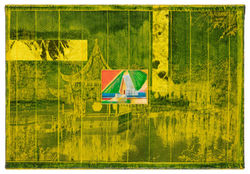 Li Qing Water Pavilions Oil paint, brocade, canvas, printed matters 28.5 x 41 cm 2025-2026 |  Li Qing The Plot of Light Oil on canvas 69 x 56 x 2.5 cm 2024-2025 |  Li Qing Spot the Difference •Sales Lady Oil on canvas 200 x 300 cm x 2 2019 |
|---|---|---|
 Li Qing Jumping Lighthouses Oil and acrylic on canvas 80 x 99 x 3 cm 2023-2026 |  Li Qing Noguchi's Light Oil paint, acrylic, panel, canvas 71.5 x 59.5 x 2.5 cm 2025 |  Li Qing My Trip to Hawaii Oil on canvas, frame 186 x 225 cm 2013 |
 Li Qing How Much Does Window Know Antique wooden window, oil paint, canvas 150 x 91 x 8 cm 2025 |  Li Qing Cableway of the Heart Oil paint, acrylic, panel, canvas 71.5 x 59.5 x 2.5 cm 2025 |  Li Qing Gazing Balls Oil paint, acrylic, panel, canvas 71.5 x 59.5 x 2.5 cm 2025-2026 |
 Li Qing House by the Sea Oil paint, brocade, canvas, printed matters 32.5 x 23.5 cm 2025-2026 |  Li Qing Cableway of the Heart Oil paint, acrylic, panel, canvas 71.5 x 59.5 x 2.5 cm 2025 |  Li Qing A Myriad of Rivers and Thousands of Mountains Oil paint, brocade, canvas, printed matters 32.5 x 23.5 cm 2025 |
 Li Qing Beneath the Vault of Heaven Oil paint, brocade, canvas, printed matters 28.5 x 41 cm 2025-2026 |  Li Qing Bloom Time Partition window, antique wooden window, oil paint, plexiglass, acrylic, oil pastels, fabric, photos, metal plate, frame 113.5 x 170 x 6 cm 2024 |  Li Qing Anteros' Wings Oli paint, paperboard, photo 101 x 69 cm 2025-2026 |
Artists
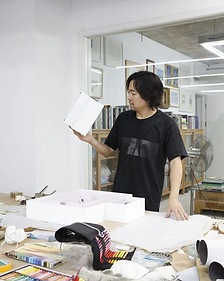
Li Qing
b. 1981, Zhejiang, China
Li Qing was born in Huzhou, Zhejiang Province in 1981. Li Qing’s paintings, installations and video works seek rational rifts in similarity and contradiction, acting on the perception and cognition of a viewer through circuitous and overlapped structures. His persistent painting practice no longer focuses on working within the four corners of the picture, but instead constantly expands the painting’s external space and modes of perception. The uninterrupted experimentation and sustained momentum across these various series are outgrowths of the themes Li Qing has been following since 2005: information and image in the technological age, the social mechanisms and power dynamics of seeing, the relationship between people, architecture and the city amidst globalization, the patterns and disciplining of aesthetics in the consumer age, constructing conflict structures and new forms of expression. The capture of micro-politics in everyday spaces and images, the analysis of ideology in aesthetic tradition, result in him a special historical consciousness.
Li Qing is currently the tutor of the Multi-dimensional Expressionism Studio of China Academy of Art and the associate professor. He has had solo shows at Long Museum, Shanghai; Song Art Museum, Beijing; Prada Rongzhai, Shanghai; Pingshan Art Museum, Shenzhen; Zhejiang Art Museum; Tomás y Valiente Art Centre (CEART), Madrid; Arario Museum, Seoul; The Orient Foundation, Macao; Goethe-Institut, Shanghai; Tang Contemporary Art; Almine Rech; Galerie Eigen+Art; among others. A number of prestigious art institutes have also included his works for group shows, such as Shanghai Biennale; Prague Biennale; Guangzhou Triennial; Bi-City Biennale of Urbanism/ Architecture (UABB); Hangzhou Triennial of Fiber Art; Venice Biennale Special Invitation Exhibition; Gwangju Biennale Special Exhibition; Lille3000; Noor Riyadh Light Art Festival; Los Angeles County Museum of Art (LACMA); São Paulo Museum of Contemporary Art (MAC USP); Asian Art Museum of San Francisco; Institut Valencia d’Art Modern (IVAM); Museum Maillol, Paris; Saatchi Gallery, London; Seoul Museum of Art; Gwangju Museum of Art; Fukuoka Asian Art Museum; National Gallery of Indonesia; Chile Museum of Contemporary Art; Power Station of Art, Shanghai; Shanghai Art Museum; etc.
Li Qing's works are also widely collected by major institutions and foundations globally, such as Fondazione Prada; Deutsche Bank; Institut Valencia d’Art Modern (IVAM); Rubell Museum, Miami; Forbes Group; Art at Swiss Re; Arario Museum, Seoul/Jeju; White Rabbit Gallery, Sydney; Kistefos Museum, Oslo; Kunsthalle HGN, Germany; Initial Access, UK; Bredin Prat Foundation, Paris; DSL Foundation, Paris; Fondazione Imago Mundi, Italy; Logan Foundation, San Francisco; Australia China Art Foundation; Art & Culture Foundation(IAC) of Spain; Long Museum, Shanghai; Yuz Museum, Shanghai; Guangdong Museum of Art; Zhejiang Art Museum; TANK Shanghai; Start Museum, Shanghai; K11 Art Foundation, Hong Kong; Fosun Foundation, Shanghai; CC Foundation, Shanghai; Longlati Foundation, Shanghai; ASE Foundation, Shanghai; The Cloud Collection, Nanjing; Yi Art Museum, Hangzhou; Iris Art Museum, Suzhou; Yue Art Museum, Yantai; Lin Fengmian Art Foundation; Live Forever Foundation, Taichung; Mountain Art Culture & Education Foundation, Taipei; etc.
Li Qing was awarded the ‘Annual Youth Power’ by ‘Southern People Weekly’ in 2025. In 2023, he was selected for Influential: Forbes China 30 Contemporary Young Artists. In 2017, He was shortlisted for the Jean-François Prat Prize, becoming the first Asian artist to be shortlisted for the prize. In 2013, he was awarded as ‘Robb Report: Best of the Best’ Artist of the Year.