
Hong Kong Dual-Space 10th Anniversary Group Exhibition
Decade One: Chronolect
Etsu Egami, Hao Zecheng, Yoon Hyup, Kitti Narod, Jade Ching-yuk Ng, Alexander Skats, August Vilella, Meguru Yamaguchi, Yu Xuan, Yukari Nishi, Gongkan, Studio Lenca
Hong Kong Wong Chuk Hang Space
2025.12.18 - 2026.1.31


Tang Contemporary Art is proud to announce to celebrate the tenth anniversary of our Hong Kong space, we are presenting a large-scale group exhibition "Decade One: Chronolect" from December 18, 2025, to January 31, 2026, at both of our Central and Wong Chuk Hang spaces. The exhibition's title, "Chronolect" – a lexicon of time – captures the distinct artistic language developed over this inaugural decade. The exhibition aims to focus on the most precious gains in artistic practice—namely, "accumulation and growth"—connecting the iterative evolution of the artists' works, the gallery's and collectors' explorations within the industry, and the unwavering adherence to their original aspirations.
Since taking root in Central in 2015, the space has borne the academic accumulation of nearly 100 exhibitions, becoming a vital bridge connecting Chinese contemporary art with global dialogue. The second Hong Kong space was established in Wong Chuk Hang in 2023, focusing primarily on pan-international projects with young artists, interspersed with group and solo exhibitions featuring artists from Europe, America, Southeast Asia, and Japan.
In the Wong Chuk Hang space, showcases twelve voices of international resonance including, Etsu Egami dissolving language into prismatic veils of misheard faces, Hao Zecheng exhaling blurred photographs until streetlamps ignite as silent fireworks, Yoon Hyup letting the city improvise through his wrist in endless vibrating lines, Kitti Narod suspending strangers and animals in the soft gravity of kindness, Jade Ching-yuk Ng painting the trembling half-inch of air between almost-touching bodies, Yukari Nishi staging a borrowed American dream inside faceless Japanese dolls, and Meguru Yamaguchi assassinating the rectangle to set the brushstroke free converge across continents, generations, and media to sketch the living ecosystem of contemporary painting. Alexander Skats reframes digital imagery into a vibrant critique of consumption, beckoning viewers to reevaluate beauty in the modern world, while August Vilella’s surreal intuitions craft dreamlike narratives with whimsical characters that invite introspection through their expressive gazes. Yu Xuan juxtaposes the charm and monotony of contemporary life, layering animal imagery over designed objects to form a strange aesthetic that mirrors society’s complexities. Gongkan’s work The contrast between the gentle pastel world and this abrupt, surgical blackness is where Gongkan’s quiet tension lives; it’s serenity interrupted by the uncanny. Studio Lenca paints in exuberant, palette-knifed layers of tropical-pop colour, draping stylised Salvadoran figures in camp, flower-laden costumes and towering sombreros to subvert machismo and reclaim joy from colonial violence. Their juxtaposition gives visible form to the “Chronolect”: a private dialect of time forged across one decade of restless practice. This is not a retrospective, but a single shared breath; ten irreconcilable tongues speaking the same urgent future, reflecting the pulse of contemporary art from Hong Kong to the world and heralding, in trembling pigment, the shape of the decade yet to come. Their juxtaposition gives visible form to the “Chronolect”: a private dialect of time forged across one decade of restless practice. This is not a retrospective, but a single shared breath seven irreconcilable tongues speaking the same urgent future, reflecting the pulse of contemporary art from Hong Kong to the world and heralding, in trembling pigment, the shape of the decade yet to come.
Etsu Egami wields the brush like a hesitant translator, her oils bleeding into prismatic veils that drape the human form in ambiguity. Broad, translucent strokes—dripping and deliberate—cascade across vast canvases, favoring the deep, conflicted lineage of oil over acrylic's shallow gloss. As an Asian heir to Western pigment, she revels in its history of intrusion and renewal, layering blues, pinks, purples, and golds to fracture faces into swirling distortions, evoking Francis Bacon's tormented whirl yet softened by Gutai's raw gesture and Japanese caricature's sly economy.
Hao Zecheng does not paint landscapes; he exhales them from the haze of half-remembered photographs. He begins with a snapshot (blurry, overexposed, forgotten on a phone), then lets it rot and bloom on the canvas. Memory is his solvent. Time loosens, space folds, a streetlamp ignites into silent fireworks, a branch twists into sudden calligraphy, a mountain ridge hardens into an ancient stele. What was once ordinary slips its skin and drifts into a dream. In his world, fidelity is a betrayal. The truest image is the one that escapes, carrying the faint perfume of a moment that never quite happened the way you thought it did.
Yoon Hyup paints the way a jazz solo moves: no beginning, no end, just pulse. From a New York rooftop or a Seoul alley wall, he lets the city’s heartbeat flood his arm. Lines (thin, thick, trembling, sure) spill like drum brushes across the snare; dots scatter like hi-hats in the night. Every mark is improvised, yet nothing feels accidental. The canvas becomes a turntable, spinning rhythms you can almost hear. He doesn’t depict the city. He lets the city paint through him, one vibrating line at a time.
Kitti Narod paints the world as it could be if kindness were gravity. In his canvases, strangers share the same soft light, dogs and children occupy the same plane of importance, and every color leans toward warmth (peach, butter, rose, the hushed gold of late afternoon). Figures are rounded, almost weightless, as though tenderness has lifted them an inch above the ground. A grandmother’s hand rests on a teenager’s shoulder; a street vendor laughs with a passerby; a cat sleeps across two laps that belong to people who, in another life, might never speak. Nothing is forced, yet everything belongs.
Jade Ching-yuk Ng does not paint bodies; she paints the trembling air between them. Her surfaces (canvas, wood relief, cut-out paper, etched copper) are quiet autopsies of touch. A hand almost reaches another hand, a cheek grazes a shoulder that is no longer there, a mouth opens as if to speak into skin that has already turned into memory. Everything is soft, almost bruised with tenderness, yet nothing ever quite connects. The gap itself becomes the subject: that half-inch of charged absence where intimacy and loneliness share the same breath. She works like an alchemist in reverse. Classical myths, religious icons, anatomical plates, modernist façades (all are fed into her private crucible, melted, and poured back out as ambiguous symbols that refuse their original names).
Alexander Skats transforms digital imagery into a kaleidoscope of intrigue, employing a vibrant palette that invites viewers to question the beauty in everyday consumption. His works, merging oil painting with digital influences, challenge perceptions as cinematic frames unfold across the canvas, blurring the line between nostalgia and modernity.
August Vilella channels his subconscious through a “surreal-intuitive” method, crafting oil paintings that immerse audiences in dreamlike realms. His characters, with their large, sparkling eyes, beckon viewers to engage with the emotional depths of each scene, balancing refined brushwork and whimsical forms.
Meguru Yamaguchi landed in Brooklyn in 2007, carrying Tokyo’s raw 90s street pulse in his wrist. He declared war on the rectangle. Canvas, with its polite corners and obedient edges, was quietly murdered. In its place, he births wild, uncontainable strokes (thick, glistening arcs of oil that leap off the wall like living graffiti, curling into space, defying gravity, refusing to be framed). Each piece in his OUT OF BOUNDS series is a single liberated gesture made flesh: paint-skinned, sculpted, and set free. These are not paintings; they are events. A crimson whip cracks mid-air, a cobalt slash knots itself into a fist, a black torrent freezes just before it spills onto your shoes. The brushstroke, painting’s oldest citizen, is finally allowed to grow up, run away, and become architecture.
Yu Xuan juxtaposes the banal and the beautiful, using animals embedded within urban typography to explore contemporary life’s intricacies. His layered compositions provoke reflection on social landscapes, where artificial objects meet evocative animal imagery, each hint weaving complexity into the visual narrative.
Yukari Nishi paints a borrowed American dream that Japan never lived. Perfect pastel kitchens, endless suburbs, golden-hour diners; yet every face is blank, every figure a plush toy or lifeless doll occupying spaces too idyllic to trust. Beneath the candy-colored light lurks neo-noir shadow, a quiet paranoia. These are postwar Japan’s imported memories: Hollywood reruns and Sears catalogs grafted onto a culture still smoking from the bombs. Nishi’s faceless citizens are what remains when identity is replaced by advertisement. In their eerie stillness, she asks: What happens to a self when its nostalgia is manufactured overseas?
Gongkan’s artistic style is instantly recognisable and deeply atmospheric. He works in a hyper-clean, graphic flatness that feels almost digital even when painted by hand: razor-sharp edges, seamless gradients, and vast planes of soft, muted colour (dusty pinks, pale blues, creamy beiges, and sage greens) create a dreamlike hush, as if the scene is suspended in twilight or memory.
Studio Lenca paints in thick, gestural layers — oil and acrylic piled on with palette knives and broad brushes, creating a lush, almost sculptural surface that catches light and invites touch. Colours are saturated and deliberately “tropical-pop”: hot magentas, acid limes, turquoise, sunflower yellow, and bubblegum pink collide without apology, evoking both Central American markets and queer club lighting. The figures emerge from this chromatic storm as stylised yet tender archetypes — elongated limbs, soft facial features, and wide, expressive eyes that stare straight out, demanding recognition.
EXHIBITING WORKS
 Yukari NishiScene: itm_E Oil on canvas 130.3 x 162 cm 2025 |  Yoon HyupAlleyway Acrylic on canvas 162 x 114 cm 2025 |  Yoon HyupQuiet Evening Acrylic on canvas 200.6 x 330.2cm 2023 |
|---|---|---|
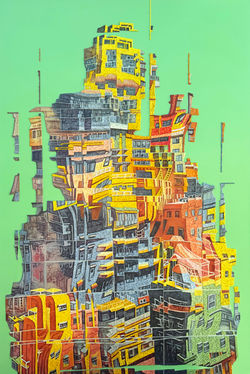 Yu XuanBlocks-2 Oil on canvas 120 x 80 cm 2025 |  Yoon HyupBeyond the Window Acrylic on canvas 121 x 91 cm 2024 |  Yukari NishiScene: itm_G Oil on canvas 130.3 x 162 cm 2025 |
 GongkanFreedom Acrylic on canvas on wooden board 160 × 120 cm 2022 |  Yu XuanBlocks-5 Oil on canvas 120 x 90 cm 2025 |  Studio LencaThe Journey Becomes You Acrylic on tarpaulin 206 x 305 cm 2022 |
 Etsu EgamiSanxingdui - Bronze Mask with Vertical Eyes Oil on canvas 196 x 280 cm 2022-2023 |  Kitti NarodDirection of Hope Acrylic on canvas 180 x 150 cm 2025 |  Hao ZechengBefore The Storm Oil on canvas 160 x 110 cm 2025 |
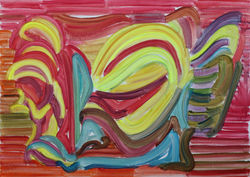 Etsu EgamiSanxingdui Oil on canvas 197 × 280 cm 2022-2023 |  Kitti NarodWe Have to Walk Anyway Acrylic on canvas 100 x 178 cm 2025 |  Meguru YamaguchiOut Of Bounds No.190 Acrylic, Epoxy Resin, and UV Absorber on Plywood 102 x 133cm 2025 |
 Meguru YamaguchiOut Of Bounds No.188 Acrylic, Epoxy Resin, and UV Absorber on Plywood 107 x 135cm 2025 |  Jade ching-yuk NgUnsettling Gravity Oil on canvas 165 x 130 cm 2025 |  Jade ching-yuk NgThe Climb Within Oil on canvas 195 x 155cm 2025 |
 Etsu EgamiAndy Warhol Oil on canvas 137.5 x 92.5 cm 2024 | 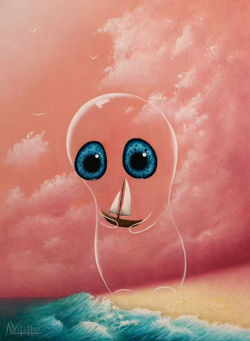 August VilellaSummer Moments Oil on canvas 33 x 24 cm 2023 |  August VilellaAutumn Hug Oil on canvas 100 x 81 cm 2023 |
 Etsu EgamiDancing in the Rainbow Oil on canvas 198 x 152 cm 2024 |  August VilellaComing Back Home Oil on canvas 24 x 33 cm 2023 |  Alexander SkatsPerseverance Oil on linen 130 x 200 cm 2022 |
 GongkanHappy Dirtday Acrylic on canvas 24 x 30 cm 2025 |
Artists
.jpg)
ETSU EGAMI
b. 1994, Chiba, Japan
Lives and works in Beijing, China and Tokyo, Japan
Growing up in the United States and Europe, and currently living and working in China, Etsu Egami experienced various communication barriers she encountered as a result of her cross-cultural residence. She felt that languages can “only be sensed, not explained”, thus becoming more interested in the discipline of language and communication. Etsu’s works are comprised of various mediums, such as voice, video, and drawings, through which she strives to question human instincts and the authenticity of communication. Estu’s perceptive contemporary pieces have led her to receive high praise from the art sector. Curator of Pompidou art centre Julie Jones describes Egami as an artist who “sees all these specificities as a source, not only of misunderstanding but also of creation and richness in people’s relationships.” Chinese curator Feng Bo Yi also summarized Etsu’s creation as being “about the concept and the significance of ‘communication’. Through the paintings and videos which embody these mishearing games, as well as the evolution of times, the clashes between civilisations, we acquire a discourse on the barriers in language communications, and subsequently even trigger a crisis.”
One of the most noteworthy contemporary artists, Estu Egami’s artistic achievement has been accredited by numerous awards: Forbes Asia 30 UNDER 30 in 2020 and 2021; Most Popular Artist on Artsy in 2021; Outstanding Artist dispatch to New York and Los Angeles from the Agency for Culture Affairs, Government of Japan (2020); CAF AWARD 2020 Finalist in Tokyo, Japan (2020); Sovereign Asian Art Award 2019; 16th Chiba city government Art and Culture new star prize (2018), among others.
Etsu Egami graduated with a B.F.A. from the Central Academy of Fine Arts (CAFA) specializing in Oil Painting in 2016. She obtained a P.H.D. at CAFA under the mentorship of artist Liu Xiao Dong and studied in HFG in Germany. In early 2023, Etsu was dispatched in New York as a talented artist by the Agency for Cultural Affairs, Japanese government. Her works have also been exhibited at important institutions including OAR Museum, Gyongju (Korea); Das Kunst Museum, Karlsruhe (Germany); New Art Center, Palo Alto, San Francisco (U.S.); OAR Contemporary Art Museum, Busan (Korea); Guggenheim Museum, New York (U.S.); the Grand Palais, Paris (U.S.), the Asian Art Institute, Chicago (U.S.), the Japan Foundation for Contemporary Art, Tokyo (Japan); the Ullens Center for Contemporary Art, Beijing (China); the Korea Cultural Agency, Seoul (Korea); the Tomioka Museum of Art, Tomioka (Japan); the Nanjo Museum of Art, Nanjo (Japan); the Japan-China Friendship Museum, Tokyo (Japan); the China Oil Painting Institute Museum, Beijing (China); Today Art Museum, Beijing (Korea); Para Site Art Space, Hong Kong (China), etc.
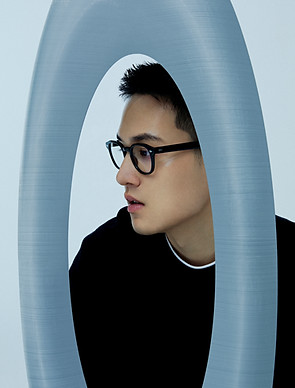
GONGKAN
b. 1989, Bangkok, Thailand
Lives and works in Bangkok, Thailand
Kantapon Metheekul, better known as Gongkan, graduated from Kasetsart University Laboratory School in 2007 and from Silpakorn University, Faculty of Decorative Arts, in 2011. After graduating and starting his career in advertising agencies in Bangkok, Gongkan decided to move to New York City to pursue his artist career, where he spent 3 years, before returning to Bangkok, where he currently works and resides.
While in New York City, he created street art and illustrations that are focusing on the idea of being transported through time and space to his homeland. Gongkan’s work, which he named “Teleport Art,” quickly gained recognition in the New York street art scene and later in Bangkok. The element of time is a predominant concept in Gongkan’s creations: a surrealistic realm populated with peculiar portals and human figures in group or isolation, realized with graphic flatness. Despite the serenity fostered by the soft color palette and smooth application, the atmosphere is occasionally disrupted by the sharp incision of black onto the canvas. Through presenting different visions of the present times or rewriting the past, the artist creates alternate realities in the process.
His selected and recent solo exhibitions include “Asynchronous Affinities,” Tang contemporary, Hong Kong (China, 2025); “Total Eclipse of the Heart,” X Museum, Beijing (China, 2024); “No Heart Here,” Pingshan Art Museum, Shenzhen (China, 2024); “No Heart Here,” MOCA, Bangkok (Thailand, 2024); “Monsters in You,” Over the Influence, Los Angeles (U.S., 2023); “Public but Private,” Tang Contemporary Art, Seoul (Korea, 2023); “Inner Place” Tang Contemporary Art, Beijing (China, 2022); “Gongkan: For someone who hate the Rainbow,” Over the Influence, Paris (France, 2022); “Introspection,” Tang Contemporary Art, Bangkok (Thailand, 2021); “Tip of the Iceberg,” Over the Influence, Los Angeles (U.S., 2021); “Yesterday Tomorrow,” River City Bangkok, Bangkok (Thailand, 2019), etc.

HAO ZECHENG
b. 1993, Beijing, China
Lives and works in Beijing and London
Hao Zecheng uses photos and memories as reference texts to describe the neglected scenes in daily life. Through the detailed description of uncertainty in the picture, he created images of time, space and events overlapping with each other. The artist recaptured the traces of time, presented the subtle relationship between self and image while processing the image, and connected the behaviour mode with "sequential painting – disordering – reconnecting", mixing reality and dreams, imagination and perception within the picture, which describes the artist's trance feeling of being and shuttling in the contemporary landscape.
In the creative process, Hao Zecheng formed his own unique method of language processing, integrating the random images that have not been designed and sorted into the context of art, blending them with reality and memory into specific empirical value. The image of the picture will be generated with the layers of density and dynamic description. This method has become an important way for him to break through the figurative quality of the landscape. His painting begins with the reproduction of images and narratives in snapshots. In the image space, the hand works under the control of the eye. However, due to the intervention of camera noise, random images, unclear shapes, fractures, and colour patches create disastrous confusion. He must handle this situation with random strokes, stains, and graffiti. With the increase of random and uncertain elements, the ratio of sensation and memory in the image gradually increases. In addition, the information and text contained in the screen image different from the real scene are also constantly produced, and the nature of the original image has changed. For example, streetlamp-fireworks, city galaxy, branch-calligraphy, mountain-monument, etc. The scenery escapes into a poetic space through memory and noise.
Memory is fluid. The remaining cognitive memory of time in the snapshot changes with the expansion of structure and the migration of interest points. However, emphasizing the restoration of the scene and situation is a deliberate retention of the original image. This persistent experience of the image presents the trace of self-experience from the perspective of the artist. While depicting elements and recreating scenes, randomness, and uncertainty are given a special path in the variation of the image. The canvas is full of ambiguous but at the same time distinguishable images. In this way, the artist generates an overlapping paradise of subconsciousness, fantasy, and imagination.
He held his solo shows “Grand Tour Through The Stars And The Moon” at Tang Contemporary Art Hong Kong in 2023, and “The Visions in My Mind,” Tang Contemporary Art, Beijing (China, 2022). His selected group shows include “Duo Exhibition: Bangkok Holiday,” Tang Contemporary Art, Bangkok (Thailand, 2024); “Global Song,” Tang Contemporary Art, (Hong Kong, 2023); “Slade Show,” Slade School of Fine Art, London (England, 2018); “Wonderful World,” Times Art Museum, Beijing (China, 2018); Shenzhen Independent Animation Biennale, Shenzhen (China, 2017); New Art Midland, Waterhall Gallery, Birmingham (England, 2016); “Affinity,” Birmingham Art and History Museum, Birmingham (England, 2016).

YOON HYUP
b. 1982, Seoul, Korea
Lives and works in New York, U.S.A
Yoon Hyup He is a New York-based painter and has been working since early 2000 with murals and live paintings. With a background in music learning, he stated that his artistic process is similar to that of playing improvisational music, where line and dots are called upon to express energy with flow and rhythm.
Components of various cultures he has experienced are strongly reflected in his works. The rhythm & improvisation in music, the flexibility & radical perspective in various cultures are some of the creative inputs that transform into lines, dots, “rhythms” and colors in his works. A combination of these elements powers the creation of unique abstract paintings. In contemporary art where rhythm and flow transcend mere formal elements, offering new ways of understanding the world, Yoon’s works visually embodies this philosophy, presenting a creative synthesis of Eastern and Western aesthetic traditions. His lines and dots go beyond simple visual expression, forming fluid structures that interweave time and space, drawing viewers into an immersive sensory flow. The order and chaos of major metropolis and the movements of people within it are abstracted and reconfigured in his work. This becomes a visual translation of urban experience, and a way of embodying the inherent rhythms of human life.
Aesthetically, Yoon Hyup’s compositions evoke Gilles Deleuze and Félix Guattari’s concept of rhizomatic thinking. His lines do not begin or end at fixed points; instead, they expand infinitely in all directions, guiding the viewer’s gaze and generating richly layered experiences. This structure mirrors the way humans experience the world—perception itself is not linear but multilayered and dynamic. Life is not a single narrative, but a fluid process in which countless possibilities are intertwined. Yoon Hyup’s work embodies this multiplicity of flow, inviting viewers to reconsider their understanding of reality through a distinctive visual logic.
Numerous key galleries and have featured Yoon Hyup‘s work, including “Montage,” Tang Contemproary Art, Hong Kong (China, 2025); “Nocturne City,” Lotte Museum of Art, Seoul (Korea, 2024); “Next Episode: Coexist,” Tang Contemporary Art, Seoul (Korea, 2024); “L'Empire des sens,” Tang Contemporary Art, Seoul (Korea, 2022); “Light and Shadow,” StolenSpace Gallery, London (U.K., 2022); The Planets, Nanzuka 2G, Tokyo (Japan, 2021); “Innervisions,” Antonio Colombo Arte Contemporanea, Milan (Italy, 2019). Yoon Hyup has been featured in articles for HYPEBEAST, JUXTAPOZ and The Korea Times.

KITTI NAROD
b. 1976, Bangkok, Thailand
Lives and works in Bangkok, Thailand
Kitti Narod trained at Wittayalai Pohchang Art College, Bangkok, from 1996 - 1998, and later obtained his Bachelor of Arts degree from the Rajamonkong Institute of Technology in 2000. He has exhibited extensively both domestically and internationally, including in Singapore, London, Bath, Edinburgh, Manchester, Dublin, Cork, Montreal, and Melbourne.
Kitti Narod creates paintings that convey a sense of joy and optimism through gentle and warm portrayals of daily life and human relationships. In his paintings, everyone and everything exist together in a utopia. This notion may seem unrealistic to some, especially during an era of social division, but the artist’s work tries to remind us to appreciate the simple pleasures and raise attention to everyday mundane matters. In which, euphoric feelings will not seem so unattainable. The artist considers his works to be an intersection for diversity, where all the physical and spiritual are equal.
His selected exhibitions include “The Pool by The Pool,” X Museum, Shanghai (China, 2025); “Simplicity Serenade,” Tang Contemporary Art, Beijing Headquarters Gallery Space, Beijing (China, 2023); “Summer Wind,” Tang Contemporary Art, (Hong Kong, 2022); “Fragrant City: Kitti Narod Solo Exhibition,” Tang Contemporary Art, Bangkok (Thailand, 2021); “Roles in Life,” We Gallery, Shenzhen (China, 2020); “Joy Land,” Tang Contemporary Art, Bangkok (Thailand, 2020); “Kitti Narod Exhibition by O'logy,” PPP, Taipei (Taiwan, 2019); “Simpleness,” Pullman Bangkok Hotel G, (Bangkok, 2015); “L’Homme Au Naturel,” Utterly Art, Singapore (Singapore, 2012); “Solo Exhibition,” Galerie Quartier Libre, Montreal (Canada, 2009); “Solo Exhibition,” The Edinburgh Art Show, Edinburgh (U.K., 2008); “Solo Exhibition,” Raw Arts Festival London (U.K., 2005).

JADE CHING-YUK NG
b. 1992, Hong Kong
Lives and works in London, U.K.
Jade Ching-Yuk Ng exemplifies life experience as the main material, combined with different symbolic visual vocabularies, so as to find the gap between reality and virtuality. She has worked on various mediums to challenge the possibilities of creating paintings beyond paints. She depicts the fragility of a physical intimate relationship between herself and others. She is drawn to the sensibility of constant touches and separation among us. By reinterpreting traditional forms of symbolism, her work creates a new, ambiguous and obscure fiction. Ng's work craves attention of our loneliness, intimacy and emptiness in today's hyper-realistic world.
Her soft, intricate works emboss the fragility of a physical intimate relationship between herself and others. Jade is interested in quoting the essence of touch and separation at a moment in time to depict a notion of loneliness, intimacy and emptiness. By exploring the possibilities of forms in painting, Jade conceives of her paintings as an assembly of her and others' body puzzles. Often revolving around personal travel experience, classical myth, alchemy, religious rituals and anatomy as references, Jade deconstructs their symbolism by attaching her own interpretation, and her symbols seem to depart from their literal connotations into an obscure and ambiguous fiction. The agency of framing becomes a gesture of embracing, defining actual and pictorial surrealistic space. The essence of modernist architecture influences how she constructs and adds odds to her composition in the picture. She develops them into printmaking, painting, sculptural painting and the most recent cut-outs and wood reliefs. Its theatricality encourages visitors to consider characters that are depicted in dialogue with themselves, whilst also considering the fine edge of collision in reality and imagination.
Ng obtained her BA at Slade School of Fine Art in 2016 and MA at Royal College of Art in 2018. She is a recipient of Cass Art Painting Prize in 2016 and Travers Smith Art Award in 2018. She was awarded the Abbey Major Painting Scholarship by the British School at Rome in 2018. Her work was commented on and published by art historians Katy Hessel and Kate Mothes respectively. She worked at Bezalel Academy of Arts and Design in 2014. Her work has exhibited internationally, such as Arusha Gallery (London, Edinburgh, UK), Matt’s Gallery (London, UK), San Mei Gallery (London, UK), Cornucopia Gallery (London, UK), Whitechapel 46 (London, UK), Siegfried Contemporary (London, UK), Assembly Point (London, UK), Horse Hospital (London, UK), CGP Gallery (London, UK), Canal Mills Armley (Leeds, UK), Video Pub (Jerusalem, Israel), Academia di Romania a Roma (Rome, Italy) . Part of her work has been collected by Penguin Random House.

ALEXANDER SKATS
b. 1986, Gothenburg, Sweden
Lives and works in Malmö, Sweden
Alexander Skats graduated with a Master of Fine Arts from Umeå Academy of Fine Arts in 2018, following his Bachelor of Fine Arts from Valand Academy of Art in 2016. Skats explores the complexities of digital imagery through his distinctive, vibrant color palette.
Skats' contemporary works serve as an active medium in evoking a rethinking of our daily modes of consumption and production. His iconic painting style and motifs hint at his perception of the implicit beauty in the world. Drawing inspiration from a variety of sources, including vintage photographs, films, and online images, Skats' fusion of symbols encourages viewers to question the meaning behind the depicted figures or objects.
Creating an intriguing fusion of digital art and oil painting, Skats' artistic practice evokes a dialogue between past and present. The artist constantly plays with scale and the expression of light, emphasizing the idea of cropping under the influence of the cinematic artist Luc Tuymans.
Alexander Skats' works have been exhibited in galleries and museums worldwide, including Sweden, the United States, and Hong Kong. His oeuvre is receiving growing popularity in diverse gallery spaces.

STUDIO LENCA (JOSÉ CAMPOS)
b. 1986, La Paz, El Salvador
Lives and works in Margate, UK
Studio Lenca (José Campos) fled his native El Salvador during the violent civil war in the 1980s. The war claimed the lives of over 80,000 Salvadorenos and displaced much of the population. José travelled to the US by land with his mother and grew up as an undocumented illegal immigrant. Eventually settling in the UK, José received a Masters from Goldsmiths University of London in 2019. His work is collected and exhibited globally and was recently acquired by the MER Foundation.
His work is focuses on ideas surrounding difference, knowledge and visibility. José Campos works under the name of ‘Studio Lenca’ as the language of ‘studio’ refers to a space for experimentation and a place that is constantly shifting. Lenca refers to the ancestors of his native El Salvador. His colourful paintings depict Salvadoran figures adorned with costume and ornament that playfully explore masculinity, the colonial past of the country and its current violent discourse. The hats and costumes allude to the folkloric traditions of Los Historiantes. MS-13 markings and 18th street tattoos are absent, instead whimsical imagery and bold colours portray a softer more vulnerable experience.
The figures in Studio Lenca’s work embody vignettes of the artist’s formative years, escaping the civil war and reckoning with his reality in a hostile environment. The navigation of identity within Studio Lenca’s work sits in parallel with that of El Salvador and it’s neighbouring countries. Riotous layers of paint, flora, fauna, logos and artefacts represent untold stories and silenced voices. The painful legacy of colonialism, mass immigration and more recent cultural imperialism is writ large. Studio Lenca shares a maelstrom of unresolved narratives; himself and his culture displaced.

AUGUST VILELLA
b. 1986, Barcelona
August Vilella is a self-taught painter who creates oil paintings which embody elements of both contemporary and classical art. He is currently based in Tokyo. Vilella’s creative process follows the “surreal-intuitive” method, embracing his subconscious mind without the facilitation of physical sketches. This results in the evocation of a dream-like, psychical, magical atmosphere in his paintings.
The use of light and shadows, and refined brushstrokes and layering in his works recall techniques employed by the old masters, presenting an interesting juxtaposition with his cartoonish characters. The big, twinkling, crystal eyes of August’s characters often gazes outwards, inviting the audience to engage with their underlying feelings and explore them with quiet introspections.
Vilella’s artistic talent has been acknowledged through numerous artist prizes, including: Best Artist at the Tokyo International Art Fair in 2016, Best Innovative Art at The Global Art Awards of Dubai (UAE) in 2017, and the International Artist Grand Prize and Chairman’s Award in the Art Revolution Taipei in 2018. In 2022, August’s paintings were shown in global art events including Art Basel in Miami, Art Basel in Hong Kong, and TEFAF in New York. Moreover, he held a successful solo exhibition titled ‘Memories’ at the historic Kudan House in Chidoya City of Tokyo. Vilella’s works have been featured in various prominent media outlets, including Vice, Hi-Fructose, and Beautiful Bizarre, further solidifying his status as a contemporary artist.

MEGURU YAMAGUCHI
b. 1984, Shibuya, Tokyo, Japan
The artist moved to New York in 2007 and currently based in Brooklyn.
The artist focuses and pursues possibilities of brushstrokes’ expressions, one of the most fundamental elements of painting. Yamaguchi’s signature work series OUT OF BOUNDS is made with conception of “transcending stereotypes, rules, borders and boundaries, expansion of painting”. Yamaguchi stopped using canvases that restrained the physical area for his brush strokes but instead invented an original method for materialising unrestrained shapes of the brush strokes, successfully expressing and exploring the possibilities of his dynamic and sculptural beauty of brush strokes.
The artist experienced the pivotal transition of street culture from the 90’s to early 2000’s in Tokyo. He has collaborated with major brands representing American street culture, such as ALIFE, BILLIONAIRE BOYS CLUB, FTC, NIKE. The artist has also collaborated with other international brands such as ISSEY MIYAKE MEN, LEVI’s, OAKLEY, and UNIQLO.
Artworks are owned by FENDI Foundation and more.
Recent publication includes OUT OF BOUNDS.

YU XUAN
b. 1981, Zhuzhou, Hunan, China
Lives and works in Beijing, China
Yu Xuan graduated from the Central Academy of Fine Arts (CAFA) with a bachelor's degree in 2005. He has used various contemporary art media such as painting and installation to express both the charming and the borings of life, so as to find the internal logic therein. The main creative vein of Yu Xuan’s recent paintings reflected different contemporary social landscapes with the appearance of self-consciousness and the surreal environment of various animal images.
The street signs and barbershop advertising lights are results of highly refined artificial designs. Yu Xuan deliberately placed these man-made design objects in contrast with the heavy animal images stacked with paint on a background either super flat or wrinkled, forming a sudden and strange aesthetic picture image. The form of artificial and natural objects, the fluidity and freedom of the shape edge, and the smoothness and fluctuation of the texture collectively shape Yu Xuan's response to the complicated and different social landscapes. The artist not only leaves numerous hints of meaning, but also uses smoke and mirrors to dilute every hint.
The exhibition experiences of Yu Xuan includes: Unnatural Relaxation (Tang Contemporary Art, Hong Kong, 2024), INQUIRY TO THE WALL (Souart, Beijing, 2023), THE WAY FORWARD (inner flo Gallery, Beijing, 2023), THE IMAGES OF DEPTH (Shenzhen City, China, 2022), Without MOI In Future (Nine art museum, Beijing, 2021), Concept, Form And Daily Life - Shenzhen Biennale of Contemporary Art (Shenzhen City, 2019), The Logical Lines Of Painting - Invitation Exhibition on the Making and Significance of Contemporary Painting, (Jinji Lake Art Museum, Suzhou City, 2019), NEITHER EAST NOR WEST - New Work by Contemporary Chinese Artists (The Galleries at Cleveland State University, Cleveland, United States, 2019), HISTORY AND REALITY (Art Museum of Ningbo, Ningbo City, 2019), STREET-WISE OF THE HUMBLES (33 Contemporary Art Center, Guangzhou City, 2017), Contemporary Art And Destiny (XIAN SPACE, Beijing City, 2017), FREE REALM (Guiyang City, 2016).
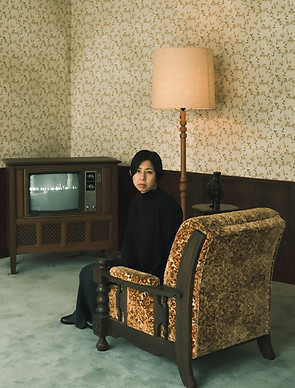
YUKARI NISHI
b. 1978, Kagawa, Japan
The surrealistic realism that dominates Yukari Nishi’s acrylic works references an idealized mid-century American nostalgia, and her strange and fantastical worldview has been a popular muse within the Japanese music scene, leading to collaborations with various musicians on CD jacket designs, posters, tour merchandise, music videos, and film works.
Faceless figures, emotionless plushies, and lifeless animals populate the idyllic landscapes of Nishi’s world. The detached, dream-like environments stir feelings of curiosity and discomfort; the dramatic elements of light and shadow, as well as the unexpected loss of coherency and meaning within familiar domestic spaces of safety and comfort, recall neo-noir themes of absurdity, nihilism, and paranoia. Nishi’s works abandon assumption and convention to enter a fourth dimension somewhere between reality and fiction, causing us to reconsider our own perceptions of what is real and what is not.
Yukari Nishi graduated from the Kyoto University of Art and Design and has been exhibiting her paintings and mixed media works at galleries and art fairs in numerous exhibitions from around the world since 2004, including: “In the meantime”, WKM Gallery, (Hong Kong, China, 2025); “Ebb and Flow”, Long Story Short NYC, (New York, NY, USA, 2024); “Index #7”, Gallery Common, (Tokyo, Japan, 2023); “IMAGRATION”, Each Modern, (Taiwan, 2023); “Index #5”, The Mass, (Japan, 2022); “Viewing”, SAI, (Japan, 2021).