


Tang Contemporary Art Bangkok is proud to present Korean American artist, Se Oh’s solo exhibition, “Polyculture,” on August 30. Born in Korea and adopted by a caucasian American family at just nine months old, Se Oh grew up in the Deep South of the United States. Drawing nourishment from nature and intertwining it with their journey of self-discovery, Se Oh weaves a poetic body of work that explores resilience, identity, and the vitality of life.
From the family garden of their childhood to their own private garden in adulthood, Se Oh has cultivated a deep understanding of existence through their dialogue with plants. Tending a garden demands patience and time—what life stirs beneath the soil? What rewards come from labor? How does one learn the needs and cycles of living things? In the garden, plants cease to be distant entities; they impose a sense of responsibility. “One cannot impose their will on a garden, only gently guide and collaborate with it.” Plants grow on their own; bees and butterflies arrive in their own time. Here, humans learn to relinquish control. Yet encounters between plants are fleeting—two dewdrop-laden petals brushing, two vines entwining in their compete for sunlight. These moments, never to recur, briefly gorgeous, marks moments in time that was, is, and will never be again. In the cyclical withering and blooming of plants, Se Oh’s sensitivity to nature’s temporality resonates with the East Asian aesthetics of mono no aware (the pathos of things) and wabi-sabi (imperfect transience). Like the ceramic materials they choose—fragile yet resilient—their work embodies the paradox of life itself, ever-changing yet part of an intricate web of existence.
Se Oh employs materials tied to Korean and Asian traditions as a means of reconnecting with their heritage. Their abstract interpretations of natural forms emerge through the malleability of porcelain. Ceramics, in their hands, unify softness and strength, delicacy and resilience. Vessel rims flare like blossoms or curling tendrils, their fluid forms evoking life’s ephemerality while celebrating the irreplicable “trace of the hand.” They reimagine classic Korean ceramic shapes using bone-white American clay—a medium that perfectly encapsulates Se Oh’s quest for "who I am."
Porcelain, with its memory-like quality, records every subtle shift in the artist’s intention during creation. As a lump of clay spins and yields to their fingers, its paper-thin walls reveal the whorls of their touch. The material transcends its physicality, becoming a vessel for emotion and time. Controlling clay demands presence—an intimate dialogue with life: How does one collaborate, rather than dominate? When to let go and when does control yield to the material’s will? Unglazed surfaces, warm as skin, soften porcelain’s typically cold rigidity. The marks of Se Oh’s hands and tools—grooves, ridges, asymmetries—become a visual language that honors fragility within resilience, mirroring life itself.
In contrast to ceramics, Se Oh’s paintings on traditional Korean hanji (mulberry paper) embrace opacity and transience. Washes of wild green bloom across fibrous sheets, their brushstrokes quivering like leaves in the wind. Rippling textures suggest growth, expansion. Se Oh’s small-scale paperworks capture microscopic universes observed in childhood through their adoptive mother’s biologist lenses: algae swirl like nebulae, organisms pulse in a drop of pond water. Microscopic and macroscopic rhythms converge, reminding viewers of the physical and emotional ties binding all life. Both paintings and ceramics freeze motion into permanence—suspending fleeting, ever-shifting states to create a slow, profound sense of time. Se Oh’s works are not representations of reality, but echoes of humanity’s relationship with time, self, and nature.
For Se Oh, Bangkok’s human inhabitants mirror its ecosystem—vibrant, diverse, forever intertwined with clashing notions deriving from both local and faraway influences. The exhibition’s title, "Polyculture," derives from agricultural polycropping, where diverse plants thrive together, mimicking natural ecosystems to enhance production efficiency. Poly- (many) and -culture (cultivation/civilization) reflect Se Oh’s belief that diversity is key to truly connecting with our human nature.: “Contrasting elements, ideas, religions; it fosters a dynamic experience that promotes thought and challenges pre-conceived notions. We live in uncertain times, where division threatens the cross-pollination of our diversity. It’s in these times more important than ever to foster conditions where diversity can be nurtured, just as horticulture continues to do in places like Thailand. This show celebrates the idea of polyculture, not merely as a way to witness and to connect with each other, but also to promote a culturally-rich existence, and a profound appreciation for humanity as a whole.”
EXHIBITING WORKS
 Where the Sky and Flora Meet Korean Gouache on Hanji Paper mounted on Wood 117 x 91 cm 2025 |  Polyculture Korean Gouache on Hanji Paper mounted on Wood 146 x 291 cm (146 x 97 cm x 3) 2025 | 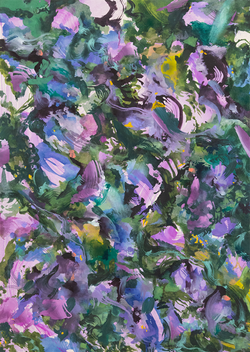 Floating Between the Blue Lotus Korean Gouache on Hanji Paper mounted on Wood 42 x 30 cm 2025 |
|---|---|---|
 Parrot Flowers Korean Gouache on Hanji Paper mounted on Wood 42 x 30 cm 2025 |  We Gather in the Shade Garden Korean Gouache on Hanji Paper mounted on Wood 65 x 53 cm 2025 |  Verdant Meadow Korean Gouache on Hanji Paper mounted on Wood 72.5 x 61 cm 2025 |
 Spring Blooms Under a Blue Sky Korean Gouache on Hanji Paper mounted on Wood 84 x 60 cm 2025 |  Pansy Party Korean Gouache on Hanji Paper mounted on Wood 61 x 50 cm 2025 |  Electric Lotus No.1 Korean Gouache on Hanji Paper mounted on Wood 103 x 73 cm 2025 |
 Bloom High Fire Raw Porcelain 16 (H) x 23 (W) x 20 (D) cm 2025 |  Porcelain Seed No. 1 High Fire Raw Porcelain 23.5 (H) x 14.5 (W) x 14.5 (D) cm 2025 |  Polyembryonic High Fire Raw Porcelain 15 (H) x 15.5 (W) x 17 (D) cm 2025 |
 Mitosis High Fire Raw Porcelain 17.5 (H) x 16 (W) x 20 (D) cm 2025 |  Nested: A Conversation of Converging Petals High Fire Raw Porcelain 14.5 (H) x 20.5 (W) x 20.5 (D) cm 2025 |  Eye of an Orchid High Fire Raw Porcelain 13 (H) x 25.5 (W) x 21.5 (D) cm 2025 |
 Orchid Bulb No. 1 High Fire Raw Porcelain 18 (H) x 18 (W) x 18 (D) cm 2025 |
Artist
.jpg)
SE OH
b. 1984, Gyeonggi, South Korea
Se Oh is a Korean-American artist based in Los Angeles, California and Seoul, Korea. Adopted at 9 months old and raised in America's Deep South, Oh draws from their personal history to create works touching on themes of resilience and existing in liminal spaces.
"As an infant I was adopted from the Gyeonggi Province of South Korea by a white Southern couple. Growing up in America's South came with its own set of obstacles like racism and othering, which perpetuated a general sense of feeling alone. I found myself internalizing these negative aspects of existence, and issues with anger and resentment came into existence at a very young age. Later in adulthood, my desire to connect with my Korean heritage became a life focus of mine. I sought to connect with my culture through Korean food and later through my ceramic work as a way of claiming ownership of my heritage. Most of my work is rendered in porcelain. My forms are inspired by classic Korean shapes found in traditional Korean ceramics. Another visual theme in my work is heavily influenced by nature, specifically plants. The resilience of nature has always fascinated me and will always be a common theme in my work." - Se Oh
Beyond porcelain, their visual language extends to paintings and soft sculptures using materials rooted in traditional Korean heritage such as Hanji paper and silk. His brush work mimics Korean ink masters abstracting the traditional to reveal a contemporary visual language closely tied to their lived experiences as a Korean American.