


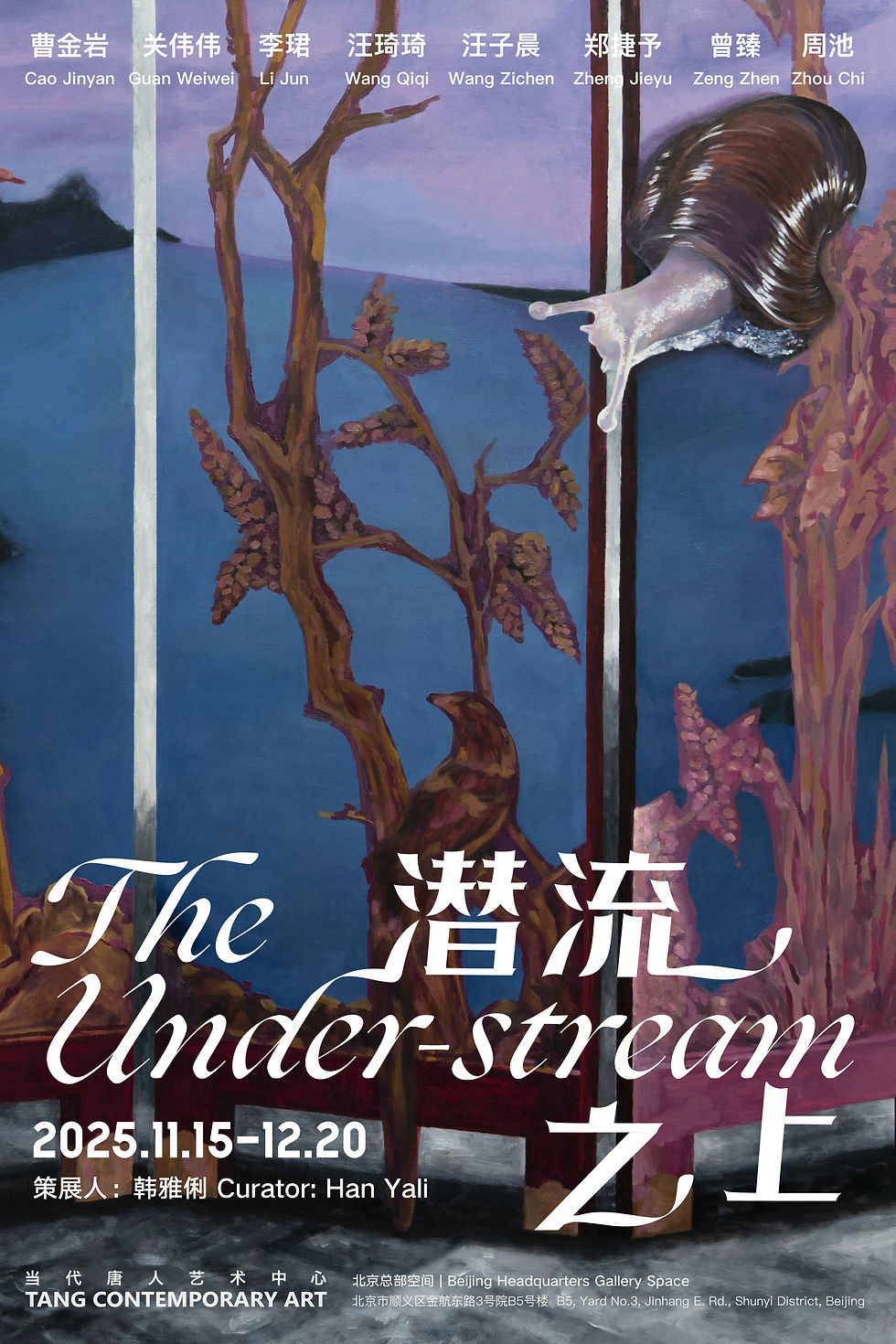
Tang Contemporary Art is pleased to announce the opening of the young artists group exhibition “The Under-stream”, launching at 4 p.m. on November 15 at the its Headquarters Gallery Space in Beijing. Curated by Han Yali, the exhibition will feature new works by artists Cao Jinyan, Guan Weiwei, Li Jun, Wang Qiqi, Wang Zichen, Zheng Jieyu, Zeng Zhen, and Zhou Chi.
The group exhibition The Under-stream brings together a selection of young artists who investigate the subsurface currents beneath the image—the concealed processes of its emergence. Rather than reproducing appearances, painting here functions as a complex mediation among visual mechanisms, psychological frameworks, and social perception—a dynamic system of mutual disclosure. As visual culture theorist W. J. T. Mitchell observed, an image is not an inert object but a “living form,” characterized by its capacity to generate, transform, and return the gaze. It is within this generative capacity that painting establishes itself as a field of thought.
The exhibition presents works by eight young artists —Cao Jinyan, Guan Weiwei, Li Jun, Wang Qiqi, Wang Zichen, Zheng Jieyu, Zeng Zhen, and Zhou Chi—whose works engage with varied critical perspectives, including feminist consciousness, social rights, spatial philosophy, and digital humanity. Collectively, they establish a multi-layered visual discourse that intertwines desire, memory, social structures, and emotional resonance. Through distinct artistic lenses, these artists direct attention to which remains concealed or unarticulated—the subtle surges of emotion, the implicit order of social structure, the inertia of visual convention, the imprint of bodily experience, and the psychological frameworks latent within pictorial systems. The “under-stream” signifies a continuous, subconscious flow of awareness, while painting serves as its tangible emergence above that hidden current.
Cao Jinyan and Li Jun take female identity as a conceptual point of departure, interrogating the intricate relationships between womanhood, desire, and the gaze. Through a symbolically charged visual language, their work reframes issues of power and identity, placing the viewer in a liminal space of ambiguity and indeterminacy. Wang Qiqi and Zhou Chi, by contrast, focus on the body’s “latent form”—a vital presence that strives to break free and reconstitute itself despite dual pressures of social and self-construction. In their paintings, the body contorts or unfolds, conceals or expresses itself, articulating a visual grammar situated between pain and rebirth. Together, the four female artists converge identity and embodiment into an emerging field above the undercurrent: what they trace is not merely the physical body, but the oscillation of consciousness between discipline and liberation.
Guan Weiwei and Wang Zichen turn toward to philosophical and spatial speculation. Guan takes black as his point of departure, exploring the boundary between the visible and the concealed through stratified compositions in dark tones. Wang, by contrast, centers her practice on the concept of cosmic order, translating metaphysical awe into a visual language of structural coherence. Meanwhile, Zheng Jieyu and Zeng Zhen incorporate the logics of images, gaming, and virtual reality into their paintings, effectively reinscribing social memory and digital consciousness. While Zheng’s work engages with narratives of the past, Zeng’s orients toward those of the future. Both artists investigate the image—tracking its generation, differentiation, and recoding within contemporary visual environments—establishing a discursive space where the real and the virtual, expectation and actuality, are held in tension.
At this point, painting emerges as an external extension of human consciousness — not merely a record of the visible world, but a vessel for the generative logic that arises from the depths of awareness. The eight artists in this exhibition seek to move beyond the language- and narrative-centered paradigm of reason, returning instead to the self-sufficiency of the image and of sensory experience.Painting is no longer subordinate to language; it becomes an independent cognitive structure — a “conceivable object of expectation.” This expectation arises from the absence, fragmentation, or ambiguity of meaning. Yet it is precisely through this incompleteness and deferral that the work drifts between illusion and reality. Within the under-stream lies the free drift of invisible thought; above it, the gradual emergence of the invisible into form.
Painting thus continues to function as an external manifestation of human consciousness—recording not only the visible world but also embodying the underlying logic of conscious experience. The eight artists in this exhibition seek to depart from rational paradigms centered on language and narrative, turning instead toward the autonomous capacity of the image and sensory perception. Painting ceases to function as an accessory to language and becomes an independent cognitive framework—an “object of anticipation.” This anticipation is rooted in the absence, fragmentation, or ambiguity of meaning, and it is precisely through such incompleteness and deferral that the work occupies an ambiguous space between illusion and reality. Within the under-stream lies a free-floating realm of formless thought; above it unfolds the progressive development of the formless into visible form.
EXHIBITING WORKS
 Articulation PointMixed media on canvas and paper, acrylic and mineral pigments 78 × 120 cm 2023 |  ActressAcrylic and mineral pigments on canvas 80 × 120 cm 2024 |  Inner ChamberOil on canvas 110 × 130 cm 2024 |
|---|---|---|
 The ShoreAcrylic and pencil on paper mounted on canvas 140 × 200 cm 2024 |  0726 The third of the twelve Earthly BranchesOil on canvas 40 × 50 cm 2025 |  Domestic TrapOiI on canvas 70 × 60 cm 2025 |
 DroopingAcrylic and pencil on paper mounted on canvas 120 × 80 cm 2023 |  0802 The ninth of the twelve Earthly BranchesOil on canvas 40 × 50 cm 2025 |  Dislocation XIAcrylic, pastel on canvas 150 × 180 cm 2025 |
 Dislocation VIIAcrylic, pastel on canvas 120 × 100 cm 2024 |  Born as a ChildOil on linen 90 × 120 cm 2025 |  Wet Dream-3Oil on linen 40 × 30 cm 2025 |
 With a Soft BreezeAcrylic on canvas 135 × 150 cm 2025 |  EclipseAcrylic on canvas 135 × 150 cm 2025 |  The Fruit of RetrospectionAcrylic on canvas 200 × 150 cm 2024-2025 |
 CarcassonneAcrylic on canvas 100 × 100 cm 2025 |
Artist

Cao Jinyan
Cao Jinyan (b.1994) now works and lives in Beijing. She is currently studying for her doctorate at the Central Academy of Fine Arts.She graduated from the Department of Printmaking of Sichuan Fine Arts Institute in 2017 and from the Department of Printmaking of Central Academy of Fine Arts in 2022 with a Master of Fine Arts degree. Cao Jinyan's artistic practice focuses on the relationship between media and psychology. In her recent research, traumatic experiences are involved in the discussion of contemporary issues, rooted in art as a form of therapeutic creation, and she constantly explores the boundaries of the medium of painting. Through the private narration of installation, painting, writing and other artistic languages, the artist's works attempt to intervene the viewer's viewing experience through hidden emotions, and give the soul connection.
Recent solo exhibitions/projects include:“Libido”Cité Internationale des Arts ,France(2025);"Blood Sugar", Central Academy of Fine Arts, Beijing (2025); "Forever Young" project,TANK, Shanghai (2024); "Embellish", Sense Gallery, Beijing (2023). She has participated in group exhibitions: "THE ART RESORT", Larry’s List, Shanghai (2024); "Semi-manual era·The dance floor of the world", Gravity Art Museum, Beijing (2024); "Secret", Cycle Space, Beijing (2024); "ART021", Shanghai Exhibition Center, Shanghai (2023); "Beijing Contemporary", Agricultural Exhibition Hall, Beijing (2023); "Loading...", CAFA Art Museum, Beijing (2022); "Lost Atmosphere", Mixart Gallery, Shenzhen (2022); "37x33CM Contemporary Portrait", Red Gate Gallery, Beijing (2021); "Young Art 100", Guardian Art Center, Beijing (2019); "New Star Art Award", Jiangsu Grand Theater, Nanjing (2018); "Luo Zhongli Scholarship Award-winning Works Exhibition", Luo Zhongli Art Museum, Chongqing (2017); "REFLECTION", Yoga Gallery, Tokyo, Japan (2016).
The artist has won numerous art awards: the Zhonghe Charity Foundation Outstanding Creation Scholarship (2022), the Xuyuan International Biennale Best Innovation Award (2018), the Luo Zhongli Scholarship Award-winning Exhibition (2017), and the E.LAND Outstanding Creation Scholarship (2015);Zhou Chunya Outstanding Creation Scholarship(2014) ;she has recently participated in domestic and international art projects, including the 2017 Sichuan Fine Arts Institute Resident Artist Program and the 2016 Tokyo University of the Arts "Reflect" International Exchange Program.

Guan Weiwei
Guan Weiwei, born in 1986 in Shanxi, graduated with a Bachelor's degree from the Printmaking Department of Tianjin Academy of Fine Arts in 2010 and a Master's degree from the same department in 2014. Currently lives and works in Beijing.
He uses a black-and-white palette to depict ordinary, everyday objects, seeking an affirmation of life through them. By incorporating a rich array of personal visual experiences, she composes images that appear tranquil yet absurd. Within a highly simplified structure, the interplay of white forms against a black background generates subtle shifts of light and shadow, leading the bewildered viewer to realize that space itself has quietly undergone an inversion and circulation between interior and exterior layers. This meticulous observation of objects evolves, on her dark canvases, into a lucid reflection on contemporary visual culture.
His artistic practice follows a clear and consistent logic: in an age of image excess, how can one reach the essence through subtraction? When every piece of information competes for attention, black becomes a weapon against homogenization. The repetitive friction of a mechanical pencil on a quartz-sand surface forms the core gesture of his recent work. This seemingly inefficient labor is, in fact, a resistance to the mechanized production of digital imagery. The pencil lead creates unpredictable textures, balancing the precision of printmaking discipline with the spontaneity of drawing. The resulting images resemble photographic negatives, yet their optical play emerges from hundreds of layered strokes—a process through which he restores to vision its original, tactile weight.

Li Jun
Li Jun, born 1994 in Changsha, China. Now lives and works in Vienna. Li Jun’s practice explores the in-between spaces of the real and the virtual, the stable and the unsettled, the artificial and the natural. By recontextualizing images and everyday objects in dislocated or unexpected settings, she highlights their ambiguity, irony, and self-reflexivity. Her work reflects on broader cultural and historical narratives through a symbolic and reflective visual language, with a particular focus on female identity and cultural colonization. She investigates how identity is constructed and mediated through symbolic forms, and how aesthetic traditions reflect systems of power, memory, and belonging.
Wang Qiqi
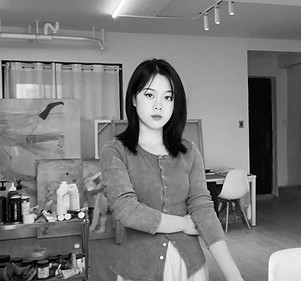
Wang Qiqi was born in Zhejiang, China in 1996. The artist lives and works in Hangzhou. She studied painting at the China Academy of Art (Hangzhou), graduating in 2018 and obtaining an MFA in 2021. Wang Qiqi is now completing her doctorate of Fine Art at Shanghai University (Shanghai).
Wang Qiqi’s work centers on the concept of the “grotesque body,” exploring the forms of life, the boundaries of existence, and the emotional experience of viewing. The bodies she depicts are in a state of continuous transformation and recombination—they are no longer closed, fixed entities, but organic forms in flux, navigating between order and chaos, reality and illusion. These twisted, extended, and unbound bodies open a window onto the irrational, revealing the multiple possibilities of life amid fractures, seams, and regeneration, and constructing a fluid narrative about the relationships between body, perception, and the world.
Recent solo exhibitions include: Body Code, Astra Art, Shanghai (2023); Exceptional Characters,BA project,Shenzhen (2023); Life Form, Banana Art Space, Nanjing (2021). Recent group exhibitions include: Almost Molting, Arario Gallery, Shanghai (2025); Out of Line: After the Studio, Hong Art Museum, Suzhou (2025); Hen Lays Eggs, ShanghART Central, Shanghai (2025); Bodyscapes,ShanghArt, Shanghai (2024); Shadowboxing, Convection Gallery, Hangzhou (2024); Eye of the Times, Art Museum of Nanjing University of the Arts, Nanjing (2023); Beyond Painting: Restoration and Infinity, Astra Art, Shanghai (2023); Art and Design Innovation Future Education Expo - The 5th Inter-Youth International Youth Painting Exhibition, Shanghai West Bund Art Center, Shanghai (2023).

Wang Zichen
Wang Zichen, born in Beijing in 2000, graduated from the High School Affiliated to the Central Academy of Fine Arts (CAFA) in 2020 and was admitted to CAFA in the same year; in 2021 she entered the Fifth Studio of the Oil Painting Department, and in 2024 she was recommended for admission to the graduate program of the Fifth Studio of the Oil Painting Department at CAFA.
Wang Zichen's work expresses a sense of tranquility and solitude within eternity through the motifs of the cosmos, architecture, and music. She observes the world with a mind as open as air, like a single drop of water merging into the vast ocean, or a cave standing sentinel for a thousand years, silently witnessing the passage of nature's beauty. Time and the curves of architecture intertwine. Her vision of peace is not static but a dynamic moment, which is why her works are titled with both modern dates and ancient shichen, encapsulating the past, present, and future.
Solo Exhibition: 2025, Beyond the Dome, Prometheus Art Gallery, Canada. Group Exhibitions: 2025, Huanxiang (Circular Image), 9th Graduate Exhibition of the Central Academy of Fine Arts, NEEDART Art Space, Beijing; 2025, Flexible Polyphony — A Dialogue Exhibition by Female Artists, Haihe Art Museum, Tianjin; 2025, Kingdom of Light, Soka Art, Beijing; 2024, Landscape Without Time or Place, Muyun Space, Beijing; 2024, Farewell to the Orinoco, TONG GALLERY+PROJECTS, Beijing; 2024, Xinxiangwangzhi (Where the Heart Aspires) — CAFA Undergraduate Graduation Exhibition, CAFA Art Museum, Beijing; 2024, Not Only... But Also..., Sanshi Space x SIMPLE ONE, Beijing; 2024, Not Only... But Also..., 798 Sanshi Space, Beijing; 2024, The Beauty of Existence, Haihe Art Museum, Tianjin; 2024, The Beauty of Existence, 798 Zero Space, Beijing; 2023, "Art Bridge — Antwerp to Beijing and Back", Royal Academy of Fine Arts Antwerp, Belgium; 2023, All Scenery Speaks — Yishi Gallery x SunS Living Gallery 2023 Year-End Exhibition, Beijing.

Zheng Jieyu
Zheng Jieyu, born 1997 in Wenzhou, China. Now lives and works in Florence. In Zheng JieYu’s work, desire itself is the central driving force of creation. Yet this desire is intertwined with the question of choice and the invisible constraints that shape it. Her creative pratice explores how desire is shaped, constrained and guided by social structures, invisible power dynamics and cultural contexts. Her paintings present relationships through composition, distances, postures, and gestures. Objects and plants, linked to her intimate memory, appear as encrypted markers she deliberately leaves unexplained, allowing viewers to project their own meanings onto them.
Solo Exhibitions: 2025 Silver Salts, Beast Gallery, Florence; 2024 Patchouli, Suburbia Contemporary, Barcelona. Group Exhibitions: 2025 Giovanni Colacicchi Painting Prize, AAIE Center for Contemporary Art, Rome; 2024 II Edition of the Todi Biennial, Comune di Todi, Umbria; 2023 Dionysus, Dake Art Museum, Chengdu; 2022 Artefici Del Nostro Tempo, Forte Marghera, Venice; 2022 ABITUDINE ARTISTICA IDEOLOGIA ECCELLENTE, AAIE Center for Contemporary Art, Rome; 2022 I Edition of the Todi Biennial, Comune di Todi, Umbria; 2021 Le Vie della Forma, Casa di Benvenuto, Vecchio.

Zeng Zhen
Zeng Zhen, born 1991 in Beihai, China; Lives and works in Hangzhou, China.
Zeng Zhen’s work seeks to capture the spiritual condition of people living in contemporary society, transforming it into a form of sacred visual metaphor. Drawing from virtual culture—such as video games, film, and music—he reconstructs gestures, fragments, and fleeting moments of digital characters to compose a psychic landscape suspended between reality and illusion. His creative motifs often arise from the anxieties and hallucinations generated by life within the overlapping realms of the real and the virtual, while also reflecting the different modes of cognition and belief through which humanity approaches both classical and fabricated histories and literatures.
His paintings possess a ruin-like patina, a mottled texture that evokes the passage of time—decayed yet solemn, carrying a sense of retro, nostalgic divinity. This divinity is not religious in nature, but rather an attempt to reconstruct spiritual symbolism within the modern context. Through the painterly strategy of overlapping, he creates scenes imbued with ritualistic intensity, where images oscillate between fragmentation and incompleteness. The resulting visual narratives—suffused with the sacred and the shattered—form a grotesque yet lyrical system of metaphors that invites the viewer to wander between the sacred and the profane, the virtual and the real.

Zhou Chi
Zhou Chi, born in 1992 in Jinzhou, Liaoning, currently lives and works in Beijing. She graduated from the Affiliated High School of the Central Academy of Fine Arts (CAFA) in 2011, where she was directly admitted to the undergraduate program of CAFA. In 2015, she graduated with a bachelor's degree from the Department of Oil Painting and was recommended for graduate school under the supervision of Professor Ma Lu. During her master's studies, she exchanged at the École des Beaux-Arts of Nantes, France. She received her doctoral degree from CAFA in 2024.
Zhou Chi's works have focused on the theme of the body since the beginning of her creative journey. During her doctoral studies, she drew inspiration from philosophy and attempted to extract elements of "line" and "philosophy" from traditional Chinese painting in her work. Through flowing lines, she allows the body to "escape" from predetermined trajectories, imbuing the dissected and domesticated modern body with new vitality. Her works have been exhibited in numerous domestic and international exhibitions and have received widespread acclaim.In the contemporary context, Zhou Chi's portrayal of the "body" transcends traditional values, dogmas, and frameworks. In her works, the body is no longer a limited existence but a creative mechanism that is interconnected and mutually influential. Through this approach, she releases the lightness and power of liberation that the body should have in society.
Curator
Han Yali
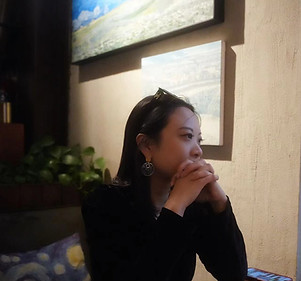
Han Yali, born in 1991 in Taiyuan, Shanxi Province, is a curator and art critic currently based in Beijing. She works in the Exhibition Department of Tang Contemporary Art. Han graduated from Tianjin Academy of Fine Arts in 2017. Her work focuses on curating contemporary art exhibitions, conducting artist case studies, and writing on visual culture. Her interests lie in the complex interweaving of imagery and narrative, body and gender, technology and nature, as well as local knowledge and global contexts.
Her critical writings have been published in journals such as Art Market, Art Attitude, Art Business, and Northern Art. Her research spans topics including the politics of imagery, feminist approaches to artistic expression, the construction of cultural identity, and perceptual experiences in the age of AI. Representative articles include: Invisible Interactions: “Artistic Narratives in the Age of AI”, “Why Women Are More Likely to Become Great Artists? ” “The Misunderstood Zen and the Redeemed Soul: Art and War”, “Can Pop Art Become the Mainstream Voice?”, “Navigating Crisis: How Art Institutions Can Achieve a Soft Landing During the Pandemic”, “New Explorations in Contemporary Ink Over the Past 40 Years”.
Han’s curatorial projects are committed to presenting the generative mechanisms of artistic languages in relation to their socio-cultural contexts. Selected projects include:“The Realm of Vision – a three-person exhibition featuring Duan Yafeng, Zhao Peizhi, and Zhang Jian”,“Contact Zone – a group exhibition of young artists”,“If You Can See – a group exhibition of young artists”,“Fractal Dimension – a solo exhibition by You Jin”,“Scenario– a solo exhibition by Fu Yao”,“Buster’s Love – a solo exhibition by Yan Jingzhou”.