


Tang Contemporary Art is pleased to announce the opening of When Daylight Descends, a group exhibition by emerging international artists, launching at 4:00 PM on December 27 at its Beijing Headquarters Space. Curated by Wang Shiying, the exhibition features works by Han Xinyu, Tang Mu, Wang Yifan, Yu Wenjie, Lucas Kaiser, Sarah Fripon, and Evgeniya Dudnikova.
Every day must fall into the dark night, as if there were a well that locks away the light.
One must sit at the mouth of this dark well, patiently fishing for the light that has fallen inside.
— Pablo Neruda
The alienation produced by image-based spectacle treats pixelated virtual associations as real bonds. The absurdity lies in the fact that the more we pursue “visible connections,” the more profoundly isolated we become. Yet the forces that give rise to these dark islands are not located in some detached “great beyond”. On the contrary, the distance between humans and things resides within the very time that flows around us and the silent spaces we inhabit.
Painting resists the dominion of rational systems through the body's sensuous presence. Within a digital age in which “seeing becomes a passive act of selection,” reconstructed logics allow the body to reforge the link between cognition, memory, and temporality, deploying eruptions of contingent feeling to confront disorder and helplessness.
The darkness we unintentionally glimpse is never the whole of what exists; light, also, lies concealed within it. As in Neruda’s well, what imprisons light is not void, but the unknown that allows it to settle. The fissures left by vanished flashes, the silences beneath the noise—these become moments where reality and perception interpenetrate, where the unspeakable quietly calls from the darkness, awaiting revelation.
The ineffable “Outside”, as Patricia MacCormack described, encompasses spacetime itself while interweaving with all things—akin to a silence beyond existence, one that neither rational nor sensuous traces can replicate. Yet artists are compelled by an impulse toward this unknown. Through the act of capturing light from darkness, they transform a “world that exists independently” into a “world that exists for us,” answering a deeper call: to become the other, to become a conduit for the unspeakable.
True resistance may lie not in rejecting technology, but in reactivating a nonhuman, almost dreamlike creativity. In her Signal: Submarine Network series, Tang Mu renders global communication infrastructures—fiber-optic cables buried beneath the ocean floor—as visualized “digital constellations.” Merging satellite imagery, microscopic images, and traditional oil paintings, she resists the algorithmic monopolization of memory. Through the slow, corporeal practice of painting, she reinscribes cold data streams with warmth and temporality. Her “signals” do not merely transmit information; they summon lost connections. From the digital chaos, she gathers algorithmically scattered light, forming constellations meant for gaze and empathy.
Han Xiny’s works, such as Hesitation of the Wind and Words Almost Spoken, capture the fleeting interstice between presence and disappearance through layered brushstrokes and fluid color. Her practice, situated between London, New York, and Shanghai, is shaped by transcultural experience yet remains grounded in an inward, spiritual pursuit. In an era where emotion is often compressed into the background noise of digital interaction, Han insists on the dilation of time through painting--allowing emotions to settle gradually through the seepage and accumulation of color. Her images often hover at the threshold of speech and silence.
Wang Yifan’s works—including A Moment, Day and Night, and Sunday— stem from a sensitive perception of everyday life. Focusing on the duration and passage of time, he seeks a balance between the eternal and the transient within constantly shifting forms. Through theatrical compositions, his works open onto nomadic spaces that connect inner consciousness to the external world, hidden beneath unknown structures. These paintings revisit otherwise overlooked moments of life, sustaining a condition in which what is gathered from nature returns to the inner self. They offer a gentle resistance to algorithmic regimes of vision while reconstructing an authentic connection between self, nature, and lived experience.
Yu Wenjie’s works—such as Dreamt of a Prophecy at Dawn and Night Soil #2—interweave sculpture, painting, and installation to construct vast yet intimate spiritual ruins. Describing himself as someone who experiences the world through insecurity, Yu fills his works with illusion, fantasy, and fragments of memory. Within his practice, time and space collapse and reassemble. His creative process itself becomes an adventure—dissolving boundaries between materials, media, and narrative to embrace rupture and incompleteness, thereby preserving the ambiguity and openness of human perception.
Sarah Fripon, a German-born artist based in Vienna, reassembles everyday domestic objects, obsolete product photography, and desire-laden symbols culled from disparate eras. Through collage-like arrangements—sometimes heavily altered, sometimes nearly intact—she replaces grand narratives with associative chains of thought. Her work harnesses the power of citation, sampling advertisements, film stills, vintage prints, and contemporary 3D-rendered images much like sound samples. As past and present collide within a single frame, time becomes unstable and fluid. This temporality flows through her brushwork, disrupting algorithmically driven visual uniformity and restoring warmth to the ordinary. Her work functions as a kind of reclamation, gathering fragmented light from the digital chaos and reconnecting the inner self with the external world.
Evgeniya Dudnikova constructs a Jungian symbolic universe through surreal imagery such as horses, centaurs, and violet-hued houses. In works like The Guest, The Pollinator, and Centaurus, she merges nature, mythology, and personal dreams, challenging anthropocentric modes of perception. For Dudnikova, the “Outside” is not a separate other, but a projected field of inner spirit. The horses in her paintings function as both spiritual vessels and embodiments of nonhuman existence, moving between reality and fiction.
Lucas Kaiser’s works—Three Apples, Fish Tank, and Golden Fruit—depict floating human figures, severed hands, and crawling amphibians, rendering the familiar strange. This form of “profanation” is not violent but gently disruptive. Viewing ceases to be passive reception and becomes an encounter that requires courage.
Genuine darkness and crisis do not emerge from nothingness or the unknown, but are embedded within the very “world that exists for us” that we have constructed. The constant generation of new digital symbols and image logics collapses spectacle into a hyper-chaos of drifting, accidental signs. Vision ceases to be an active gaze; power no longer resides in fixed visible structures, but disperses across minute deviations within data flows. Refusing passive compliance, the artists fish for light within infinite différance, rebuilding emotional and cognitive connections. They become perceptible sources of warmth within the well that “locks away the light.”
Light has never truly disappeared. Artists are those willing to sit at the rim of the dark well, fishing for it with patience and courage. Their works provide no definitive answers, only echoes; they are not windows, but things in themselves— palpable, estranging, and articulate. In this sense, art is not an escape from the world, but a profound act of care for the world that threatens to abandon us.
EXHIBITING WORKS
 GuestsEvgeniya Dudnikova Oil on canvas 150 × 120 cm 2025 |  PollinatorsEvgeniya Dudnikova Oil on canvas 110 × 57 cm 2025 |  SagittariusEvgeniya Dudnikova Oil on canvas 130 × 130 cm 2025 |
|---|---|---|
 When the breeze hesitates to touchHan Xinyu Oil on linen 160 × 200 cm 2025 |  Purple HouseEvgeniya Dudnikova Oil on canvas 100 × 120 cm 2023 |  Big CupLucas Kaiser Oil on canvas 90 × 70 cm 2025 |
 Words fall apart, and the heart remains unspokenHan Xinyu Oil on linen 170 × 120 cm 2025 |  Three ApplesLucas Kaiser Oil on canvas 140 × 120 cm 2025 |  Yellow AppleLucas Kaiser Oil on canvas 40 × 30 cm 2025 |
 Put It Somewhere, Couple MemoriesSarah Fripon Acrylic on canvas 160 × 180 cm 2024 |  Signal_Submarine Networks 07 (Australia)Tan Mu Oil and acrylic on linen 152.5 × 183 cm 2025 |  Signal_Submarine Networks 04 (Norway)Tan Mu Oil and acrylic on linen 152.5 × 183 cm 2025 |
 Put It somewhere, ClockwiseSarah Fripon Acrylic on canvas 160 × 180 cm 2024 | 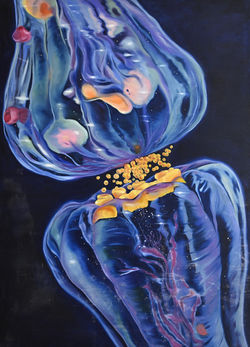 SynapseTan Mu Oil on linen 184 × 132 cm 2023 |  EphemeraWang Yifan Mixed media on wood board 80 × 80 cm 2025 |
 A Fleeting MomentWang Yifan Mixed media on wood board 100 × 100 × 4 cm 2023 |  Day and NightWang Yifan Mixed media on wood board 100 × 100 × 4 cm 2021 |  SundayWang Yifan Mixed media on wood board 50 × 40 × 4 cm 2024 |
 Night Soil #2Yu Wenjie Cotton cloth, linen, elastic fabric, cotton sewing thread, sand, soft pastel, resin and wood paint 120 × 100 cm 2025 |  A prophecy dreamed at dawn #3-2Yu Wenjie Cotton cloth, linen, elastic fabric, cotton sewing thread, sand, soft pastel, resin and wood paint 106 × 160 cm 2025 |  The carnival on the silent wasteland #1Yu Wenjie Cotton cloth, linen, elastic fabric, cotton sewing thread, sand, soft pastel, resin and wood paint 97 × 93 cm 2025 |
Artist

Xinyu Han
Xinyu Han (b.1998) was born and raised in Shanghai, China, and is currently based in London, UK. Xinyu graduated with an MFA in Painting from the Slade School of Art in London in 2024. She received her BFA from the School of Visual Arts in New York in 2020.
After completing her postgraduate studies at the Slade School of Fine Art (UCL), Han Xinyu chose to remain in London. Through her experiences of studying abroad, participating in artist residencies, and presenting her work in exhibitions, her life and artistic practice have continually evolved across diverse settings, allowing her to accumulate rich cross-cultural experiences within varied cultural contexts and art systems. The measured diversity of London, the open directness of New York, and the inherent memories of Shanghai all form the contextual backdrop of her work.
Beyond geographical mobility, environment also constitutes an atmosphere woven from interpersonal relationships, daily rhythms, and social structures—a reflection of one’s active self-construction. Through movement and choice, Han anchors her creative practice in a form of sustained spiritual sustenance. As environments shift, they continuously shape her ability to capture time, space, and emotion.
Han Xinyu's practice explores the tension between structure and emotion, stillness and movement, memory and time. Influenced by literature and lived experience, I extend time on the canvas through layered brushwork and dynamic shifts of color, capturing moments that hover between presence and absence—where chaos and order, rhythm and emotion, confront and dissolve into one another.
Han Xinyu's work has been exhibited in Zurich, London, New York, Beijing and Shanghai. Her recent solo shows include: 2025"At the still point of the turning world”, Modern Animals Gallery, Zurich; 2023 "Dancing on the Line", Gene Gallery, Shanghai. Her recent group shows include 2025 "Betwixt", General Assembly Gallery, London; 2024 "SUPERCROWS/SUPERCOMMUNITY", TANK Shanghai, Shanghai.

Tan Mu
Tan Mu (b. 1991, Shandong, China; lives and works in the United States) is a long-form, research-driven contemporary artist whose practice navigates the hidden architectures that shape our contemporary condition: submarine cable networks, data systems, cosmic perspectives, and the fragmented memory structures of both individuals and societies. Her work constructs a visual language that bridges structure and emotion across both macro and micro scales, emphasizing the themes of connection and continuity that underscore our shared human experience.
Combining traditional oil painting with tools of expanded vision, including microscopes, satellite imagery, and scientific visualization, Tan Mu navigates the liminal space between technological history and personal experience. She views technology as both an extension of the body and an externalization of memory, creating compositions that interweave embryos, neurons, logic circuits, quantum computers, solar farms, data nodes, and celestial bodies. Through this layered imagery, she builds visual bridges between the visible and the invisible, the tactile and the abstract, the systemic and the affective.
Tan Mu’s ongoing Signal series is a sustained artistic investigation into the invisible architectures of global communication. Grounded in infrastructure, media geography, technological poetics, and human perception, the series transforms submarine fiber-optic networks into symbolic “digital constellations” that bridge abstraction and representation, emotion and system. Mu reimagines these hidden infrastructures not merely as technical constructs, but as vessels of collective memory and human connection. By fusing planetary systems with individual and cultural histories, Signal creates poetic diagrams of connection and rupture, mapping time, scale, and collective presence. Works from the Signal series have been acquired by major international collections, positioning the project within a global cultural dialogue.
Tan Mu holds a BFA in Expanded Media from Alfred University, New York (2015), and graduated from the Central Academy of Fine Arts, Beijing in 2011. Her work has been exhibited internationally, with solo exhibitions at Peres Projects (Berlin and Milan, 2022) and BEK Forum in Vienna (2025). She will be featured in a group exhbition at the ERES Froundation in Munich and has previously participated in group exhibitions at Arario Gallery, Shanghai (2025), Penske Projects, New York; Winter Street Gallery, Martha’s Vineyard (2024); YveYANG, New York (2023). Her work has been widely featured and critically reviewed in international publications such as Artnet News, Mousse Magazine, and Numero Berlin, engaging themes of technology, memory, and visual abstraction. Her paintings are held in major private and institutional collections, including the Carmen Thyssen-Bornemisza Collection (Spain), A.R.M. Holding Art Collection (United Arab Emirates), The Institute for Electronic Arts (United States), the Central Academy of Fine Arts Collection (Beijing), and the Alfred School of Art and Design Collection (New York).

Wang Yifan
Wang Yifan was born in 1993 in Yantai, Shandong Province, and currently works and lives between Beijing and Guangzhou. Her artistic practice is deeply rooted in Chinese cultural traditions, while adeptly incorporating the aesthetics of classical painting, the logic of cinematic narrative, and the material language of contemporary media. Through this synthesis, she constructs a unique and introspective visual universe, consistently exploring the subtle yet profound dialogue between materiality and human perception. Her work stems from a keen sensitivity to everyday life, aiming to provoke contemplation on the nature of “seeing” and the essence of reality through a direct engagement with natural forms.
The artist’s practice can be understood as a process of revisiting and reconfiguring the “unseen.” She seeks to capture those fleeting, ethereal moments—the vitality of fruit, the clarity of ice water, the refraction of glass, the soft luster of pearls—and transmute them into enduring, inward spiritual landscapes. Her creative philosophy emphasizes “drawing from nature and returning to the inner self,” using visible forms to contemplate the invisible, striving to evoke a state of being that is both tranquil and vitally alive.
Since around 2018, the depiction of ordinary objects has become a significant thread in her work. These pieces are not mere representations but rather reflective sketches that carry the sentiment of “the universe within one’s own heart.” Her fascination with transparent or reflective materials like glass and ice water stems from a profound conceptual engagement with “lightness”—not as emptiness, but as a quality imbued with energy, pertaining to breath, flow, and an acute awareness of time. During specific creative periods, solitude became a fertile ground, prompting her to imbue the work with a sense of “self,” initiating silent and intimate dialogues with her subjects.
In exploring form, she is drawn to motifs such as fountains and chandeliers, which embody both structure and a natural rhythm, seeking an intangible order within their design. The “White Night Wanderings” series reveals her aesthetic pursuit of “emptiness” and “less,” informed by Eastern philosophy. Inspired by literature, she employs the monochromatic yet rich imagery of winter scenes, attempting to use minimal visual language to convey abundant emotion and imagery, finding spiritual movement and vital warmth within the cold.
Reading and misreading also form a critical part of her creative thinking. She believes the spirit of Romanticism offers a path to momentarily transcend reality, and that “precise misreading” can often generate new meanings. This allows her work to remain open and polysemous through processes of translation and interpretation. In pieces that integrate classical figuration, she seeks to reconcile rationality and sensibility, allowing the absurd theatricality of reality to intertwine with refined fantasy, blurring their boundaries.
In summary, Wang Yifan’s creative process resembles capturing a flowing river—a silent, enduring dialogue with her subjects. She emphasizes leaving traces through repetitive practice, awaiting signals and responses from the objects themselves, and ultimately establishing a relationship of trust and communion through rigorous refinement. Her art is not a simple reproduction of details but a subtle inscription of the passage of time, shifts in temperature, and inner stirrings, aiming to arrive at a tested, unified, and profoundly alive inner truth. Her work overall presents a distinct path of introspective excavation and poetic transformation of traditional spirit within a contemporary context.
Her recent exhibitions include: 2025 "Seeing the Grand in the Minute", Iris Art Museum, Suzhou; 2025 "Microcosms: The Intimacy of Proximity", Tang Contemporary Art, Singapore; 2025 "From Points to Lines: The Micro Art Biennale", Blunt Society, Shanghai; 2025 "True Love Indeed", ArtPDF, Waldorf Astoria Shanghai on the bund, Shanghai; 2024 "Hello, Stone Art Museum" CAFA Outstanding Graduates Invitational, Stone Art Gallery, Zhengzhou; 2024"New Kang Restaurant", Blunt Society, Shanghai; 2024 "G-Class Mysterious Bird Billboard", Xian Dong Tang, Zhengzhou; 2024 "Taking New Narratives as Method", Yangpu Cultural Arts Centre, Shanghai; 2024 "Warm Current", Dongyi No.6 Art Space, Beijing; 2024 "Extraordinary Dust", Haihan Art Space, Shenzhen; 2023 "MOODDN Art Fair", Hexagon Gallery, Guangzhou; 2023 "Circular Structure" Xian Dong Tang × 1933 Old Millfun Art Season, Shanghai; 2023 "JINGART Art Fair", 10pm Sleep Art Space, Beijing.

Yu Wenjie
Yu Wenjie (b. 1997, Shanghai) lives and works in London and Shanghai. He holds MA degree at Royal College of Art and a BFA degree at China Academy of Art. He is an artist who experiences the world with insecurities. He regards absolute honesty and courage in art as his priority. His artworks originate from the expression of inner experiences generated by the body and spirit in the process of experiencing and exploring the world. These inner experiences give rise to illusions, memories, associations, fantasies and feelings, while these elements are constantly broken and reorganized into visual fragments. Therefore, grand and micro narratives that are both delicate and sensitive always coexist in his works.
Yu Wenjie is an artist who experiences the world with insecurities. He regards absolute honesty and courage in art as his priority. His artworks originate from the expression of inner experiences generated by the body and spirit in the process of experiencing and exploring the world.
These inner experiences give rise to illusions, memories, associations, fantasies and feelings, while these elements are constantly broken and reorganized into visual fragments. These fragments lose the limitations of time and space but maintain a similar spatiotemporal distance from his present experience. The cracks that appeared naturally between these visual fragments are displayed in his artworks by either strengthening the direct presentation or weakening the transition zone. Therefore, grand and micro narratives always coexist in his works. His artworks are both delicate and sensitive, manifested in the destruction and reshaping of materials during the making process, showing a kind of “fragile yet firm” innocence and romance.
His media includes painting, sculpture, installation, moving images, performance, and sound. He combined history and the future in a leap way, showing that the present is both past and future. His inspiration system is huge and complex, so it is difficult to detect a specific clue of inspiration in his practice. He is a hybrid and diverse artist who is at translating objects from his spiritual world directly to the real world through his artworks. He maintains principles while constantly changing rapidly. Believing that “not being changed by the world is actually changing the world.”
His recent exhibitions include: 2025 Lingerfield, Nanke Gallery, Shanghai; 2025 En route II, HdM Gallery, Beijing; 2025 The rite of spring, Nan Ke Gallery, Shanghai; 2024 Wind whispers, Bluerider ART, Taipei; 2024 Ways of being, Once Gallery & SunS Living Gallery, Beijing; 2024 Hope is the thing with feathers, Bluerider ART, Shanghai; 2024 Everything grows and grows, Z Space & Once Gallery & SunS Living Gallery, Beijing; 2024 Unraveling landscape, The SWATCH Art Peace Hotel, Shanghai; 2024 Dark sky park, SHAN SHANG Art Space, Xiamen, CN; 2023 Sheer Edgy, Hankyu, Ningbo, CN; 2023 Chain reaction, Bonian Art Space & WAS Art Centre, Shanghai; 2023 Escape of light, Gallery OM, Shanghai; 2023 The infinite game: Dicing, Hexagon Gallery, Hongkong; 2023 In the midst of a melting garden, RuptureXIBIT, London.

Lucas Kaiser
Lucas Kaiser, born in 1994 in Erding, Germany, and currently based in Leipzig, is a highly-regarded contemporary artist. He is known for exploring the phenomenon of the "uncanny valley" and the boundary between figuration and abstraction, with his work often prompting profound reflection on the relationship between reality and virtuality, the familiar and the unfamiliar. Kaiser studied painting at the Academy of Fine Arts Leipzig (HGB Leipzig), where he received his Master of Fine Arts degree in 2021. His educational background has provided a solid foundation for his artistic practice, enabling him to navigate freely between traditional and contemporary approaches, thereby forging a distinctive visual language.
Kaiser's practice is primarily painting-based, incorporating diverse media such as pencil, pigment, watercolor, and oil stick. His works traverse the space between two and three dimensions, creating a visual experience that is simultaneously tangible and illusory. He frequently depicts ambiguous humanoid forms, devoid of specific features, appearing as if in a state of metamorphosis or dissolution, thereby challenging the viewer's perception of the human figure. He shows a particular interest in the "uncanny valley" effect—the sense of unease evoked when a human-like object approaches realism but falls short of being convincingly authentic. By manipulating proportions, postures, and spatial relationships of forms, he generates a visual tension that is both compelling and disquieting.
Furthermore, Kaiser's work investigates the conflict between pastoral idyll and reality. He references idealized natural landscapes, such as meadows, trees, and cabins, yet subverts traditional aesthetic perceptions through distorted forms and discordant color palettes, inviting viewers to contemplate the gap between idealization and actuality.
At first glance, Lucas Kaiser's paintings appear calm and comforting, yet a closer examination of their details reveals that they largely originate from fantastical perspectives detached from reality: figures suspended inexplicably in mid-air, severed hands oozing yellow fluid, unidentified amphibians crawling... He layers different pictorial elements using varied brushwork, much like dominoes stacked one upon another. His representations are often non-specific, fragmentary, and resist clear situational interpretation.
Amphibious creatures of various sizes are replicated, pasted, or fragmented within his compositions, undergoing bizarre distortions. In Kaiser's view, unlike mammals, amphibians do not inhabit fixed environments, residing sometimes on land, sometimes in water. Their expressions are inscrutable, and empathy with them is difficult. This emotional barrier is precisely what he seeks to convey through his imagery.
His recent solo exhibitions include: 2025 Constant Glimmer, ThisWeekendRoom, Seoul, KR; 2023 Soil Slayer, Galerie Kleindienst, Leipzig, DE; 2023 Down at the Green Meadow, ThisWeekendRoom, Seoul, KR. His recent group exhibitions include: 2025 Kunstpreis junger westen 2025– Malerei, Kunsthalle Recklinghausen, Recklinghausen, DE; 2024 fresh from the studios, Galerie Kleindienst, Leipzig, DE; 2024 MILKYTOWN HOBBYPETS, THEORY IN PRACTICE, Munich, DE.

Sarah Fripon
Sarah Fripon was born in 1989 in Zeitz, Germany, and currently lives in Vienna, Austria. Her artistic practice originates in the everyday. Her inspiration stems from city streets, supermarket shelves, dust-gathering corners in other people's living rooms—the glint of a potato peeler, a page from a 1996 product catalogue, an overexposed stock photo of a woman laughing over a salad. These lingering banalities are collected via her phone, forming a private archive of mediocrity and low-resolution cultural fragments. They are insignificant, yet omnipresent.
These fragments—tacky domestic objects, outdated product photography, the flicker of desire from another era—are rearranged, collaged, and painted onto her canvases. Sometimes she alters them significantly, sometimes she renders them almost exactly as found. It is a way of thinking through what is seen, an attempt to trace the contours of things discarded by their time. Comfort food, physical currency, hygiene rituals, templates of beauty—the tiny systems that constitute the larger picture. Her works are not grand narratives but loose chains of thought; they offer not answers but echoes. They are interconnected leaps of thought that can evoke ideas or feelings in themselves and others. She views her works as conversational openers. They are tools for getting people to talk to each other, to share thoughts about painting and develop ideas together.
Painting slows everything down. It provides space to linger over the stupidly familiar, the usually overlooked. She is not interested in articulating a thesis or telling a story; she is interested in what happens when an image unfolds—when it becomes a conversation, a moment of shared recognition. The painting is not the message; it is the moment before, after, or beside it.
Her work is also deeply concerned with ‘quotation’. Her paintings quote other images, much as sounds and songs can be sampled into a track—advertisements, film stills, vintage print media, 3D renders exuding a contemporary digital sheen. Some elements feel dated, others unmistakably of the now. Time becomes slippery. Looking at a work can transport you elsewhere—into a parallel decade, a different mood. This temporality also resides in the brushstroke, in the way figuration slides into abstraction, in the strange democracy of motifs on the canvas.
Even the exhibition space becomes part of the conversation. She values the viewing experience that requires the audience to move—to crouch, to stretch, to peer around a corner. She appreciates how a space talks back. Works are not just hung; they are embedded. They quote the architecture, mimic its gestures, point to what is already there. These paintings are not windows; they are objects. They exist, with us, in physical space. Real, strange, and speaking.
Her recent exhibitions include: 2025 Just Looking, The Shophouse, Hong Kong, HK; 2024 Holiday, Harper´s, New York, US; Zone1, Vienna Contemporary with Commune, Vienna, AT; The Last Laugh, Podium Gallery, Hong Kong, HK, etc.

Evgeniya Dudnikova
Evgeniya Dudnikova was born in 1995 in a family of professional sculptors in Ramenskoe, Moscow region. Now, she lives and works in Santiago, Chile.
In 2019, she graduated from the Stroganov Academy, the Faculty of Monumental and Decorative Painting and the School of Contemporary Art "Free Workshops" at MMOMA. She works with the mediums of painting and linocut.
Working at the nexus of traditions of the surrealism and Jungianism, the artist finds her own unique sincere painting tone of voice. Evgeniya issues the challenge to create complicated symbolic language, in which she addresses herself to the inner wandering and transformation. The core motif of her oeuvre are images of horses, indued with metaphorical and symbolic roles. Eugeniya is interested in topics of the future, utopia, harmonious relations between the man and the nature, ecology and the spiritual path. Mixing the real and fictional worlds in a single pictorial space is a method by which the author demonstrates her own perception of reality.
Evgeniya works mainly with figurative painting, sculpture, and installation in which she is balancing between traditions of surrealism and ideas of Jungianism. She issues the challenge to create symbolic language, in which she addresses herself to the inner spiritual wandering, theme of fate and transformation, and exploring nature of reality. Her tools for carrying out this research become world and personal myths, her relationships with nature, dreams analysis, and life experience.
In each work, she contemplates the nature of things and intertwines interrelations between objects. The rich abundance of images, combined into constellations, is a distinctive feature of Dudnikova’s style, alike the surrealistic techniques. Her images mostly deal directly with nature, emerging from it or producing new lifeforms. The artist’s profound connection with nature dates as far back as her childhood, she spent, surrounded by forests and their dwellers, and her close relations with horses as well. The attachment to wild nature, traveling, and intense observation of the elements and natural phenomena have now become an integral part of her creative practice as well as her personal identity.
Her recent solo exhibitions include: 2025 "Terra Incognita", Lazy Mike Gallery, Seoul; 2023 "A star is born in the cloud", Triumph Gallery, Moscow; 2021 "Nomads", JART Gallery, Moscow. Her recent group exhibitions include: 2025 ”Kiaf”, Contemporary Art fair, Lazy Mike gallery’s booth, Seoul; 2024 "Woolwich Contemporary Print Fair", London; 2024 "|catalog|" art fair, participation with Jart Gallery, Sitin’s topography, Moscow; 2023 "|catalog|" art fair, participation with Triumph Gallery, Sitin’s topography, Moscow; 2023 "1703" art fair, participation with Third Space Gallery, Saint Petersburg.
Curator

Wang Shiying
Wang Shiying, holds dual master's degrees from the Central Academy of Fine Arts and the Curating Contemporary Art program at the Royal College of Art in the UK, currently works in the Curatorial Department of Tang Contemporary Art. Her curatorial practice revolves around alternative exhibition, contemporary fluid, networked culture approaches to art. Exhibitions she has curated include: “Light in the Whirlpool” (2025), “Xiang Nan: Favoring Winds and the Promised Land” (2025), “Stemming from Umwelt” (2024), “Bangkok Holiday: Hao Zecheng & Wanpeng Dual Exhibitiion” (2024), “Frida Wannerberger Solo Exhibitiion: Into the Sunset with you”(2023), "Yangna Solo Exhibition: The Land of Ēse" (2023), “Group exhibition: The traces of light”(2023), "Indoor Weather" (2022), "Immunity Geography" (2021), the Gaswork "Awakening" online exhibition project(2021), and the "Post-Life" alternative space group exhibition at the Sweet Potato Community (2019), among others.