
GROUP EXHIBITION
Constellations of Difference
Artists: Romina Bassu, Marion Bataillard, Sunkyung Beak, Evgeniya Dudnikova, Etsu Egami, Sarah Fripon, Krizia Galfo, Alice Herbst, Kaito Itsuki, Opal Mae Ong, Salome Rigvava, Laura Sanders, Marinella Senator, Pannaphan Yodmanee
Beijing 2nd Space
2026.9.5 - 2026.10.16
Curated by Michela Sena


Tang Contemporary Art is pleased to announce “Constellations of Difference,” an international group exhibition featuring women artists, opening at its Beijing 2nd Space at 4 PM on September 5. Curated by Michela Sena, the exhibition brings together more than 40 representative works by 14 women artists from different parts of the world: Romina Bassu (Italy), Marion Bataillard (France), Sunkyung Beak, Evgeniya Dudnikova (Russia), Etsu Egami (Japan), Sarah Fripon (Germany), Krizia Galfo (Italy), Alice Herbst (Sweden), Kaito Itsuki (Japan), Opal Mae Ong, Salome Rigvava (USA), Laura Sanders (USA), Marinella Senatore (Italy), and Pannaphan Yodmanee (Thailand).
To bring together, within a single exhibition constellation, the works of Salome Rigvava, Romina Bassu, Laura Sanders, Krizia Galfo, Evgeniya Dudnikova, Marion Bataillard, Opal Mae Ong, Marinella Senatore, Sarah Fripon, Kaito Itsuki, Alice Herbst, and Etsu Egami is to engage with a question that lies at the heart of contemporary artistic discourse: to what extent can the feminine still function as a critical category without reducing the plurality of experiences, geographies, and artistic languages to a singular definition of identity?
The exhibition takes shape precisely within this tension. What brings these artists into dialogue is neither adherence to a shared aesthetic nor the articulation of a common iconographic repertoire, but rather the possibility of observing how distinct contemporary artistic practices question the processes through which identity, experience, memory, and representation are constructed and transmitted.
In this sense, the feminine emerges not as a circumscribed theme, but as an open field of possibilities. It may manifest itself through the presence and representation of the body, but equally through the construction of space, the relationship with landscape and objects, the elaboration of memory, the affective dimension, language, imagination, or collective participation. In other words, the feminine does not necessarily coincide with what the work represents: it may reside in the perspective from which the work originates, in the artist’s position in relation to the visible, and in the processes through which experience is translated into image.
The diversity of artistic languages represented in the exhibition is therefore integral to the project. Figuration, photography, conceptual and interdisciplinary practices delineate a deliberately heterogeneous territory in which the recognisability of the real coexists with processes of alteration, fragmentation, and perceptual ambiguity. In certain works, everyday reality is observed with an almost analytical precision; in others, the image appears progressively to emancipate itself from its descriptive function, becoming a mental space, a repository of memory, a projection, or an apparition.
Of particular significance is the relationship between the individual dimension and the collective construction of identity. Intimacy, domesticity, interpersonal relationships, and private experience do not constitute territories separate from the public sphere, but rather sites in which social structures, cultural conventions, and systems of representation are continuously at work. Likewise, where artistic practice explicitly enters the participatory or political realm, the individual is not subsumed into the collective but remains its primary measure and point of articulation.
What emerges is thus an understanding of identity as a process rather than a given: something continuously produced at the intersection of personal experience and shared imaginaries, memory and the present, belonging and otherness. The presence of artists from different generations and geographical contexts further expands this perspective, divesting the very notion of femininity of any claim to universality. What is proposed here is not a paradigmatic female experience, but a plurality of positions from which reality may be observed, questioned, and reformulated.
Even where the body appears, it participates in this condition of instability. It does not necessarily constitute the conceptual centre of the work, but functions as one of the possible devices through which relations with the other, vulnerability, desire, self-perception, or the conventions of the gaze may be interrogated. Elsewhere, it is precisely the body’s absence that becomes significant: environments, traces, natural forms, objects, or the structures of the image itself preserve the presence of a subject that does not require representation in order to assert itself.
It is precisely this oscillation between presence and absence, visibility and withdrawal, the private dimension and the public sphere that resists any reading of the exhibition through a rigidly defined category of identity. The feminine appears here not as an essence to be represented, but as a critical position from which the very processes of representation may be interrogated.
The works assembled in this exhibition thus trace a cartography that is necessarily incomplete and discontinuous. Rather than attempting to define what it means to be a woman today, they reveal the increasing inadequacy of any totalising definition. It is in the irreducibility of these individual experiences that the project finds its coherence: not in the assertion of a common identity, but in the possibility of recognising difference itself as a form of relation.
Femininity thus becomes not a boundary within which these practices are to be contained, but a point of departure for a broader reflection on contemporary identity and on art’s capacity to render visible its multiple, contradictory, and continually shifting forms.
EXHIBITING WORKS
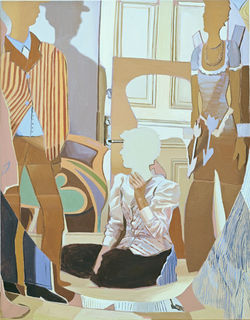 MimicryAlice Herbst Oil on canvas 90 × 70 cm 2025 |  Running Behind Herself in a CircleAlice Herbst Oil on canvas 120 × 100 cm 2025 |  The CastAlice Herbst Oil on canvas 155 × 124 cm 2025 |
|---|---|---|
 Unlock a DoorAlice Herbst Oil on canvas 120 × 100 cm 2025 | 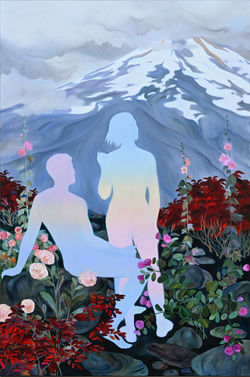 Garden on a Volcanic SlopeEvgeniya Dudnikova Oil on canvas 150 × 100 cm 2026 | 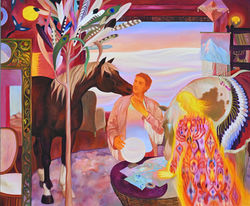 The Purple HouseEvgeniya Dudnikova Oil on canvas 100 × 120 cm 2023 |
 Tumbleweed ValleyEvgeniya Dudnikova Oil on canvas 160 × 200 cm 2026 |  PollinatorsEvgeniya Dudnikova Oil on canvas 110 × 57 cm 2025 |  Rainboiw-2022-t-15Etsu Egami Oil on canvas 202 × 178 cm 2022 |
 Rainbow-2021-T-21Etsu Egami Oil on canvas 200 × 140 cm 2021 |  Waterfall RainbowEvgeniya Dudnikova Oil on canvas 110 × 90 cm 2026 |  Before LeavingKaito Itsuki Oil on canvas 91 × 73 cm 2024 |
 Package ArrivalKaito Itsuki Oil on canvas 100 × 73 cm 2024 |  Imprint on Contours (Blue)Kaito Itsuki Oil on canvas 162 × 112 cm 2024 |  Un deux troisMarion Bataillard Tempera on wood 180 × 100 cm 2022-2023 |
 Espace OuvertMarion Bataillard Tempera on wood 180 × 90 cm 2022 |  Veneer on Yellow FurKaito Itsuki Oil and charcoal on canvas 160 × 130 cm 2024 |  The Cosmic Womb of PurityPannaphan Yodmanee Acrylic and oli color on canvas 120 × 95 cm 2026 |
 The Cosmic WombPannaphan Yodmanee Acrylic and oli color on canvas 120 × 95 cm 2026 |  Meanwhile EternityOpal Mae Ong Gouache & acrylic on canvas 121.92 × 91.44 cm 2026 |  CrushingOpal Mae Ong Gouache & acrylic on canvas 121.92 × 91.44 cm 2026 |
 AfterbirthRomina Bassu Acrylic on canvas 100 × 80 cm 2025 |  By Any Other NameRomina Bassu Acrylic on canvas 100 × 80 cm 2026 |  ConversationsSalome Rigvava Oil on canvas 91.5 × 91.5 cm 2024 |
 First KissSalome Rigvava Oil on canvas 76 × 76 cm 2023 |  The History of the Blue RoomSalome Rigvava Oil on canvas 102 × 102 cm 2023 |  Yellow Color in Blue RoomSalome Rigvava Oil on canvas 101 × 102 cm 2024 |
 Valentine’s Day in the Blue RoomSalome Rigvava Oil on canvas 102 × 101 cm 2023 |  Put It Somewhere, Couple MemoriesSarah Fripon Acrylic on canvas 132 × 100 × 2.5 cm (72 × 100 × 1.7 cm, 60 × 100 × 1.7 cm) 2024 |  Slowly Seeping In (Sofa II)Sunkyung Beak Oil on canvas 60 × 97.1 cm 2026 |
 Put It Somewhere, ClockwiseSarah Fripon Acrylic on canvas 160 × 180 cm 2024 |  Slowly Seeping in (Curtain II)Sunkyung Beak Oil on canvas 60 × 40 cm 2026 |  Slowly Seeping in (Curtain III)Sunkyung Beak Oil on canvas 60 × 40 cm 2026 |
 The Room, Still Wet 1Sunkyung Beak Oil on canvas 125 × 200 cm 2026 |  The Room, Still Wet 2Sunkyung Beak Oil on canvas 125 × 200 cm 2026 |  A Carousel WebKrizia Galfo Oil on linen D 50 cm 2026 |
 The Blue RoomKrizia Galfo Oil on linen 50 × 60 cm 2023 |  The Blue ShirtKrizia Galfo Oil on linen 50 × 60 cm 2021 | 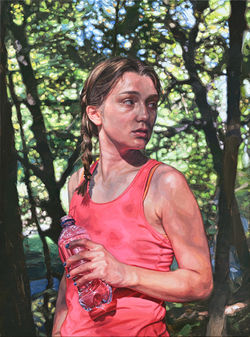 By Herself, Armco ParkLaura Sanders Oil on canvas 91 × 66 cm 2020 |
 Fisrt SeasonLaura Sanders Oil on canvas 91 × 66 cm 2025 |  The CakeKrizia Galfo Oil on linen 15 × 23 cm 2026 | 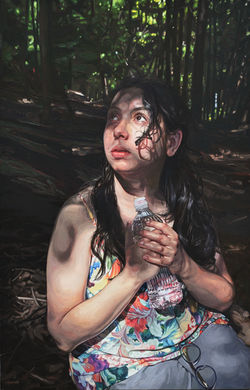 Girl with Bottled WaterLaura Sanders Oil on canvas 106 × 69 cm 2022 |
 On WatchLaura Sanders Oil on canvas 101 × 63.5 cm 2020 | 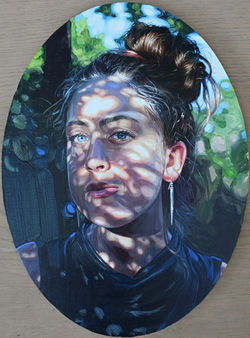 Portrait of a Young WomanLaura Sanders Oil on linen panel 48 × 35 cm 2024 |  Watch Here to be HappyMarinella Senatore Collage on cotton paper 210 × 150 cm (70 × 50 cm × 9) 2025 |
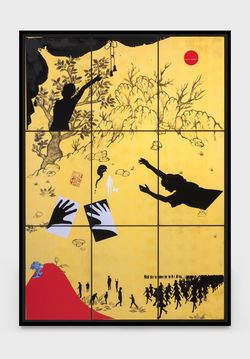 There is So Much We Can Learn from the Sun #2Marinella Senatore Collage on golden leaf 300 × 210 cm 2025 |  View Someone in a New LightMarinella Senatore Fabric embroidered banner 112 × 200 cm 2025 | 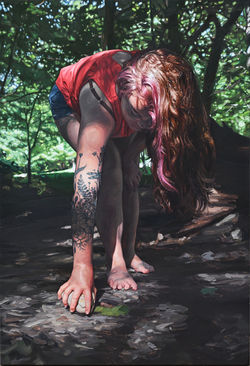 The BatherLaura Sanders Oil on canvas 127 × 84 cm 2020 |
 Soulful Melodies of NatureMarinella Senatore Fabric embroidered banner 180 × 120 cm 2025 |
Artist

Romina Bassu
Romina Bassu, born in Rome in 1982, where she currently lives and works. She studied at the Academy of Fine Arts of Rome and at the Faculty of Fine Arts of Seville. In 2004 she started to work as assistant at Alberto di Fabio and Cristiano Pintaldi’s studies. She continues her artistic research between London, Berlin and Spain where she starts Anonymous Archive.
In this project Romina Bassu reproduces in a pictorial key a lot of ancient photographic images collected over the years. With this project, Romina Bassu begins to work on the connection between individual and collective memory, proposing a sort of archeology of memory. Her reflexion on memory aims to create a continuum between universal history and individual one. Over the years her research has increasingly focused more and more on the representation of those feminine stereotypes, modeled accordingly to the needs of a male culture and a society of consumption, which still today are taken for granted but painted though in a version “altered” by the female gaze. The apprehensive mother, the housewife proud of her talent in the art of ironing, the young woman looking for an husband, the girl eager to look beautiful. These and many others are the subjects of her works that come from a very specific iconography: the Fifties. This is the epoch when a particular female imaginary begins to take shape and inevitably will influence the next twenty years, up to present times.
The subjects of the most recent works (2018-2019) are about the connection between woman, body and vulnerability: three elements that, through pictorial narration, define an existential space. For the artist recovering and representing this space means access to a moment of humanity and authenticity – often handled with secrecy – in a time of consumerist culture that claims a constant productivity that extends also to the body of the woman herself.The hallmark of his painting lies in the dark humor that always characterizes the imaginary of the artist’s works.
In the spring of 2017 she won the ARTFORARTSSAKE award in Berlin and in 2018 she was among the finalist of Premio Cairo (Milan, Italy). She exhibited her works in art galleries and museums in Spain, Germany, UK and Italy. Among her most recent exhibitions: Ciò che vedi. Nuova figurazione in Italia, curated by di M. de Pilati – A. Cramerotti, Galleria Civica di Trento – MART, Trento (forthcoming, February 2020); Monday blues, Studio SALES di Norberto Ruggeri, Roma (2019, S); Male gaze, SALES di Norberto Ruggeri, Roma (2017, S); Analogue Champion, Burning Giraffe Art Gallery, Turin (2017, S); Social utopia / Open Studies Festival, XII edition, Ameno, Novara (2016, G); Carte Blanche, Galerie Olivier Nouvellet, Paris (2016, G); Book Art Project, Fondazione Pastificio Cerere, Rome (2015, G); Francesco Fabbri Award for Contemporary Arts 2015, Villa Brandolini, Treviso (2015, G); Combat Prize, Civic Museum G. Fattori ex Granai by Villa Mimbelli Livorno Natural History Museum (2013, G).

Marion Bataillard
Marion Bataillard (b.1983, Nantes, France), graduated from ESAD Strasbourg under Manfred Sternjakob and Daniel Schlier in 2007. After graduating in 2007, she moved to Berlin for six years, before returning to France through several residencies in Auvergne and Limousin.
There is more from the world and the urban in these new paintings of Marion Bataillard. They investigate the questions of otherness, relations and group. In her works, conditions formed by bodies and spaces unfold over the whole spectrum of perception. So much so that it becomes impossible to tell what is actually taking place. The works of Marion Bataillard, whose titles are true metaphysical programs, deal with contingency and a certain form of vernacular: a collective dance, a young woman who telephones on the street, a discussion in a closed space, a wait, a walk. Through these everyday occurring, residual objects escape any form of explicit symbolism, while the compositions make their encounters with mysticism. The prism of references to art history, with which the artist obviously plays, is not there to unite nor to stabilize our knowledge. On the contrary, it comes as a play, or a burst of sensations. Bataillard is one of those painters who relaunch the methodological challenge of the classic painting by prioritizing the cognitive with space and body. The action of the painter is projective and not restrained, incarnated rather than deposited. Something physiological radiates.
Her work was spotted in 2015 at the Salon de Montrouge where she won the Grand Prix, which led to an exhibition at the Palais de Tokyo. She also won the Prix Marin in 2016. Since then, her paintings have been exhibited regularly in solo and group shows, in galleries and art institutions in France, Germany and China.
Her recent solo exhibition include: “De chair, de force et de relief”, Aponia, Monastier-sur-Gazeille, 2026; “Notre corps”, Galerie PARIS-B, 2023; "Salut", presented by Guido Romero Pierini, Paris, 2021; "Rester vivante", POCTB, Orléans, 2020; "La vie sur Terre", Église des Trinitaires, Metz, 2020; Centre d'art Les Églises, Chelles, 2019; "Inévitable Clairière Amie", Galerie Guido Romero Pierini, Paris, 2019; "Créatures", Galerie ALB, Paris, 2017; "Figures de l'amour", Amy Li gallery, Beijing, 2016; "Ripailles", Orangerie du Château de la Louvière, Montluçon, France, 2013.

Sunkyung Baek
Sunkyung Baek (b. 2000, Seoul, Korea) is a South Korean artist currently based in London. Working primarily in oil on canvas, she is presently undertaking an MA in Painting at the Royal College of Art, London, having completed her BFA at Hongik University, Seoul. She is the recipient of the 2026 Jackson's Art Prize People's Choice Award, and her work has been exhibited in Seoul and London.
Baek's practice explores contemporary society through images of water, flooding, and destabilised familiar spaces. She understands contemporary life as shaped by fluidity, flexibility, and mobility, employing flooding as a metaphor to examine how these conditions unsettle environments typically associated with safety—such as homes, cars, and rooms.
In her paintings, water operates as an uncontrollable external force: quiet, excessive, and persistent, entering and transforming these spaces. Rather than depicting dramatic catastrophe, Baek focuses on slower processes of accumulation and infiltration. Her work oscillates between submersion and aftermath, where traces of sediment, dampness, and residue remain and continue to shape space.
She views contemporary life as marked by the accumulation of information and images, excessive choice, and constant change, which together form a flood of uncertainty, anxiety, and fatigue. Baek captures suspended moments in which—like water seeping through the gap of a door—the boundaries between inside and outside, stability and instability, gradually dissolve.

Evgeniya Dudnikova
Evgeniya Dudnikova was born in 1995 in a family of professional sculptors in Ramenskoe, Moscow region. Now, she lives and works in Santiago, Chile. In 2019, she graduated from the Stroganov Academy, the Faculty of Monumental and Decorative Painting and the School of Contemporary Art "Free Workshops" at MMOMA. She works with the mediums of painting and linocut.
Working at the nexus of traditions of the surrealism and Jungianism, the artist finds her own unique sincere painting tone of voice. Evgeniya issues the challenge to create complicated symbolic language, in which she addresses herself to the inner wandering and transformation. The core motif of her oeuvre are images of horses, indued with metaphorical and symbolic roles. Eugeniya is interested in topics of the future, utopia, harmonious relations between the man and the nature, ecology and the spiritual path. Mixing the real and fictional worlds in a single pictorial space is a method by which the author demonstrates her own perception of reality.
Evgeniya works mainly with figurative painting, sculpture, and installation in which she is balancing between traditions of surrealism and ideas of Jungianism. She issues the challenge to create symbolic language, in which she addresses herself to the inner spiritual wandering, theme of fate and transformation, and exploring nature of reality. Her tools for carrying out this research become world and personal myths, her relationships with nature, dreams analysis, and life experience.
In each work, she contemplates the nature of things and intertwines interrelations between objects. The rich abundance of images, combined into constellations, is a distinctive feature of Dudnikova’s style, alike the surrealistic techniques. Her images mostly deal directly with nature, emerging from it or producing new lifeforms. The artist’s profound connection with nature dates as far back as her childhood, she spent, surrounded by forests and their dwellers, and her close relations with horses as well. The attachment to wild nature, traveling, and intense observation of the elements and natural phenomena have now become an integral part of her creative practice as well as her personal identity.
Her recent solo exhibitions include: 2025 "Terra Incognita", Lazy Mike Gallery, Seoul; 2023 "A star is born in the cloud", Triumph Gallery, Moscow; 2021 "Nomads", JART Gallery, Moscow. Her recent group exhibitions include: 2025 ”Kiaf”, Contemporary Art fair, Lazy Mike gallery’s booth, Seoul; 2024 "Woolwich Contemporary Print Fair", London; 2024 "|catalog|" art fair, participation with Jart Gallery, Sitin’s topography, Moscow; 2023 "|catalog|" art fair, participation with Triumph Gallery, Sitin’s topography, Moscow; 2023 "1703" art fair, participation with Third Space Gallery, Saint Petersburg.

Etsu Egami
Etsu Egami is a Japan-born artist internationally recognized as a leading figure of the third generation of postwar Japanese artists, with a significant presence across the United States, China, and Europe. She was selected for the Forbes 30 Under 30 list in both 2020 and 2021 for her impact on the global arts landscape. In 2021, she was designated an Emerging Artist by Japan’s Agency for Cultural Affairs and dispatched to New York. She was also a finalist for the 2019 Asian Art Award, named one of six women “Changing the Art World” by Net-a-Porter in 2022, and received the Young Artist of the Year award in 2023.
Egami’s work centers on the human figure, with a particular focus on anatomical structures, musculature, and the interplay of light and color. Her artistic inquiry can be described as an exploration of the “enigma of humanity.” Her diverse subjects span genders, eras, and social standing—from Vincent van Gogh and ancient philosophers to contemporary celebrities and anonymous individuals. Through vivid color and fluid brushwork, she creates vibrant, living compositions that draw viewers into a mysterious, hazy exchange of gazes. This emotive power resonates deeply with audiences. For Egami, people represent an eternal riddle—an object of enduring fascination and longing. Humanity’s relentless quest for self-understanding, from ancient cave paintings to contemporary portraiture, stands as testament to both our boundless curiosity and persistent ignorance about ourselves. As she reflects, “A person is a small universe—infinite and unfathomable.”
To Egami, a face encapsulates a person’s life and narrative—a story that can never be fully read, yet one she seeks to interpret through her brush. She elaborates: “The human face is not static; it conveys emotion and spirit. Its form is constantly shifting—a reflection of the energy and information passing through a person. In one’s lifetime, a face is like what Buddhism describes as a ‘once-in-a-lifetime encounter.’ It is inherently transient, without a fixed state. Even misunderstandings and disjunctions in life can become opportunities—starting points for insight and exchange. We may depict the face in countless ways, searching for truth within it, yet all such attempts occur through a kind of dislocation. In fact, every portrait I paint could be seen as a form of misinterpretation, because the face is not permanent. The human face is an endless book—ever-renewing, embodying the vitality and essence of human life.”
Her recent solo exhibitions include: 2026--Blessings From Afar, Tang Contemporary Art, Hong Kong, China; 2025--Echoes of the Earth, OAR Contemporary Art Museum, Korea; 2024--Time: Etsu Egami Solo Exhibition, Tang contemporary Art, Bangkok, Thailand; 2023--Oriental Mystery: Etsu Egami Solo Exhibition, HOW Art Museum, Shanghai, China;2023--Etsu Egami solo exhibition: Incessant is the change of water where the stream glides on calmly, White Stone Gallery, Singapore; 2023--Souls Carried — Etsu Egami: Questioning Modernity, A New Horizon, Woodone Museum of Art, Hiroshima, Japan; 2021--In a Moment of Misunderstanding, All the Masks Fall, Contemporary Art, Beijing, China;2021--RAINBOW - ETSU EGAMI solo show, Whitestone gallery Taipei, Taipei.; 2021--Face book- EGAMI ETSU solo show, Chambers FineArt, New York, USA, etc.

Krizia Galfo
Krizia Galfo is a rising-generation Italian contemporary figurative painter whose work merges classical portraiture traditions with cinematic narrative language. Her key characteristics include cinematic composition. Drawing heavily on cinematic devices such as closeups, photographic cropping and framed stills, her paintings often read like a paused film frame rather than conventional portraiture. Her figures generally exhibit no overt dramatic gestures; instead, their psychological states are conveyed through gazes, postures and physical spacing. This creates a quiet yet oppressive psychological atmosphere, with many critics observing that her oeuvre is imbued with “a sense of frozen time”.
In Galfo’s practice, the threefold media of painting, cinema and fabric folds draw viewers into an alternative spacetime, suspended within a static, hovering mood. Adopting filmphotographic syntax and closeup techniques, the artist explores humanity’s inner spiritual motivations and unresolved internal conflicts, amplifying their inherent tension and emotional unrest.
Alice Herbst
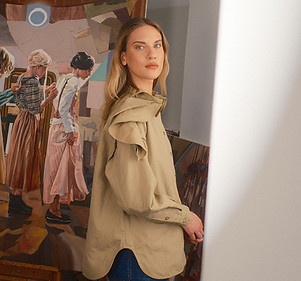
Alice Herbst (b. 1993, Stockholm, Sweden) is an artist based in Stockholm. After frequently relocating during her childhood, she returned to Stockholm to study at the Stockholm School of Art and graduated from Gerlesborg School of Fine Art in 2017. Shortly after completing her studies, Herbst was invited to lecture at the Ferrari Design Center in Maranello, Italy, in recognition of her exceptional artistic vision.
Herbst’s practice is centered on figurative painting, characterized by a distinctive fusion of abstraction and realism. She frequently constructs props from everyday materials such as cardboard, paper, and fabric, arranging them within her compositions to animate the spatial and atmospheric qualities of her paintings. Like a set designer, she orchestrates these objects to encourage viewers to imagine unfolding narratives. Familiar objects, such as a cardboard sideboard or a flattened teacup, are transformed through unexpected materiality, sometimes mimicking real textures and other times emphasizing flatness or artificiality, inviting viewers to find their own meaning. Her attention to dress patterns and color schemes is evident throughout her work, and she occasionally positions herself within the scene, transforming into new characters. Through these approaches, Herbst continually explores the transformation of materials and the fluidity of identity.
Herbst’s work has been exhibited internationally and is held in collections worldwide, including the prestigious Collezione Maramotti in Italy. A former fashion model, she has also been featured in Harper’s Bazaar, L’Officiel, and the BBC. She currently lives and works in Stockholm, where she continues to expand the boundaries of figurative painting and challenge conventional notions within contemporary art.

Kaito Itsuki
Kaito Itsuki, born in Sapporo, Hokkaido, Japan, in 1993. Received her BFA from the Department of Fine Arts, Tōhoku University of Art & Design (TUAD), Yamagata, in 2016, and her MFA from the Painting Department, Kyoto City University of Arts (KCUA), Kyoto, in 2019. Currently lives and works in Tokyo and New York.
Though born in Sapporo, Itsuki found her hometown somewhat stifling as an aspiring artist. "I could sense its beauty, but with no proper museums and no real art, I felt trapped—there was nothing there to ignite any creative impulse." Turning to the internet for self-education shaped her visual sensibility: "That's why my imagery isn't particularly Japanese, and why viewers often struggle to pinpoint where I'm from."
With few opportunities to encounter art in person growing up, Itsuki drew aesthetic influences largely from anonymous images circulating online, video games, and manga. After graduating from a local arts high school in Sapporo, she studied painting at Tōhoku University of Art & Design, where she also pursued cultural anthropology, religion, and youth culture—all of which continue to inform her artistic themes. She earned her MFA from Kyoto City University of Arts in 2019 before relocating to Tokyo and New York to launch her career.
These comparative experiences broadened her reservoir of visual references. "New York has no shortage of galleries and museums, but it's overwhelming, the competition is fierce. It was actually going there that made me recognize what Tokyo has to offer." As Itsuki explains, her focus in New York was on surviving as an artist; while the city offered more material advantages, Tokyo ultimately suits her better. Making art is a solitary pursuit, and she wants to work in dialogue with her own country.
Solo exhibitions include Quadruped Masking (Tang Contemporary Art, Beijing, 2024); Tools are validated (Tang Contemporary Art, Bangkok, 2022); Blacken (Hive Center for Contemporary Art, Beijing, 2022); No excuses for showing up (LEESAYA, Tokyo, 2021); Hierarchy of Beasts (Gallery MEME, Seoul, 2021); In search of... (14a, Hamburg, 2020); Unsatisfied animals of the cycle (Ginza Tsutaya, Tokyo, 2019), among others. Group exhibitions include The Tale of Tales (G Museum, Nanjing, 2022); Collection as Poem in the Age of Ephemerality (X Museum, Beijing, 2020); The 4th CAF Prize Exhibition (Hillside Terrace, Tokyo, 2017).

Opal Mae Ong
Opal Mae Ong (b. 1994, Los Angeles, CA) is a Filipino-American artist living and working on Lenapehoking in Brooklyn, New York. They hold an MFA in Painting from Hunter College (2021) and a BFA in Illustration and Cartooning from the School of Visual Arts (2016).
Ong's current body of work emerges from a felt response to the natural world and an innate reverence for the otherworldly. Drawing from lost ancestral knowledge, grief, and speculative visions, their paintings and drawings constitute a form of personal myth-making. The works present liminal landscapes where feminine figures crawl toward horizons, commune with flora, carry moons, shapeshift, or collapse from unrest. Materially, the works are built through layered drawing and pigment. Ong uses liquid pigments "with a history," sourced from Guerra Pigment & Paints, a local supplier known for salvaging rare and discontinued pigments. The paintings also incorporate gouache—long associated with draftsmanship—whose matte, hyper-saturated surfaces evoke both transparency and opacity, flattening and depth. Color shifts across bodies and environments, reflecting the artist's experience of mixed-race identity as relational rather than fixed. Figures blur into plants and land, dissolving the boundaries between self and world.
Within Filipino cosmologies, there are stories of human-like spirits that dwell within trees. Some, like the duwende, are small and elusive beings often associated with sacred trees, while others, like the kapre, are towering hairy tricksters said to inhabit large trees such as mangoes, banyans, and bamboo. In relation to these unseen presences, Filipinos commonly say tabi tabi po, which roughly translates to “excuse me,” when passing through nature or entering unfamiliar spaces. The phrase expresses respect toward what may exist beyond what is immediately visible, acknowledging that places are already inhabited and carry their own histories.
As someone who is mixed and Filipino American, I have been reflecting on what it means to carry these ways of seeing within the diaspora. I’ve been thinking about how an animistic worldview might exist alongside my experience of living in an increasingly urbanized place like New York City, a city often understood through its architecture and infrastructure, but one that is also shaped by layered histories, ecologies, migrations, and communities. These reflections feel alive and have been inspiring the current state of my practice and life.

Sarah Fripon
Sarah Fripon (b. 1989, Zeitz, Germany) is a Vienna-based artist whose practice centers on painting as a way of thinking through the everyday image world. Trained first in fashion design at the University of Art and Design Linz (BFA 2015) and later in Fine Arts at the Academy of Fine Arts Vienna (Mag.Art. 2021), she builds her compositions from an extensive archive of stock photos, advertising images, domestic snapshots, cinematic stills, and digital ephemera.
These fragments —comfort food, money, hygiene rituals, beauty templates—are collaged and repainted into associative, often darkly humorous scenes that probe contemporary consumer culture, power structures, and the absurdity of everyday life. Her textural acrylic paintings oscillate between figuration and abstraction, treating images less as illustrations and more as “association chains” that render time slippery, folding together analogue and digital sources like layers of encoded metadata.
Her work was shown, among others, in Taxispalais Kunsthalle Tirol (2019), Palais Liechtenstein Vienna (2020), Fünfzigzwanzig Salzburg (2021), Harkawik New York (2022) and Kunstforum Vienna (2024). Her works are part of the collection of the Baden State Museum in Karlsruhe, the Graphic Collection of the Academy of Fine Arts Vienna and the Collection of the Vienna Museum, as well as the By Art Matters Museum, China.

Marinella Senatore
Marinella Senatore (b. 1977, Cava de’ Tirreni) is a multidisciplinary artist trained in music, fine arts and cinema. Her practice is defined by a strong collective and participatory dimension that acts both as method and content, combining rigorous aesthetic research with the transformative power of social engagement. Through the use of traditional and vernacular language forms - including pop culture, dance, music, mass events - and activism, Senarore reflects on the political nature of collective formations and rituals and their possibility for social change, creating moments of encounter, sharing and workshops. Her works are based on a potentially infinite inclusion of elements: her approach acknowledges the surrounding context, in which the artworks become functional structures and create new ambiences through the use of multiple media: light installations, collage, textile and performance.
In 2012, Marinella Senatore created The School of Narrative Dance(SOND), a nomadic, free of charge, and non-hierarchical school that proposes an alternative educational system based on emancipation, empowerment, and self-education. With SOND, the artist creates platforms that invite often non-professional community members to create site-specific collective movements and storytelling activities, aligned with the collective rituals of public festivals and protests alike. The school’s activities vary according to their hosting space: in ten years, they have taken place in over 23 countries, involving about 8 million people.Since her training at the National Film School in Rome (where the artist studied direction of photography), light has always been a key element for the artist: “Light can prove to be a tool for narration and poetic creation, as well as for resistance and cohesion.”The large-scale light sculptures, handcrafted in Apulia, Italy, with LED bulbs and recycled materials, have been designed for public places, museums, and festivals worldwide. These “luminarie” have become a key, recurring element in Senatore’s production: particularly significant for their catalytic power, these ephemeral architectures create temporary spaces for rituals and socialization. Inspired by Southern Italy’s traditional illuminated decorations, they incorporate evocative quotes about empowerment and community building.
Senatore’s works have been commissioned and exhibited by Italian and international institutions alike, including: Hayward Gallery / Southbank Center, London; Noor, Riyadh; Fondazione Sandretto Re Rebaudengo Guarene; Berlinische Galerie; High Line, New York City; Centre Pompidou, Paris; Palais de Tokyo, Paris; BAK Utrecht; Schirn Kunsthalle, Frankfurt; Kunsthaus Zürich; ICA, Richmond; Musée d’art contemporain de Montréal; Pearl Art Museum, Shanghai; Domaine Pommery, Reims; Moderna Museet, Stockholm; Centro de Arte Dos de Mayo, Madrid; Serpentine Gallery, London; Museum of Contemporary Art of Chicago; Bozar, Bruxelles; Kunsthalle Sankt Gallen; Kastner Gesellschaft, Hannover; Museum der Moderne Salzburg; Museum VILLA STUCK, Munich; Kurgarten vor dem Kurhaus, Baden-Baden; FIAC Hors Les Murs at the Jardins des Tuileries, Paris; Steirischer Herbst’21, Graz; MAXXI, Rome; FORMAT Festival, Betonville, Arkansas; Kappa Futur Festival, Turin; Villa Borghese, Rome; Museo del Novecento, Milan; Fondazione Palazzo Strozzi, Florence; Museo Madre, Naples; Palazzo Grassi, Venice; M.A.C.C.A., Peccioli. The artist has participated in the following contemporary art biennials: Venice Biennale; São Paulo Biennial; Lyon Biennial; Thessaloniki Biennial; Liverpool Biennial; Athens Biennial; Havana Biennial; Gothenburg Biennial; Cuenca Biennial; Pune Biennial; South Tyrol Biennial; Bangkok Biennial; and Manifesta12, Palermo.
Senatore won numerous awards, such as: Premio Officina Arte Ducati, 2025; Lio Art Prize, 2023; ACACIA Prize 2021; Cantica21 Italian Contemporary Art Everywhere Prize; Cinello Unlimited Prize; Italian Council Award (4th and 7th editions); Evelyn Award; York Museum, UK; Art Grant - The Foundation of Arts and Music for Dresden, Germany, 2017; MAXXI and AMACI (Associazione dei Musei d’Arte Contemporanea Italiani) Prize, 2014; Castello di Rivoli Fellowship, 2013; American Academy in Rome Fellowship, 2012; Gotham Prize and 23rd M. Bellisario Prize, 2012; The New York Prize and Premio Terna, 2010; and Dena Foundation Fellowship, 2009.

Laura Sanders
Laura Sanders (b. 1966, Detroit, MI) is a painter who lives and works in Columbus, OH, and maintains a studio in Long Island City, NY. She received her BFA from the Columbus College of Art and Design, Columbus, OH, in 1988.
Sanders has participated in numerous solo and group exhibitions at galleries and museums across the United States and abroad. In 2025, her work was the subject of a mid-career survey, Laura Sanders: Force of Nature, at The Contemporary Dayton, Dayton, OH. Recent solo exhibitions include Her Habitat, Contemporary Art Matters, Columbus, OH, 2024, and Shifting Baselines, Contemporary Art Matters, Columbus, OH, 2021. In 2022, she both curated and showcased work in the group exhibition To Die For at Contemporary Art Matters, Columbus, OH. Additionally, Sanders’ work was recently included in Beyond the Present: Collecting for the Future, The Christine Mack Collection, Southampton Arts Center, Southampton, NY; Here’s Looking at You, Plato Gallery, New York, NY; Belonging: The Long Island City Studio Collective, Contemporary Art Matters, Columbus, OH; Rewilding, Nino Mier Gallery, Los Angeles, CA; Playful Perspectives: Staff Reflections on Play, Columbus Museum of Art, Columbus, OH; The Scenic Route, 1969 Gallery, New York, NY; Shape of an Image, curated by Sasha Bogojev, Woaw Gallery, Hong Kong; and Xenia: Crossroads in Portrait Painting, Marianne Boesky Gallery, New York, NY.
Her work has been featured in New American Paintings, Midwest Edition, Issue No. 77, and as an Editor’s Pick in Midwest Edition, Issue No. 149. It is held in many public and private collections, including the Pizzuti Collection, Columbus, OH; the Scantland Family Collection, Columbus, OH; the Beth Rudin DeWoody Collection, West Palm Beach, FL; and the Columbus Museum of Art, Columbus, OH.
Sanders has received a number of grants from arts organizations, including the Greater Columbus Arts Council’s Individual Artist Award in 2011 and the Ohio Arts Council’s Individual Excellence Award in 2009, 2013, and 2019. She has been awarded artist residencies at the Headlands Center for the Arts, Sausalito, CA, and the Fine Arts Work Center, Provincetown, MA.

Salome Rigvava
Salome Rigvava (b. 1988, Gagra, Abkhazia, Georgia) lives and works in New York, USA. Works by her are in private collections in Germany, Japan, USA, Sweden, the UK, Russia and her homeland Georgia.
Salome graduated MFA at the New York Academy of Art. She also completed her studies on a full scholarship at the Stuttgart State Academy of Art and Design with Professor Holger Bunk in 2014. Prior to that, she studied painting at the Tbilisi State Academy of Art. Earning a Bachelor’s degree (2006-2010) and a Master’s degree (2010-12).
She has participated in many personal and group exhibitions all around the world and was an Artist in Residence at Art Mora Studio Program in Ridgefield, New Jersey during the summer of 2016.

Pannaphan Yodmanee
Pannaphan Yodmanee (b.1988, Pattani, Thailand), lives and works in Bangkok, Thailand.
Pannaphan Yodmanee is one of Thailand’s most eye-catching new artists. Her works combines found objects, natural elements such as rocks and minerals, and painted elements that recall traditional Thai art and architecture. Through her mesmerising abstract works, she explores Buddhist philosophy and cosmology; the natural phenomena of time, loss, devastation and death; and the Karmic connection of time as we are born and reborn.
In 2015, Yodmanee’s work was shown at “Thailand Eye” at London’s Saatchi Gallery. The show later traveled to the Bangkok Art and Culture Center. In 2016, she won the Benesse Prize, and Akiko Miki, the chair of the jury, commented, “Her painterly, sculptural and architectural work creates a unique, breathtaking landscape by mixing microscopic and macroscopic visions with Buddhist cosmology, traditional and modern techniques, and natural and artificial materials.”
Curator

Michela Sena
Michela Sena is a curator and art critic based in Rome and Bangkok. Her research focuses on experimental and emerging contemporary art within a global context, as well as dialogues between artists from different regions. She previously served as Exhibition Director at Primo Marella Gallery in Beijing and Tang Contemporary Art in Bangkok. In recent years, she has curated numerous exhibitions, contributing meaningful frameworks for artistic research, with a particular focus on the exploration and study of contemporary art in China and Southeast Asia.