


Tang Contemporary Art is pleased to announce Luminous in the Dark Mirror, a solo exhibition by Korean artist Jiwon Choi, on view from November 6 to December 12 at the gallery’s Beijing Headquarters Space. Curated by Fiona Lu and Wang Shiying, the exhibition presents over twenty paintings newly completed by the artist in 2026.
From In Praise of Shadows, Jun'ichirō Tanizaki defends the beauty of darkness: it is shadow that gives lustre its depth, and darkness that allows a glimmer of light to become an event. Jiwon Choi’s new works Black Mirror and the Black-glazed Vase seem almost like painted annotations to this passage. A slender black vase stands at the centre of the composition, its glazed surface dark and gleaming, as though absorbing all light. Only along the curve of a subtle turn does its form gradually emerge, like a reflection suspended in the night. Choi recalls that she began painting vases in earnest while preparing for her solo exhibition in Berlin. At the time, she was depicting a glossy black orchid pot containing an oriental orchid. While gathering reference images, she suddenly remembered the elongated, lustrous black flowerpots she had seen as a child in her maternal grandfather’s home. Captivated by their stretched forms and polished, pitch-black surfaces, she began exploring what she describes as the “black surface.”
Choi observes that the dark yet luminous surface of a vase evokes the black screen of an iPhone, the first thing many of us encounter each morning: a kind of “black mirror,” our primary window onto the outside world. Yet the black mirror in her paintings is not a cascade of information, but a deep well. Images are not displayed upon it; they seem instead to sink into the depths of the glaze, “as though they exist within the profound interior of the object, only faintly revealing themselves through its surface.” Rather than rendering her subjects with sharp clarity and brightness, she allows their forms to “slowly emerge in the faint light,” like the shadowy surface of a river glimpsed during a nighttime walk, drawing the viewer inward. This is both an inversion of the visual logic of digital screens and, in a sense, a form of redemption. At a time when algorithms flood our eyes with an excess of images, Choi allows images to sink back into darkness, waiting for the gaze to retrieve them from the depths. In an age of image overload, she invites us to relearn a forgotten way of looking: not scanning, but immersing ourselves.
Martin Heidegger used the term aletheia, or unconcealment, to describe the emergence of truth: being does not come into presence through exposure to intense light, but reveals itself from within concealment. Choi’s painting can be understood as an exercise in this very process of unconcealment. She studies the effects of light and shadow produced by different sources, observing how variations in intensity and angle alter the perception of volume. Ultimately, however, she translates these experiments into painting by concealing the light source itself, allowing light to emerge instead through the reflected surfaces of objects. Her compositions thus remain in a state of ambiguous illumination: they are not simply lit, but in the process of becoming luminous; not merely visible, but in the act of appearing. Her devotion to light, shadow, and surface texture draws upon the tradition of seventeenth-century Dutch still-life painting. Yet she deliberately introduces subtle inconsistencies, creating contradictions between the direction of light and the composition, leaving room for imagination and illusion to enter.
In Stillness in the Red, stillness is not an absence of sound, but a kind of suppressed roar. Beneath the seemingly tranquil darkness of Choi’s paintings, a searing heat lies dormant, as though concealed beneath a layer of glaze. Looking becomes an act of patient archaeology: the eye must move through the darkness of the glazed surface before encountering the faint light concealed beneath it. From a distance, the paintings appear almost photographic in their precision; only upon closer inspection do the flowing brushstrokes and traces of pigment emerge from behind the illusion. This perceptual reversal is precisely what fascinates Choi most.
This inward exploration also emerges from a lived, bodily experience. Choi recalls one summer when the plants in her family garden had grown wildly out of control. As she crouched down to part the weeds, her body became completely entangled among the plants, and her vision grew blurred. She transformed this unfamiliar bodily sensation into a visual language in which “long, curving blades of grass obscure parts of the image.” When an object is not fully revealed, when certain parts remain concealed and seem to recede into the depths of the composition, our instinct is to look more closely. Concealment is not an act of withholding, but an invitation; darkness is not emptiness, but a condition for things to take shape. Although the human body never appears directly in her paintings, the porcelain dolls partially obscured by blades of grass, and the orchids emerging from the depths of black glaze, assume the role of surrogates, carrying traces of bodily memory and tremor. Her paintings thus become a form of inward-looking vision: every act of looking becomes a descent, and every gaze an attempt to retrieve a glimmer of light from the depths.
Luminous in the Dark Mirror is Choi’s meditation on the age of looking. Amid the torrents of images, true seeing has never been simply a matter of receiving information; it is an act of turning inward, of sinking beneath the surface. She transforms painting into a mirror that knows how to preserve darkness—not one that hastens to reflect, but one that waits; not one that actively displays, but one that allows light to slowly emerge, of its own accord, from the depths of the glaze.
EXHIBITING WORKS
 The Black Swan FigurineOil on canvas 40.9 × 24.2 cm 2026 |  The White Swan FigurineOil on canvas 40.9 × 24.2 cm 2026 |  Black MirrorOil on canvas 193.9 × 130.3 cm 2026 |
|---|---|---|
 Orchid FeverOil on canvas 181.8 × 454.6 cm (181.8 × 227.3 cm × 2) 2026 | 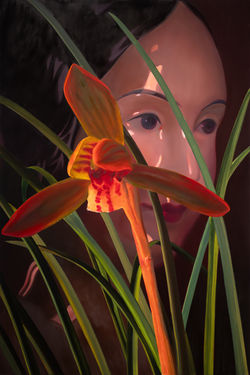 Orchid Hunter in the NightOil on canvas 145.5 × 97 cm 2026 |  Glazed LightOil on canvas 145.5 × 112.1 cm 2026 |
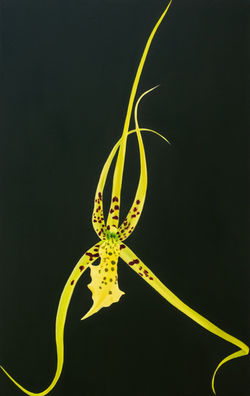 Spider Orchid with Dancing LinesOil on canvas 53 × 33.4 cm 2026 |  Stillness in the RedOil on canvas 227.3 × 181.8 cm 2026 |  The Deep Blue Glazed Vase - Bird FigurineOil on canvas 60.6 × 40.9 cm 2026 |
 The Orchids in the FrameOil on canvas 45.5 × 45.5 cm 2026 | 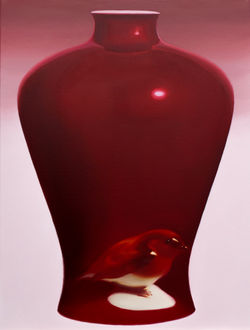 The Red Glazed Vase - Bird FigurineOil on canvas 60.6 × 45.5 cm 2026 |  The Orchids in the FrameOil on canvas 27.3 × 27.3 cm 2026 |
 The Red Glazed Vase - OchidOil on canvas 72.7 × 53 cm 2026 |  The Spider Orchids in the FrameOil on canvas 27.3 × 40.9 cm 2026 |  The Warm White Glazed VaseOil on canvas 60.6 × 40.9 cm 2026 |
 The Red Glazed VaseOil on canvas 72.7 × 53 cm 2026 |  Black Mirror - Shell PlateOil on canvas 130.3 × 130.3 cm 2026 |  Black MirrorOil on canvas 193.9 × 112.1 cm 2026 |
Artist

Jiwon Choi
Jiwon Choi (b.1996, Lives and works in Seoul, Republic of Korea) explores the gap between life and death, tracing interstitial spaces where the present and future intersect. She employs objects such as frames, doors, and blinds as symbolic portals, opening onto narrative fields where time, space, and memory accumulate. By incorporating remnants of life such as antique crafts and preserved insects, her work evokes a quiet persistence beyond vitality. Her recent practice centers on the theme of ‘Fever’, reflecting sensory thresholds shaped by shifts in temperature and their corresponding affective states, from numbness to heightened passion and immersion. Recurring motifs of orchids in varied colors and forms, once the subject of obsessive collection, function alongside porcelain dolls as devices that generate subtle visual tension.
Jiwon Choi holds a BFA and MFA in Painting from Ewha Women University. She has held solo shows at Tang Contemporary Art(Beijing, 2026), Kumho Museum of Art(Seoul, 2026), WESERHALLE(Berlin, 2025), PARKSEOBO FOUNDATION(Seoul, 2024), and ThisWeekendRoom(Seoul, 2023, 2020) and actively participated in various group shows in Korea, China, Germany, and Thailand including at Tang Contemporary Art(Beijing, 2024), Backstage(Shanghai, 2024), Seoul National University Museum of Art(Seoul, 2023), WESERHALLE(Berlin, 2023), Art Space Hohwa(Seoul, 2023), Daejeon Creative Center(Daejeon, 2023), Gyeonggi Museum of Modern Art(Ansan, 2022), Ilwoo Space(Seoul, 2022), and Seoul Arts Center Hangaram Design Museum(Seoul, 2021). Choi was a selected artist of Kumho Young Artist(2025), Kiaf HIGHLIGHTS Awards(2024), New Hero of Public Art Magazine(2022) and her works are included in the collection of Government Art Bank of MMCA(Korea), X Museum (China) PARKSEOBO FOUNDATION(Korea), Space K(Korea), and White Rabbit Gallery(Australia).