


Tang Contemporary Art is pleased to announce the presentation of Memory · Line - Yuan Yunsheng, 1978-1987, a solo exhibition by Yuan Yunsheng (1937–2026), opening on October 31, 2026, at 4 PM at its Beijing 2nd Space.
As the first retrospective exhibition of Yuan Yunsheng since his passing, the exhibition is curated by his son, Yuan Ye. Focusing on the artist’s works from 1978 to 1987, it brings together a selection of his line drawings, prints, ink and color paintings, oil paintings, sketches, and mixed-media works, tracing his artistic explorations across the distinct cultural contexts of China and the United States. The exhibition is both a revisiting of this formative decade in the artist’s practice and a process of rediscovery shaped by the perspective of a family member, grounded in artworks and personal memories. Through this interweaving of artistic legacy and intimate recollection, the exhibition invites viewers to encounter the enduring threads that run throughout Yuan Yunsheng’s artistic practice.
Memory · Line — Yuan Yunsheng, 1978–1987
Curatorial Essay by Yuan Ye
Since my father passed away, I have spent a great deal of time sorting through what he left behind. Ink line drawings (baimiao), Prints, Ink-and-color paintings, Oil paintings, Sketches, Written exchanges—stack after stack, spread across the room until there was barely any space left to stand. At first, I tried arranging everything chronologically, but soon realized that this simply wouldn't work, as the works had not come into being in chronological order.Some lines ran all the way from Yunnan to New York; others took a turn at the edge of a printmaker's blade; still others lay hidden beneath the brushstrokes of oil paintings, almost impossible to find unless you looked closely.
The exhibition is called Memory · Line. The two words simply came to me as I was sorting through his things. Remembering is what I am doing now; the line is what he had been working with all along. I cannot claim that these two words can sum him up, but at least they give me a way to keep talking about him.
My father, Yuan Yunsheng, has been discussed in many different ways. The most common account divides his career into two halves: first he painted Yunnan, then he turned to abstraction, with a dividing line called "going abroad" drawn between them. It is a convenient narrative, but the more I look at these works, the less convincing I find it. Before leaving for the United States in 1982, he had already traveled through northwestern China, written Return, O Soul, and produced a substantial body of ink line drawings in Xishuangbanna. He did not arrive in New York empty-handed, searching for a direction. He brought with him a way of seeing that had already become ingrained in his hand, and there it underwent a kind of stress test.
This exhibition, therefore, does not set out to tell another story of "stylistic transformation." I want to talk about the line. For him, line was never merely a matter of what appeared on paper. In Baimiao, once a brushstroke is made, it cannot be undone. In printmaking, once a cut is made, it cannot be undone. In oil painting, the line may not be visible on the surface at all. It may be concealed in the direction of a brushstroke, the boundary between colors, or a shift in structure. The handwritten characters in his written exchanges are lines too—the traces left behind by thought. Only by looking at these things together can we understand why, when he arrived in America and began working on such a large scale, with gestures of such speed, his hand still retained its power of judgment.
The exhibition begins before Yunnan, with just a small selection of earlier brush sketches and manuscripts. They establish one thing: line, as a means of understanding the world, was already present before Yunnan. Yunnan was not a sudden discovery, but rather the moment when a long-established line erupted with extraordinary intensity. From there, the exhibition moves to the Ink line drawings made in Xishuangbanna and Lincang, presented alongside prints and oil paintings. What I hope visitors will see is not simply "which ethnic groups he depicted," but how line itself performs the act of seeing—the center of gravity in a posture, the direction of a fold in clothing, the way a plant grows. He later described the use of empty space and deliberate omission in Baimiao as "pure drawing." This is an idea worth taking seriously. It pulls the Chinese tradition of line out of the category of "national form" and places it within the realm of how we perceive and understand form. The prints and oil paintings are not here as supporting material. They are here to demonstrate that this line can still hold its ground beyond paper.
The next section covers his years in America, focusing primarily on sketch-like works and mixed media, with only one or two large-scale pieces included to provide context. This is the period most easily interpreted as a "turn toward abstraction." I would rather ask the question in reverse: beneath those seemingly uncontrolled fields of ink, does the judgment cultivated through Baimiao—the conviction that once a stroke is made, it cannot be undone—still remain? Visitors can look for the answer themselves.
I want to emphasize this again: the central concern of his Baimiao was not the decorative representation of ethnic-minority customs, but the ability of line to capture form and growth. That is also why, in selecting works, I have favored structure and movement over festive scenes.
Memory · Line is not an attempt to prove that he was "deeply rooted in tradition." Roots cannot be established through declarations. They must be demonstrated through choices within the works themselves—choices that can be examined with one's own eyes. The decade from 1978 to 1987 happens to have left us enough evidence.
Since my father passed away, these works have become neither more significant nor any less weighty. They remain what they have always been. There are marks left by blades, traces of ink, revisions, hesitations, and things he had no time to explain at the moment his hand moved. What I can do is place them before viewers once more, and let the lines continue to speak.
If my father were still here, he would probably think I had said too much.
So I'll stop here.
Please take your time looking.
EXHIBITING WORKS
 BatherInk and color on paper 104 × 100 cm 1980 |  Dai WomanInk and color on paper 104 × 100 cm 1980 |  Dance IIICopperplate monotype 60 × 90 cm 1983 |
|---|---|---|
 MartyrInk on hemp fabric 198 × 188 cm 1981 |  Little Grove in front of A Red WallOil on canvas 58 × 69 cm 1973 |  LidaOil on canvas 168 × 132 cm 1985 |
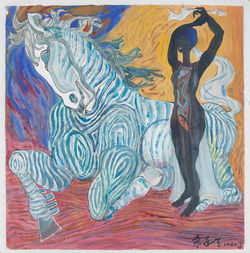 Girl and HorseInk and color on paper 105 × 105 cm 1980s | 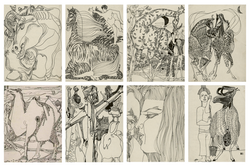 Love of the Moon Series IPaper sketch 30.5 × 19 cm × 8 1977 | 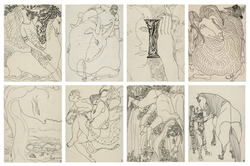 Love of the Moon Series IIPaper sketch 30.5 × 19 cm × 8 1977 |
 Rose-Tinted MelodyOil on canvas 200 × 190 cm 1981 |  Self-PortraitOil on canvas 168 × 92 cm 1980 |  Still LifeOil on canvas 58 × 68 cm 1972 |
 Song of the Heart IInk and color on paper 102 × 100 cm 1980 |  Song of the Heart IIInk and color on paper 102 × 100 cm 1980 |  Zhao Shutun SeriesPaper sketch 21 × 20.5 cm × 9 1978 |
Artist

Yuan Yunsheng
Yuan Yunsheng was born in Nantong, Jiangsu Province, 1937, died in Beijing, 2026. Studied under the famous artist Dong Xiwen, Yuan Yunsheng graduated in 1962 from the Oil Painting Department of the Central Academy of Fine Arts (CAFA). His early career was marked by political adversity. Labeled as a "Rightist" in 1957, he underwent re-education at Shuangqiao Farm. His graduation piece, Memories of the Water Village, sparked controversy for its modernist style. Subsequently, he was assigned to work for 18 years at the Workers' Cultural Palace in Changchun, Jilin Province.
During his sketching trip to Xishuangbanna, Yunnan in 1978, Yuan used “lines” as the most potent medium to capture the region's essence. For Yuan, line drawing was not merely observation but an act of liberating vital energy. "I prefer not to sketch preliminaries; I hold a blueprint in my mind and develop it as I draw. This is more meaningful because it is a test for myself." Yuan’s Yunnan Line Drawing Sketch Series garnered significant acclaim for its rhythmic and lyrical quality.
In 1979, Yuan participated in the creation of murals for the Beijing Capital Airport. His seminal work for this project, Water Splashing Festival – Ode to Life, ignited public debate because of its modern decorative style and depiction of nude figures. For Yuan, this was both an artistic expression and a challenge to prevailing conventions: "To depict a bathing scene, people cannot be clothed. More importantly, I believe the human body should not be taboo." The mural represented a radical departure from the dominant social realist idiom, marking a crucial step in Chinese artists' exploration of formal language and becoming a significant cultural event in the early years of China's reform era.
In 1980, Yuan joined the Mural Department at CAFA. He was invited to the United States in 1982, teaching at Harvard University and other institutions. From 1988, he settled in New York as a professional artist, engaging with figures like Willem de Kooning and Robert Rauschenberg. In 1996, he returned to China at the invitation of Jin Shangyi, assuming roles as Director of the Fourth Studio of the Oil Painting Department, Professor, and Doctoral Supervisor at CAFA. He later served as Vice Chairman of the CAFA Academic Committee and led the major national project "Reconstructing the Chinese Art Education System," for which he was honored as a "National Professor of Special Contribution."
Through his representative works like Transporting Grain (oil painting; CAFA Art Museum), Solitude (ink and color painting;Taikang Art Museum) and Struggle (Long Museum), Yunnan Line Drawing Sketch Series and Wordless Stele (Long Museum) , Yuan advocated for grounding art education in Chinese artistic heritage. He emphasized cultural confidence and transmission of indigenous aesthetics. Championing the ethos of "forging a Chinese path," Yuan Yunsheng dedicated his career to "pursuing the true spirit of national art". His exploration has significantly advanced dialogue between Chinese modern art and traditional aesthetics, establishing him as a representative of cultural confidence and artistic innovation.
Curator

Yuan Ye
Yuan Ye graduated from the High School Affiliated to the Central Academy of Fine Arts in 1988 and from the Third Studio of the Oil Painting Department at the Central Academy of Fine Arts in 1992. In 2003, he became the first recipient of a doctoral degree in Oil Painting from the Central Academy of Fine Arts. He is currently a faculty member of the Department of Mural Painting, School of Plastic Arts, at the Central Academy of Fine Arts, and serves as Executive Director of the Research Center for Traditional Chinese Plastic Arts.