

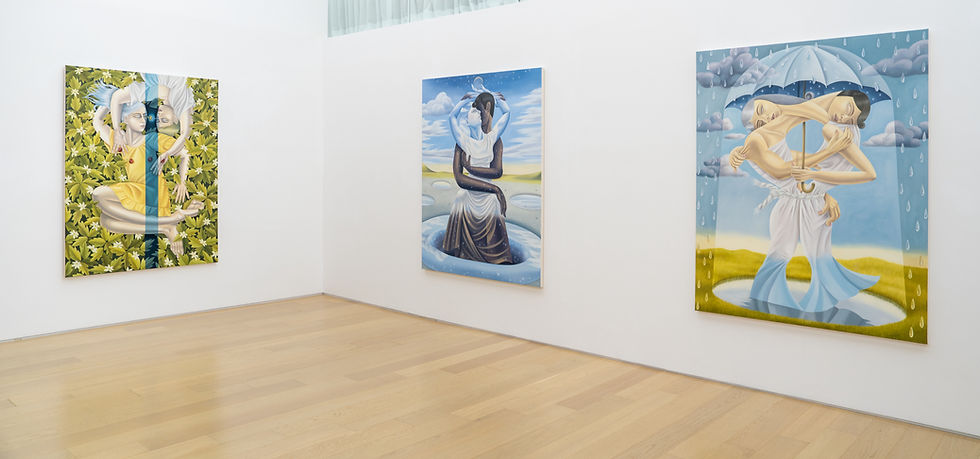

In the discourse of cultural studies, skin is not merely the biological envelope that individuates the body, but also a membranous interface mediating the inner and the outer, the self and the other. The exhibition takes as its point of departure the concept of the "skin-ego" (Le moi-peau) proposed by psychoanalyst Didier Anzieu—skin as "a primary datum which has elements of both the organic and the imaginary," and a psychic boundary. As human bodies begin to disperse in global migration, as technology reconfigures the senses, and as identity undergoes continual recoding, this protective, perceptive membrane becomes at once an information interface and a site of identity politics. Jade Ching-yuk Ng's surreal tableaux—hybrid assemblages of natural symbols, affective experiences, and sensory imagery—operate as alternative, multi-layered skins that overlay the surface of things, probing the tensions and vulnerabilities inherent in intimacy while allowing these very forces to grow autonomously.
Jade's narrative depictions of figures are shaped by distance, memory, and her experience of inhabiting multiple worlds at once. The geometry of Central Asian mosaic murals and the linear architectonics of modernist structures are transmuted, cut, and reconfigured into the body’s structures; the layered intersections of drapery folds accentuate boundaries with a romantic yet disciplined rhythm. The mural-like scale of her works bestows upon her soft yet resilient female figures an undeniable monumentality. Her palette of fatigued greys, earthy ochres, and pale blues renders everything sits in these soft transitions between fluid forms. Entwined, doubled, seemingly adrift in time and space, her figures become emblems of affective flux itself. The dialectic between exaggerated "presence" and tendency to "disappearance" provokes a destabilising uncertainty in the viewer.
At times, unsettling details emerge: broken cracks, oozing blood, burning lawns, and spilled ink. These volatile elements are inseparable from the artist's embodied experience of diaspora. Shifting between cultural territories and geographical coordinates, Jade's movement never quite settles into any singular belonging—it merely accumulates. How does the skin signify in an age when fluidity dissolves both geopolitical borders and subjective boundaries? On this question, Jade opens a wound: the body carries its own absence, and identity reverberates like a faint echo drifting slightly elsewhere. Skin is conceived as a risky boundary: an interface affording “inter-embodiment,” yet haunted by the risk of uninvited permeationn. Latent dangers intertwine with desire, like the dark side of the moon, metaphorising an invisible feminine force.
After the Enlightenment, the ascendancy of scientific method and the proliferation of visual technologies have elevated vision to a privileged position in the exploration and interpretation of the world, steering humanity into the "Hegemony of Vision". Touch, by contrast, has been tacitly relegated to the domain of instinct and desire. Jade's "Plural Skin" begins with touch—it is the body's foundational sense, the only sensory modality that always yields reciprocal feedback. In her works, whether fingertips graze reflections on water or palms trace the contours of another's face and body, the warmth and pressure thus evoked simultaneously awaken the viewer's sensory experience and construct the outer stratum of self-awareness. For Jade, humans yearn to be touched or to touch others—yet these contacts remain, ultimately, a fragile form of connection, perpetually suspended like the infinitesimal gap between the fingers of God and Adam in Michelangelo's Creation of Adam.
The eye is a recurrent, uncanny motif in Jade's pictorial world—and it occupies more than its proper place: eyes are embedded in spines, or straining to emerge from the crevices of split flesh. The artist connects this motif to the iconographic tradition of St.Lucy, patroness of the blind, whose emblematic attribute is a platter bearing her own excised eyes—externalized, rendered relic and testimony of faith. This dislocation induces discomfort in the viewer: when the organ of sight becomes the object of sight, when the act of "seeing" is excised from its subject and transplanted into alien contexts, the viewer is compelled to re-examine the very structure of looking. The artist's obsession with this iconography is also a sustained interrogation of the nature of vision: is sight, from the outset, bound to absence? How effortlessly does the gaze turn inward? The body becomes a peculiar mirror between desiring gaze and feminine self-scrutiny. Vision becomes a vortex, surging both inward and outward.
This sense of rupture extends to the landscape. Lakes as smooth as mirrors, fields stretching into emptiness—these vistas are serene and remote, yet so vast that the domestic no longer offers shelter. Nature becomes the carrier and symbol of emotion; landscape, an interior psychic terrain, collapses together with physical space. Tension finds its most potent expression in Fractured Skin—the upper and lower halves of the figure twist in opposite directions, where the perennial longing for intimacy begets an inescapable estrangement. The elongated torsos pushed beyond proportion derive from the artist's acute internal sensations of tension—sensations that seem never resolved. Fragmented corporeal flesh no longer encloses; it becomes an interface where inner and outer interpenetrate, where presence and absence transmute into one another. This bears an almost homologous duality with intimate relationships: intimacy is always interwoven with absence, and this indeterminacy yields its own profound anguish.
All this disquiet culminates in a tranquil eruption in The Rite of Spring: rose vines climb upward, almost engulfing the canvas, while bleeding eyes and blades hint at violence already enacted. In this excess of vitality, destruction and renewal seem to be one and the same gesture. In this sense, Jade's practice continually returns to Stravinsky's The Rite of Spring—where fragmentation does not signify an end, but rather a becoming.
When the skin of the flesh is opened, the paradox of eros is magnified again and again. Jade Ching-yuk Ng's paintings preserve an intimate, slow, and persistently unfolding sensory space, where the senses exist as an affective interface that can never be fully articulated. In the artist's own words: "the self is not something unified, but a plural terrain. It is shaped through touch and distance, memory and rupture—like a tear held together with stitches, or a coffee stain on a sketch you decide not to erase. It exists somewhere between visibility and disappearance. A body constantly shedding itself, trying to stay coherent without ever fully becoming one thing." The artist's refusal of resolution constitutes, in itself, a more honest articulation: in the face of the complexity and fluidity of contemporary embodied experience, the authentic response is not to fix it into determinate meaning, but to keep it in flux, to regenerate with each viewing.
EXHIBITING WORKS
 Jade Ching-yuk NgAfter Stillness Oil on canvas 210 x 240 cm 2025 |  Jade Ching-yuk NgAnatomy of an Interrupted Bed Oil on canvas 210 x 240 cm 2025 |  Jade Ching-yuk NgTwo Breaths Oil on canvas 210 x 240 cm 2025 |
|---|---|---|
 Jade Ching-yuk NgTracing Your Absence Oil on canvas 210 x 260 cm 2026 |  Jade Ching-yuk NgWhere Winter Meets Ocean Oil on canvas 210 x 260 cm 2025 |  Jade Ching-yuk NgEdge of Skies Oil on canvas 195 x 155 cm 2025 |
 Jade Ching-yuk NgTethered to Survive Oil on canvas 195 x 155 cm 2025 |  Jade Ching-yuk NgOrbiting Within Oil on canvas 195 x 150 cm 2025 |  Jade Ching-yuk NgThe Weight of Reflection Oil on canvas 182 x 137 cm 2025 |
 Jade Ching-yuk NgAfterimage Oil on canvas 182 x 137 cm 2025 |  Jade Ching-yuk NgThe Atlas of Your Body Oil on canvas 160 x 130 cm 2025 |  Jade Ching-yuk NgThe Gravity We Share Oil on canvas 165 x 130 cm 2026 |
 Jade Ching-yuk NgOde to a Silent Tide Oil on canvas 160 x 130 cm 2026 |  Jade Ching-yuk NgTwin Vessel Oil on canvas 160 x 130 cm 2026 |  Jade Ching-yuk NgThe Rite of Spring Oil on canvas 130 x 160 cm 2026 |
 Jade Ching-yuk NgUnbroken, Unwhole Oil on canvas 160 x 130 cm 2026 |  Jade Ching-yuk NgBlindspot Oil on canvas 80 x 60 cm 2024 |  Jade Ching-yuk NgThe Beast I Carry Quietly Oil on canvas 80 x 60 cm 2026 |
Artists
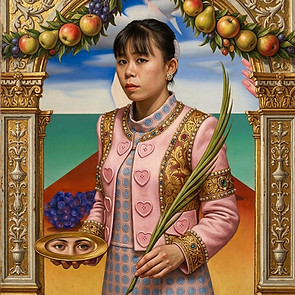
Jade Ching-yuk Ng
b. 1992
Jade Ching-yuk Ng was born in Hong Kong in 1992 and currently lives and works in London. She received her BA from the Slade School of Fine Art in 2016 and her MA from the Royal College of Art in 2018. She is the recipient of the Cass Art Painting Prize (2016) and the Travers Smith Art Award (2018), and was awarded the Abbey Major Painting Scholarship by the British School at Rome in 2018. In 2014, she worked at Bezalel Academy of Arts and Design in Jerusalem.
Jade Ching-yuk Ng explores the body as a fluid vessel of memory, intimacy, and transformation. Her work evokes layered experiences of presence and absence, tracing how identity is shaped through relationships, displacement, and acts of remembrance. Drawing on the emotional and psychological textures of diaspora, she reflects on what it means to inhabit multiple worlds at once — carrying traces of home, loss, and belonging across time and space. Fragmented yet interconnected, her double-exposed figures reveal the self as neither singular nor fixed, but continuously formed through movement, encounter, and shared histories.
Her recent solo exhibitions include: Echo of Silhouettes, Tang Contemporary Art, Beijing, 2024; Comfort in Discomfort, Ronchini, London, 2023; Gush, Tang Contemporary Art, Hong Kong, 2022; It’s (kind of) a Love Story, NatashaArselan Gallery, London, 2022; I is Another, Cornucopia Gallery, London, 2021.