


Modern society is marked by a curious paradox in which an overabundance of images gives rise to a loss of the real. In On Photography and Regarding the Pain of Others, Susan Sontag observed that the proliferation of images reshapes our understanding of the world, while repeated visual exposure dulls perception and introduces a subtle distance. Under the pressure of incessant stimuli, we are gradually repositioned as spectators, our capacity to attend closely to the essence of things diminished.
Against this accelerated condition, where images circulate lightly and vanish almost as soon as they appear, the exhibition turns towards those who seek to pause and recover the ‘aura’ of things. Walter Benjamin described aura as a rare and fleeting presence, something distant even at close range. It names a mode of experience that feels increasingly out of reach.
Melody Park, Goyoung, Vibeke Slyngstad, Ruo-Hsin Wu, Yasuhito Kawasaki and Yoshikatsu Ikeuchi work across distinct media and formal languages yet converge in their attention to what lies beneath the visible surface. Structured as a continuous movement rather than a fixed sequence, the exhibition unfolds as a gradual reawakening of sensory registers that have receded from view.
In the paintings of Melody Park and Goyoung, rhythm emerges not as a simple orchestration of colour, but as an immediate, perceptual encounter. Here one might recall Sontag’s call, in Against Interpretation, for an ‘erotics of art’ that resists reduction to meaning. Their fluid lines do not translate into information; instead, they register as intensities, reactivating a bodily mode of looking.
This energy gives way to the measured stillness of Vibeke Slyngstad. Her use of light operates with a quiet precision, reflecting a distinctly contemporary solitude. These works invite a slower form of attention, where light and shadow hold the transience of being in tension. What emerges is an experience in which memory seems to take on a spatial, almost architectural presence.
In Ruo-Hsin Wu’s practice, the fleeting image is reconfigured as something more enduring. Drawing on the notion of the transitional object, she reworks fragments of the everyday into forms that carry emotional weight. Beneath the surface of her dreamlike imagery lies a quieter unease, one that unsettles the polished surfaces we habitually consume and redirects attention towards the formative traces of memory.
With Yoshikatsu Ikeuchi, this enquiry turns inward. His paintings give form to sensations that precede language, to states that resist clear articulation. The expressions of his figures remain unresolved, holding together multiple emotional registers at once. Rather than offering explanation, they call for a mode of response grounded in perception, where meaning is felt before it is understood.
A related stillness appears in the sculptural works of Yasuhito Kawasaki. His figures seem withdrawn from the surrounding noise, inhabiting a concentrated state of solitude. Their restraint is not emptiness, but compression, as if emotion has been gathered to the point of near release. In encountering these faces, the act of looking becomes reciprocal, suggesting that the recognition of the other may also be a means of approaching the self.
Taken together, the exhibition proposes not so much a theme as a recalibration of attention. It invites a return to a way of looking beyond habit and immediacy. The intervals between works become part of this experience, allowing perception to settle and extend. What remains is not a fixed conclusion, but a lingering afterimage that continues to resonate beyond the space of the exhibition. Art may not alter the world directly, yet it can offer a site in which our relation to it is quietly, but fundamentally, reoriented.
EXHIBITING WORKS
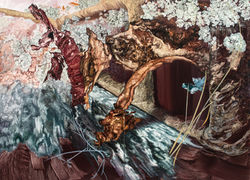 GoyoungThe Edge of the World Oil on canvas 162 x 224 cm 2025 |  GoyoungShell Within Oil on canvas 146 x 97cm 2026 |  GoyoungUnfolded Wings Oil on canvas 45 x 91 cm 2026 |
|---|---|---|
 GoyoungAn Unentered Depth Oil on canvas 91 x 91 cm 2026 |  GoyoungA Body Without a Center Oil on canvas 90 x 61 cm 2026 |  GoyoungRoots Flow Upward Oil on canvas 65 x 91 cm 2026 |
 Melody ParkA Journey That Never Arrived Oil on canvas 150 x 140 cm 2020 |  Melody ParkUntitled Oil on canvas 140 x 150 cm 2020 |  Ruo-Hsin WuShooting Star Acrylic on canvas 116 x 92 cm 2024 |
 Ruo-Hsin WuRibbon Acrylic on canvas 91 x 73 cm 2026 |  Ruo-Hsin WuNight Cruising Acrylic on canvas 100 x 80 cm 2024 |  Vibeke SlyngstadSkagerak 1 Oil on canvas 120 x 100 cm 2025 |
 Vibeke SlyngstadGingko Garden Oil on canvas 120 x 80 cm 2025 |  Yasuhito KawasakiBoy Straddling Elephant 2024-10 Ceramic 32 x 22 x 14 cm 2024 |  Yasuhito KawasakiAfternoon Acrylic on canvas 91 × 117 cm 2026 |
 Yasuhito KawasakiResting in the Tree Shade Acrylic on canvas 91 × 117 cm 2026 |  Yoshikatsu IkeuchiSignal of Us Oil on canvas 53 x 46 cm 2026 |  Yoshikatsu IkeuchiRemnant of light Oil on canvas 53 x 46 cm 2026 |
Artists

Goyoung
b. 2000, South Korea
Goyoung’s practice begins with the collection of image fragments that arise from unconscious association. Informed by pareidolia, she attends to fleeting, ambiguous forms encountered in everyday life, receiving them as cues rather than fixed representations. These fragments are not defined by resemblance alone but are shaped into roles, forming the basis of her visual language. Once removed from their original contexts, these elements are brought together within the canvas, where they connect, overlap, and subtly diverge. Figures, symbols, and partial forms interact to create shifting relationships that remain open rather than resolved. In this process, Goyoung focuses on the unexpected changes that occur as different parts come together, allowing meaning to shift and unfold. Her paintings do not follow a singular centre or a fixed narrative. Instead, they unfold as open scenes that continue to evolve. Meaning does not exist in advance but emerges
through the interaction of images. Moving between recognition and ambiguity, her work remains deliberately open-ended, inviting multiple interpretations shaped by perception and association.

Melody Park
b. 1987, South Korea
Melody Park’s work is grounded in the everyday sensations that emerge through the passage of time and subtle shifts in her surroundings. She explores experiences shaped by light, space, and seasonal change through colour, translating sensations that resist language into visual form. Treating colour as both material and sensory element, Park experiments with its texture and physical qualities, extending its expressive potential. Her practice invites a heightened awareness of perception, evoking sensory responses that are at once personal and difficult to define.
Melody Park (b. 1987) received a BA in Fine Art from Kingston University, UK, and an MA in Fine Art Drawing from Glasgow School of Art. Her solo exhibitions include Spring Snow to Summer Watermelon at Choi Jeong-ah Gallery, Seoul (2025), and Willow Charcoal Gray at Prompt Project x hpix, Seoul (2023). She has participated in group exhibitions including Incheon in Spring at Incheon Art Platform (2024), Quiet Noise at Fim (2024), and Turps Banana x PADA Residency 04 at Galeria PADA, Barreiro, Portugal (2022).

RUO-HSIN WU
b. 1993, Taipei
Ruo-Hsin Wu is a visual artist working in painting, drawing, and handmade animation. She majored in Animation at Taipei National University of the Arts, earning a Bachelor of Fine Arts degree, and subsequently pursued a Master of Arts degree in Illustration at Royal College of Art in the United Kingdom. Her visual style is dreamy yet bittersweet, fluctuating between innocence and grotesque imagery. The childlike appearance of her work often conceals uncomfortable emotions and latent threats. Through narrative image-making, Ruo explores the relationship between humans, nature, and other species. Reflecting on her experience, she notes, “Nature is the crossroad of personal and collective memory. Upon moving to London, nature provided me with a sense of intimacy and familiarity.” Ruo-Hsin Wu’s works often unfold against dark or white backgrounds. To convey the complexity of inner emotions, she employs the softness of charcoal, the depth of paint, and the delicacy of pencil, utilizing different mediums to express the diverse textures of the inner world. In her 2022 solo exhibition Sunlight, Air, and Water, she presented a series of acrylic paintings exploring moments from childhood that continued to shape her into adulthood. She connects her creative motivation with the psychological concept of “transitional objects” — soft, comforting items that provide emotional security to infants in unfamiliar environments — much like the way the artist projects her feelings onto each work in order to adapt to changing realities and mental states.
Ruo-Hsin Wu has participated in numerous exhibitions worldwide, including Gentle Like Water at ELI ERE (South Korea, 2024) and Yesterday, Today, and Tomorrow at Vlab Gallery (Spain, 2023).
Vibeke Slyngstad
b. 1968, Ålesund, Norway
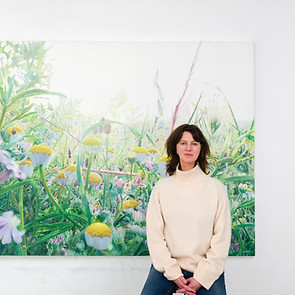
Vibeke Slyngstad grew up on the west coast of Norway, surrounded by the rugged seascape of the fjords and the Atlantic Ocean. She graduated from Oslo Academy of Fine Art in 1994, after completing film studies in Norway and art studies in Graz, Austria. Vibeke Slyngstad’s practice is centered on figurative painting, often focusing on vulnerable landscapes, whether politically contested territories or endangered natural environments. She works at a slow, meditative pace, rendering each image with a single layer of paint so that the finished surface attains a delicate, almost translucent quality that reflects broader notions of liminality. Although her compositions are inspired by photographs from real-life encounters with nature, the vivid hues and magnified perspectives of plants set against blank white skies evoke a heightened, dreamlike state rather than a specific geographical location. Slyngstad also engages with materiality to create a shifting sense of perception, as though moving in and out of consciousness. From a distance, the precise details, intense bursts of light, and contrasts between sharpened and blurred edges — reminiscent of the flash and zoom of a camera — produce a striking impression of photorealism. Upon closer viewing, however, the artist’s hand becomes visible through fine irregular brushstrokes and subtle imperfections where colour bleeds beyond the lines or paint softly smudges. As the artist states, “It is very important to me that the works have a humanity and honesty about them. The viewer is able to see every mark.”
Vibeke Slyngstad has exhibited extensively at Scandinavian and international institutions, including the British Museum, London (2025); Henie Onstad Art Center (2025); Made in Cloister, Naples (2022); Bocconi University, Milan (2018); Fondazione Stelline, Milan (2017); and the National Museum of Contemporary Art, Oslo (2013). In 2009, she participated in the 53rd International Art Exhibition of the Venice Biennale at the Nordic Pavilion, curated by Elmgreen & Dragset.

Yasuhito Kawasaki
b. 1983, Saga Prefecture, Japan
Yasuhito Kawasaki currently creates his works in a studio in Takeo City, Saga Prefecture, Japan. In 2010, he earned a Master’s degree in Casting from Kanazawa Art University in Ishikawa, Japan. From 2010 to 2013, he worked at a casting company, where he had the opportunity to assist in the production of artworks by Yoshitomo Nara and Takashi Murakami, experiences that significantly influenced his artistic development. Yasuhito Kawasaki became independent in 2013. His practice initially focused on self-portraiture using FRP. In 2018, after meeting his wife, a ceramic artist, he began expanding his practice into ceramics while also developing painting-based works. During the coronavirus pandemic, however, the subject matter of his works shifted toward themes of “closed spaces and the inner world.” Working in a narrative style reminiscent of illustrated book pages, Kawasaki constructs stories drawn from reflections on family, his surroundings, and his inner self while experiencing a sense of isolation from the outside world. Mythology frequently serves as a source of inspiration in his work, with the “Apple” from the story of Adam and Eve appearing as a recurring motif throughout his practice.
Yasuhito Kawasaki has participated in numerous international exhibitions, including Apple at Secret Fresh Gallery (Philippines, 2024); On the Table at Soft Corner Art (South Korea, 2023); Hello Bearchan!! at Thinkspace (USA, 2023); and Continuous at Touch Ceramics Gallery (Hong Kong, 2021).

Yoshikatsu Ikeuchi
b. 1993, Kyoto, Japan
Born in Kyoto, Mio Yashiro Ikeuchi began teaching himself composition and painting from an early age, deeply influenced by his parents. During his high school years, he started releasing original music online, marking the beginning of his dedicated career in music production. In 2016, Mio Yashiro Ikeuchi collaborated with Ryuichi Sakamoto to compose the score for the film Rage, which subsequently received the Outstanding Picture Award at the 40th Japan Academy Film Prize. In 2023, Ikeuchi’s dedication to his Kyoto heritage was formally recognised through his appointment as a Cultural and Tourism Ambassador for Kyoto Prefecture. In the same year, he composed a commemorative work celebrating the relocation of the Agency for Cultural Affairs to Kyoto.
By 2025, Mio Yashiro Ikeuchi further expanded his creative practice into the field of fine art, holding his inaugural solo exhibition of oil paintings at the Kyoto National Museum.