
GROUP EXHIBITION
Radiant Phases
Artists: Guan Yinfu, Guo Yuheng, He An, He Chi, Huang Yongping, Leng Guangmin, Li Qing, Lin Minghong, Liu Jianhua, Liu Qinghe, Liu Yujia, Lu Hao, Mao Xuhui, Ming Ying, Shen Yuan, Sun Yu, Wang Sishun, Xiyao Wang, Weng Fen, Xiang Jing, Xu Qu, Xue Feng, Yan Jingzhou, Yan Lei, Yang Jiechang, You Jin, Yue Minjun, Zhao Bandi, Zhang Hui, Zhao Peizhi, Zhao Zhao
Beijing 2nd Space
2026.5.20 - 2026.6.25
Curated by Sherry Wang


Tang Contemporary Art is pleased to announce the group exhibition Radiant Phases, featuring Chinese artists, opening on May 20, 2026 at 4:00 PM at its Beijing 2nd Space in 798 Art District. The exhibition is curated by Sherry Wang.
"Phase," in physics, describes the state of a wave—the instantaneous position of energy within time, and the dynamic relations generated through cycles, oscillations, and shifts. Transposed into the context of contemporary art, the concept suggests how different historical experiences, forms of knowledge, and ways of seeing can overlap and resonate with one another. This exhibition brings together more than thirty Chinese artists born between the 1950s and the 2000s, treating each generation as a distinct wave in a continuous spectrum. The artists rise and fall through shifting social contexts, cultural experiences, and changes in medium, each forming their own "phase structure."
Artists born in the 1950s grew up during a period of radical social change. Their work carries a broad historical vision and a deep concern for the human condition. Huang Yong Ping's two early paintings from the 1980s show a dual inquiry into form and concept, while the installations Deer and Crane continue his long-running questioning of cultural symbols, life and death, and cyclical time. Mao Xuhui's "Patriarch" series constructs an oppressive yet absurd metaphor of power through recurring images of high-backed chairs and dark frames, pointing to family ethics and social structure. Yang Jiechang's Underground Flowers, composed of blue-and-white porcelain and ebony, explores the idea of spirit outlasting death. Shen Yuan's The History of Nanling turns to the women and local memories of Guangdong's Nanling region, embedding intimate stories within larger geopolitical shifts. With a cool, penetrating gaze, this generation laid the groundwork—critical and intellectual—for those that followed.
Artists born in the 1960s came of age during Reform and Opening-Up and the advance of globalization. They kept one eye on social realities while experimenting with new media and a more personal point of view. Liu Qinghe's ink paintings capture the emotional states of ordinary people through loose, relaxed brushwork. Weng Fen's installation, made from various eggshells arranged in the shape of bird nests, extends his satirical commentary on urbanization and the fragility of modern life. Liu Jianhua's Can You Tell Me? consists of fifty stainless-steel books engraved with one hundred imagined questions, inviting viewers into a space of shared speculation. Yue Minjun presents both his iconic "laughing face" imagery and the transitional abstract work Dragon's Memorial Tower, in which seal-script calligraphy is broken down into colored planes and geometric rhythms, letting traditional cultural symbols regain visual force through abstraction. Zhao Bandi's Blue Game merges his distinctive "Panda Man" figure with the language of fashion, producing a form of art that intervenes in society with irony and political bite. Xiang Jing's sculpture Wine preserves the vulnerability and physical presence of the female body through a subtle tension between realism and slight distortion. Lu Hao's Flowers, Birds, Insects and Fish - Insectpot—a signature work—combines plexiglass, oil on canvas, and manuscript to make familiar architecture strange, weaving historical and urban memory into a hybrid visual field. Yan Lei's Eternal Value, a painting project developed with a commercial brand, sets floating crystals against leopard print, capturing the uneasy alliance between art and consumer culture with a wry, detached humor. Zhang Hui's recent Untitled works depict everyday objects and bodily gestures, injecting a sense of theatrical estrangement into otherwise ordinary scenes. Lin Minghong continues his signature "fabric-pattern aesthetics," using traditional decorative motifs to suggest an absent yet inhabitable imaginary space. This generation of artists has begun to drive Chinese contemporary art to shift from grand narratives to complex realities.
Artists born in the 1970s witnessed the full expansion of China's art market and its entry onto the international stage, and they focused on forging a visual language unmistakably their own. He An's circular illuminated installations use ambiguous titles and LED lighting to evoke the emotional texture of urban life. Zhao Peizhi's two works return to a raw, childlike vitality through intense color and rough form, exploring the landscapes of Northwest China and an inner wellspring of life force. Xue Feng builds visual bridges between abstract landscape and political geography, with layered color suggesting tectonic shifts beneath the surface. Guan Yinfu's layered acrylic on wooden panels produces relief-like color fields where material weight and chromatic intensity meet. He Chi's "Pearl" installation examines the tension between value, weight, and surface. Xu Qu's two works from the Maze series use geometric illusion and carefully calibrated color—powder green-blue and grey-pink—to create perceptual traps; the central axis is dismantled into a vantage point that hints at authoritarian oversight, amounting to a meditation on the nature of painting itself. Wang Sishun's Apocalypse 18.11.21, resembling an extraterrestrial meteorite, creates a sense of suspended time that points toward transcendence and revelation. You Jin's violently intertwined colors and lines cross the unstable boundary between consciousness and reality. These artists form the densest concentration of "phase" in the exhibition.
Artists born in the 1980s are preoccupied with visual culture, spatial politics, and a fresh round of experimentation in painting. Li Qing combines antique wooden windows, oil paint, acrylic, and wood panels into collage-like assemblages that merge architectural fragments with painting, probing how memory and perception fracture. Liu Yujia's The Koh Larn Island uses a poetic cinematic language to record the fluid interplay between place and feeling, continuing her ethnographic approach to film. Zhao Zhao's monumental oil painting Constellations assembles a sweeping galaxy through the collision of romance and violence, while the companion piece Chinese Ladders, carved from traditional white marble, renders the ladder as abstract form, creating a tension between material tradition and conceptual intent. Leng Guangmin's paintings render transparency, reflection, and fracture through depictions of glass, producing pictorial spaces that appear infinitely folded. Sun Yu presents symbolic forms reminiscent of children's games, within which cultural memory and more elusive structures of desire and choice are tucked away. This generation charts new territory between globalization and local identity, their work reflecting how our very ways of seeing have changed in an image-saturated age.
Artists born in the 1990s grew up in a world thoroughly shaped by the internet, consumer culture, and virtual experience. Their work draws on personal life and popular imagery with a directness rarely seen before. Wang Xiyao constructs pictorial structures through charcoal and gestural traces that resemble the trajectories of bodily movement, foregrounding the relationships among action, speed, and space. Ming Ying captures fleeting moments and sensations of dissolution through densely saturated color, digging into desire and the gaze beneath the visible surface. Yan Jingzhou employs coarse brushwork and ironic titles to channel the defiance of youth subculture. The post-2000 artist Guo Yuheng assembles kaleidoscopic clusters of densely layered imagery that evoke the spectacle of virtual idols and digital carnival. Their work operates like rapidly flickering high-frequency signals: each at its own phase, yet each glowing with a light particular to its moment.
From Huang Yong Ping's civilizational allegories to Guo Yuheng's digital spectacles; from Mao Xuhui's spiritual metaphors of power to Wang Xiyao's immediate records of bodily experience, the artists in this exhibition do not form a linear story of progress. Rather, they create intersecting frequencies within time itself. Each artist is an independent wavelength; each work, a distinct pulse of energy. Chinese contemporary art has never been a single line moving forward. It is an archipelago in constant formation—tides rolling in, waves crossing, light scattering across the water.
EXHIBITING WORKS
 Pearl 37.4He Chi River stone 39 × 83 × 64 cm 2014 |  Eleven LayersGuan Yinfu Acrylic on wooden board 240 × 200 × 7 cm 2025 |  CraneHuang Yongping Animal specimens, earthen jar 70 × 70 × 155 cm 2014 |
|---|---|---|
 DeerHuang Yongping Animal specimens, earthen jar 70 × 70 × 155 cm 2014 |  GalssLeng Guangmin Mixed media on canvas 235 × 185 cm 2026 |  UntitledHuang Yongping Acrylic on canvas 88 × 70 cm 1983 |
 UntitledHuang Yongping Oil on canvas 76 × 80 cm 1983 |  Noguchi's LightLi Qing Oil paint, acrylic, panel, canvas 71.5 × 59.5 × 2.5 cm 2025 |  Vacant Seat No.2Lin Minghong Acrylic on canvas 200 × 400 cm 2013 |
 Beautiful World - Bird NestWeng Fen Egg shell, glass, glass glue 189 × 169 × 44 cm 2006-2007 |  FingerSun Yu Oil on canvas 130 × 120 cm 2026 |  A Day on the Drifting Island No.1Wang Xiyao Oil stick, charcoal on canvas 250 × 450 cm 2025 |
 Maze-Central Axis Soft Green BlueXu Qu Acrylic on canvas 198 × 148 cm 2022 |  Club of the FallenYan Jingzhou Acrylic on canvas, oil pastel 213.5 × 305 cm 2024 |  Uunderground flowers (porcelaine)Yang Jiechang Blue-white porcelain, black sandal wood boxes and pedestal Work 50 × 50 × 6 cm × 6; Case 100 × 150 × 40 cm 2004-2009 |
 Eternal value - All that I see, and That I hear I wantYan Lei Mixed media on canvas φ 178 cm 2011 |  Entering the Realm on a BoatYou Jin Oil on canvas 240 × 540 cm 2017 |  A Sugar-Coated TaleMing Ying Oil on canvas 150 × 200 cm 2025 |
 Untitled · FlurryZhang Hui Acrylic on canvas 216 × 97 cm 2025 |  FloatYue Minjun Oil on canvas 250 × 200 cm 2025 |  Blue GameZhao Bandi Oil on canvas 220 × 170 cm 2022 |
 ConstellationsZhao Zhao Oil on canvas 300 × 1200 cm 2021 | 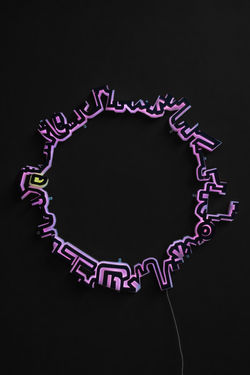 A mole on the nose and another on the breastHe An Neon light and acrylic light box sculpture φ 150 cm 2014 |