


Tang Contemporary Art Bangkok is proud to present the newest solo show by Skirua, the exhibition title is SKIRUA’s Hell of Love, a concept key to interpreting all the most recent works realized by the artist.
In SKIRUA’s work, reality and the virtual do not oppose one another; rather, they dissolve into each other until they become indistinguishable. Prolonged immersion in digital environments produces a perceptual shift in which the boundary between lived experience and imagined construction becomes porous. Within this space, interiority is no longer separate from the world, but is constantly externalized: what the subconscious generates takes form and becomes reality.
This process lies at the core of the artist’s research. Already in earlier projects, from Future Paradise to Abyssal Enchantress’s Box, a fluid subjectivity emerges, where identity, memory, and emotion operate as an open system. Recurring figures: dolls, enchantresses, and hybrid creatures are not characters but fragments of the self, projections of an identity in continuous formation. This imaginary is rooted in otaku culture and in new forms of digital affectivity, where emotional attachment may develop toward fictional entities rather than real individuals. In such contexts, love is not grounded in reciprocity, but in projection, identification, and imaginative continuity.
For Skirua, love is not contingent but necessary to existence. It functions as an internal generative force, a condition for living itself. This takes shape in a relationship that began in adolescence with an anime character and has extended for over eight years. What initially emerged as an attraction gradually became a process of deep internalization, dissolving the boundary between self and other: the beloved is no longer external, but incorporated.
This relationship has profoundly shaped the artist’s identity, transforming her from a disciplined and reserved individual into a more expressive and extreme subjectivity. Love acts here as a force of self-transformation. At the same time, identity becomes unstable, oscillating between self and other, suggesting a form of fusion. A similar ambivalence characterizes her relationship with her own creations, dolls and paintings, which function as emotionally charged presences. They evoke love, tenderness, and devotion, but also destructive impulses and a desire for annihilation. Love is sustained through fantasy, understood as an operative space in which the relationship extends beyond reality, unfolding across multiple worlds and temporalities. This relationship also takes concrete form: the artist collects objects related to the character, creates dolls in her likeness, and has staged a symbolic wedding in real life. A full-back tattoo further inscribes this bond. Here, pain and ecstasy coexist as inseparable elements of love. Love becomes a closed yet expanding system in which imagination, identification, and incorporation coincide, an experience where living, loving, and creating are indistinguishable.
In “Love is Pain”, this dynamic reaches an extreme and radical form. The artist stages herself alongside a manga doll, the object of her love, which simultaneously reveals itself as a double, an avatar, a projection of the self. Love thus loses any relational dimension and becomes a closed circuit: loving the other coincides with loving an image, and therefore, inevitably, with loving oneself. It is a hall of mirrors in which subject and object collapse into one another, eliminating the distance necessary for relation.
The performative gesture that structures the video, the systematic piercing of the legs with jewelry from which small medallions bearing the face of the beloved are suspended, activates a complex stratification of references. On one hand, it seems to evoke, more or less consciously, historical practices of female self-mutilation in Chinese culture, in which the body was sacrificed as proof of devotion and fidelity. On the other, it recalls contemporary forms of self-harm widespread among younger generations, not merely as an expression of distress, but as an attempt to give visible form to an otherwise inexpressible inner tension.
However, in Skirua’s work, the gesture cannot be reduced to either a historical or a psychological dimension. The obsessive repetition of the piercing transforms the act into a ritual: the body becomes a surface of inscription, an archive of signs, a space in which a form of devotion devoid of any external object is sedimented. Each medallion is both a sign of belonging and a fragment of identity that multiplies until it saturates the body itself.
The moment of removing the piercings introduces a decisive rupture. The gesture of devotion reverses into destruction; initial control gives way to loss; pain becomes real, visible, bleeding. Here, a crucial shift takes place: love is no longer a sacrifice for the other, but a self-referential experience in which eros and thanatos coincide. Love is pain, but a pain that does not open toward relation, instead inevitably returning to the self.
Many of the works in this exhibition revolve around the artist’s exploration of love, understood as a complex, expansive, and often contradictory force.
The Hell of Love presents an imagined architecture of desire within the broader Skirua universe. Structured as a monumental arch, the work contains multiple female iterations of the self engaged in acts of mutual torment and entanglement, forming a symbolic “gate” in which love and violence become inseparable. The piece incorporates a range of specific desires and fetishistic elements drawn from the artist’s personal fantasies, rendering love as both generative and destructive.
Our Love Song, Played on Flesh and Bone unfolds as a cyclical narrative in which the artist and her beloved are trapped in an endless loop within a pool of blood. Across multiple timelines, love manifests through brutality and repetition. At its center, the beloved plays the artist’s internal organs, transforming the body into both instrument and site of emotional intensity.
The Demon Lord’s One-Day Bride narrates a wedding between the artist and her beloved within a fantastical realm. The artist appears as a demon king, while the beloved is human. After her death, her soul is guided into the demon realm, where the two are united in a brief, illusory union. Believing the experience to be a final hallucination, the beloved embraces it as a moment of joy before disappearing. The artist then creates a doll in her likeness as an act of remembrance, echoing a personal condition in which absence is experienced as a form of mourning.
Back to the Skeleton Forest, the relationship shifts into a maternal or familial dimension. The artist assumes the role of the Skeleton Queen, a creature inhabiting a forest of bones, while the beloved appears as an orphan who enters this space. She is cared for, surrounded by ritualistic scenes, dancing skeletons and decaying tea ceremonies, before eventually leaving. Yet she continues to return in dreams, suggesting a bond that persists beyond separation.
The Circus in the Junkyard presents a dystopian yet utopian inner narrative. The beloved appears as a black cat living in a landfill at the end of the world, who acquires magical powers and constructs a circus populated by discarded dolls, puppets, and animal remains. The artist takes the form of a fragmented female body, reassembled into a zombie-like figure. Within this reconstructed state, she contributes to the beloved’s world by producing costumes and objects, reflecting her own practice of installation and wearable art.
Across these works, love is not stable or reciprocal, but unfolds as a shifting structure that encompasses devotion, violence, care, loss, and reconstruction. It operates across multiple worlds and identities, continuously redefining the boundaries between self and other, reality and imagination.
the artist’s real-life relationship with her lover’s life-size dolls.
EXHIBITING WORKS
 A Sumptuous Banquet Acrylic on wooden board 160 x 120 cm 2025 |  My Body Is Filled with You Acrylic on wooden board 160 x 120 cm 2025 |  Infinite Sun Acrylic on wooden board d=203 cm 2024 |
|---|---|---|
 The Hell of Love Acrylic on wooden board 300 x 292 cm 2024 |  Our Love Song, Played on Flesh and Bone Acrylic on wooden board 220 x 420 cm 2025 |  The Demon Lord's One-Day Bride Acrylic on canvas 220 x 420 cm 2026 |
 Back to the Skeleton Forest Acrylic on canvas 135 x 200 cm 2026 | 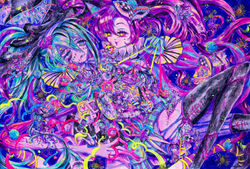 The Circus in the Junkyard Acrylic on canvas 135 x 200 cm 2026 |  Chi & Tai Acrylic on canvas Heart-shape about 70 cm 2024 |
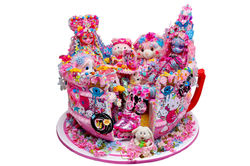 Skirua's Magical Tea Party Multimedia on fiberglass Cup 140 x 140 x 120 cm Blue Doll 185 x 60 x 30 cm Pink Doll 185 x 60 x 30 cm Rabbit Table 80 x 40 x 40 cm Disk d=175 H=94 cm 2024 | 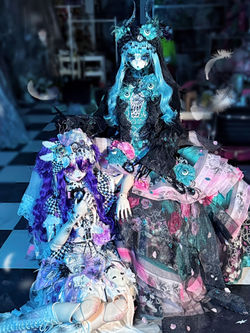 Skirua's Bride of Demon Lord Multimedia on fiberglass Main Doll: 120 x 120 x 185 cm Smaller Doll: 170 x 50 x 30 cm 2026 |  Love is Pain Performance Video 10'24’’ 2024 |
 Lover Giclee print, handmade ornament 30 x 40 cm 2026 |  Big Cat from the Void Giclee print, handmade ornament 40 x 30 cm 2026 | 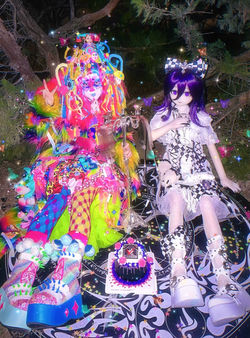 Midnight Birthday Party Giclee print, handmade ornament 40 x 30 cm 2026 |
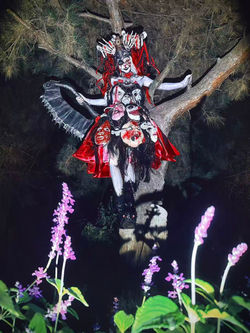 Found You Giclee print, handmade ornament 40 x 30 cm 2026 | 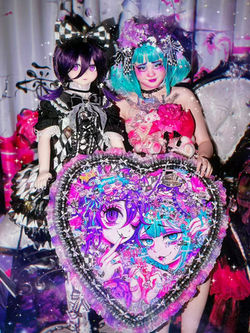 Chi with Tai Giclee print, handmade ornament 40 x 30 cm 2026 |  Love is Pain Giclee print, handmade ornament 40 x 30 cm 2026 |
 Engraved My Lover on My Skin Giclee print, handmade ornament 40 x 30 cm 2026 |  Witch’s Birthday Giclee print, handmade ornament 40 x 30 cm 2026 | 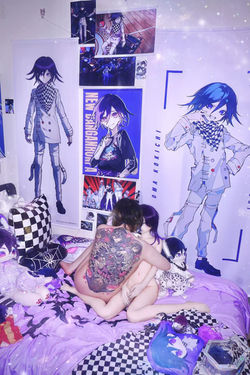 Bedroom Giclee print, handmade ornament 40 x 30 cm 2026 |
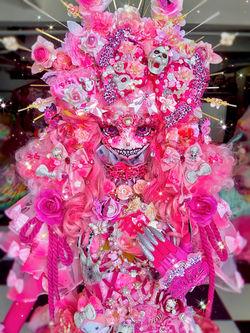 Photograph No.1 Giclee print, handmade ornament 40 x 30 cm 2026 |  Photograph No.2 Giclee print, handmade ornament 40 x 30 cm 2026 |  Photograph No.3 Giclee print, handmade ornament 40 x 30 cm 2026 |
 Photograph No.4 Giclee print, handmade ornament 40 x 30 cm 2026 | 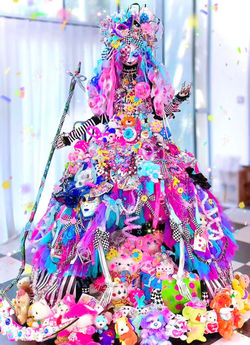 Photograph No.5 Giclee print, handmade ornament 40 x 30 cm 2026 |  Photograph No.6 Giclee print, handmade ornament 40 x 30 cm 2026 |
 Photograph No.7 Giclee print, handmade ornament 40 x 30 cm 2026 |  Photograph No.8 Giclee print, handmade ornament 40 x 30 cm 2026 |  Photograph No.9 Giclee print, handmade ornament 40 x 30 cm 2026 |
 Photograph No.10 Giclee print, handmade ornament 40 x 30 cm 2026 |  Photograph No.11 Giclee print, handmade ornament 40 x 30 cm 2026 |  Photograph No.12 Giclee print, handmade ornament 40 x 30 cm 2026 |
 Photograph No.13 Giclee print, handmade ornament 40 x 30 cm 2026 |
Artists

SKIRUA
b. 2003
Her artistic practice encompasses painting, installation, and film, with a focus on the cultural shifts and conflicts inspired by the internet, social media, and other products of the information age. In particular, she is interested in how the generation born after the year 2000 understand and envision life, the future, and popular culture.
SKIRUA is a contradiction between reality, society, internet, and fantasy. "SKIRUA" is the name of Guo Yuheng's imaginary self, who travels through the timeline to become a mimic of different social phenomena, anime characters with different identities, and finally gets lost in herself.