


In Transmutations in the Image Labyrinth, how to move from capturing images to breaking the mold is the challenge facing these four artists. Contemporary art is fundamentally rooted in problem-posing. In their early careers, they all used painting to raise questions, thereby developing a multidimensional and all-encompassing capacity for perception and social empathy.
Chen Shaoxiong’s consistent focus on the city and his sense of humor run throughout his work. Since the Dawei Xiang period, his practice has been profoundly shaped by the rapid pace and constant changes of urban development. At the same time, he engages with this issue through different artistic media, approaching painting, photography, video, and installation with an almost equal passion. Centered on a rewritten natural language, and in an era of overproduction of images and materials, his creation no longer points toward endless generation. It turns instead toward the redistribution and reactivation of existing resources. In this sense, painting, photography, video, and installation are placed on equal terms.
In Chen Shaoxiong’s two striking works, Collective Memory: Centre Pompidou-Metz and Collective Memory: Nanjing Presidential Palace, the artist invites the public to participate in creating images of the city through their fingerprints. Through this direct physical contact, urban memories are preserved again, and public participation becomes a way of evoking collective memory.
Similarly employing ink as an artistic language, Cai Guangbin demonstrates an extraordinary resolve in his departure from conventional imagery. From the images on mobile phone screens in his earlier practice to his current series Void Realm · 2025 · Reminiscing Bada Shanren, Cai continues to compress and flatten the image. Bada Shanren, as a Ming loyalist, remained dissatisfied and indignant toward Qing rule, and his “white eyes” represented a silent contempt for the murky currents of the secular world and the politics of power. A solitary fish swims through the void, its eyes turned askew in a sidelong glance. The fish becomes an embodiment of the self-spirit.
Zen Buddhism emphasizes the non-duality of form and emptiness, while Cai Guangbin’s reinterpretation of this traditional cultural symbol compresses and flattens the image into a monument. Tradition is ironed flat into speechless specimens. The artist has moved from a rebel against contemporary society to a metaphorical interpreter of Chinese traditional culture. The images once unfolding through faint and flickering ink washes have become more distilled. These secretive and voiceless images hover in an instant. The deeper we move into our own culture, the broader our reach into the world becomes.
Mao Xuhui participated in the 1985 Art Movement in his early years with his incisive scissors imagery. His work has consistently resonated with the transformations of Chinese society. The critical symbols of power structures, once embodied in the sharpness of scissors and chairs, gradually shifted toward the warmth of sketching on Guishan Mountain, and more recently, toward the Clues series, which captures glimpses of old city streets. The artist has completed visual transmutation again and again, moving from Guishan to Kunming, over a hundred kilometers away.
The unadorned stillness of this remote corner of Southwest China strikes the viewer with a deafening intensity. This comes from the long-term resonance between the grand sweep of the era and the intimate depths of the heart. Returning to simplicity, the artist perceives through bodily observation a more boundless expanse of fields and mountains. Centered on the purest gestural brushwork, images of memory appear by chance, entering the work like a fleeting glimpse. Mao Xuhui has found the eternity of Guishan. This permanence differs from Cézanne’s structured Mont Sainte-Victoire. It contains instead a mysterious poetic quality.
While continuing to use the smiling face symbol, Yue Minjun incorporates elements of parody, with flowers serving as the blade that deconstructs the original image. Behind the inevitability of creating the “Flowers” series lies the close connection between this symbol and everyday life. When a single flower fills the entire canvas, we can only perceive its beauty; yet the visual irony of these exaggerated grins remains potent in our era. Even as the artist’s own face ages and sags, these grins never show a single wrinkle. Aging is never a human flaw; it is a compromise made by genes for the optimal allocation of resources. Laughter is etched into our genes; it embodies joy and contentment, yet it can also be greed and mania. Yue Minjun says that because we do not know what happiness is, nor how to pursue it, in fact, everything is a state of bewilderment. If escape itself is a tedious act, and if the locks of the labyrinth of images have long been unlocked, then the labyrinth becomes a square with nowhere to hide, and those moments of enjoyment and recognition are about to become flaws exposed to the light of day.
EXHIBITING WORKS
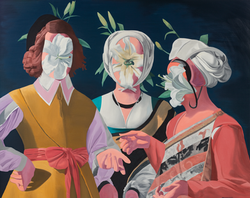 Yue MinjunLilium Oil on canvas 200 x 250 cm 2021 |  Yue MinjunStamen or Pistil Oil on canvas 120 x 100 cm 2020 |  Yue MinjunSelf-Portrait Oil on canvas 91.5 x 61.5 cm 2014 |
|---|---|---|
 Yue MinjunStill Alive Acrylic on canvas 130 x 110 cm 2024 |  Yue MinjunBlue Chair Oil on canvas 248 x 200 cm 2015 |  Yue MinjunHibiscus Oil on canvas 160 x 140 cm 2022 |
 Yue MinjunSea Oil on canvas 230 x 200 cm 2011 |  Yue MinjunDahlia Oil on canvas 120 x 100 cm 2020 |  Yue MinjunThe Red PVC Pipe Acrylic on canvas 250 × 200 cm 2023 |
 Chen ShaoxiongCollective memory -New Museum of Contemporary Art Chinese ink on canvas 160 x 261 cm 2016 |  Chen ShaoxiongCollective memory -Centre Pompidou-Metz Chinese ink on canvas 160 x 266 cm 2016 |  Chen ShaoxiongCollective Memory – Nanjing Presidential Palace Chinese ink on canvas 135 x 228 cm 2016 |
 Chen ShaoxiongUpload and Download Oil on canvas 115 x 150 cm 2007-2008 |  Chen ShaoxiongUpload and Download Oil on canvas 115 x 150 cm 2007-2008 |  Mao XuhuiRed Half Scissors, Upright Oil on canvas 100 x 200 cm 2008 |
 Mao XuhuiGreyish Blue Scissors and White Curtain Oil on canvas 96 x 77 cm 2002 |  Mao XuhuiFour Lost Goats Oil on canvas 150 x 180 cm 2021 |  Mao XuhuiGoat in the Darkness Oil on canvas 155 x 185 cm 2022 |
 Mao XuhuiLost Mother of Red Earth Oil on canvas 155 x 185 cm 2021-2022 |  Mao XuhuiClue: The End of a Day Acrylic on canvas 185 x 155 cm 2024 |  Mao XuhuiClue: 101 Xiba Road Acrylic on canvas 155 x 185 cm 2024 |
 Cai GuangbinVoid Realm · 2025 · Reminiscing Bada Shanren No.02 Ink on paper 180 x 98 cm 2025 |  Cai GuangbinVoid Realm · 2025 · Reminiscing Bada Shanren No.01 Ink on paper 140 x 70 cm 2025 |  Cai GuangbinVoid Realm · 2025 · Reminiscing Bada Shanren No.04 Ink on paper 180 x 98 cm 2025 |
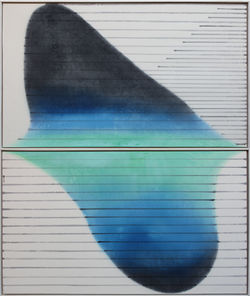 Cai GuangbinChinese Mountains · Grotto Mountains Series Inspired by Dunhuang Cave 428 · Meditation on the Eastern Wall of the Northern Vault Slope No.069 Ink on paper 72 x 120 cm x 2 2025 |  Cai GuangbinVoid Realm · 2025 · Reminiscing Bada Shanren 09-2023 Ink on paper 98 x 180 cm x 2 2020 |  Cai Guangbin2020 · On Compromise In Memory of Da Vinci & Yezhi Lake Summer Solstice to Spring, 2003–2022.7.28 No.001 Ink on paper 97 x 180 cm x 2 2022 |
Artists

Yue Minjun
b. 1962, Heilongjiang, China
Yue Minjun is a leading figure of contemporary Chinese art, internationally renowned artist, who is currently living and working in Beijing.
Yue Minjun had been creating this exaggerated “Self-image” since the beginning of the 1990s. And in recent years, this image has been used in the field of sculpture and printmaking. Sometimes “it” appears independently, or collectively. “It” closes its eyes and laughs grinningly; with dramatic gestures and confidence.
He became the cover story of Time magazine in 2007, and nominated as one of the “Person of the Year 2007-People Who Mattered”, on the list of the five award winners, there were Putin, Barack Obama and Hilary Clinton etc., Yue Minjun was the only Chinese, and only artist who had been nominated, Time described Yue Minjun as: “If you think China has a close relationship with the current and future status of the world, then this is the man to paint China”.
On the other hand, Yue Minjun’s artworks have been collected by domestic and foreign art institutions, galleries and museums. For example, San Francisco Museum of Modern Art, Denver Art Museum, The Culture Centre of Francois Mitterrand, Busan Museum of Art, Guangdong Museum of Art, Shenzhen Art Museum and other important institutions have all brought Yue’s works into their permanent collections. Since participated in the 48th Venice Biennale in 1999, Yue had been invited as one of the regular contemporary Chinese artists in every Venice Biennale, which demonstrates his profound artistic contribution, and his distinctive artistic characteristics have established the non-negligible importance in contemporary Chinese art and the world stage.

Chen Shaoxiong
b. 1962, Guangdong, China
Born in 1962 in Shantou, Guangdong Province, China, Chen Shaoxiong graduated from the Printmaking Department of the Guangzhou Academy of Fine Arts in 1984. As early as the 1980s, he became involved in Guangzhou’s underground experimental art scene. In 1990, he co-founded the "Big Tail Elephant Working Group" in Guangzhou with Lin Yilin and Liang Juhui.
Since the Big Tail Elephant period, Chen’s Street Scenes series has drawn inspiration from the urban landscapes of southern China. Street Scenes II builds upon Street Scenes I, which consisted of 14 photographs taken on the streets, by re-photographing the same locations. Like more than half of the works in the exhibition, Street Scenes II remains relatively unknown even within art circles. Chen once stated, "All my current creations, whether in terms of language and concepts or attitude and media, have grown from seeds planted in the work I did in the 1990s." By capturing and re-collaging urban landscapes from various locations, he transforms himself into a "perpetual tourist" within the familiar city.
From the 1990s to the present, Chen Shaoxiong’s focus on the city and his sense of humor have remained consistent. After the Big Tail Elephant period, his work was deeply influenced by the speed and transformation of urban development, while also addressing these issues through diverse media—including video, installation, photographic montage, painting, and performance. His works often present a convergence of contradictory and unstable dual visions.
Chen Shaoxiong's Street Scenes series explores urban transformation through photography and recombination. In 1999, he created the internet-based installation Landscape 3, an early example of net art in China. His performance-installation Consuming 72.5 Hours used neon tubes to symbolize urbanization. In 2003, he held the solo exhibition "Anti—Chen Shaoxiong" in Guangzhou. He later created the four-channel video installation Sight in 2016. In June of that year, the Power Station of Art in Shanghai hosted his largest retrospective, "Chen Shaoxiong: So Ready," spanning three decades of his work across video, installation, painting, and other media. At the time of his passing on November 26, 2016, his solo exhibitions at both the Pace Beijing and Tang Contemporary Art Center—featuring his new work Collective Memory—were still on view. Situated adjacent to each other, the two galleries connected the artist’s enduring legacy with his latest creations.
Chen’s works were featured in the 2003 Venice Biennale, the 2005 Guangzhou Triennial, and the 2002 Shanghai Biennale, and he received nomination awards for the CCAA Chinese Contemporary Art Award in 2000 and 2006. His work has profoundly influenced subsequent contemporary artists in the Pearl River Delta region, inspiring artistic explorations centered on urban space, international politics, daily life, and popular culture.

Mao Xuhui
b. 1956, Chongqing, China
Mao Xuhui has been living in Kunming with parents since 1956, and graduated from the Yunnan Art Academy in 1982. Mao Xuhui is an iconic artist in Chinese contemporary art history. He is one of the figures in China Art Power 100 and the leader of the avant-garde community in southwest China in the 1980s. Between 1985 and 1989, he brought together a host of young artists mostly from Yunnan and Sichuan under the banner of “New Figurative” to form the Southwest Art Research Group, whose members represented and celebrated in their paintings such intense life awareness typical of the southwestern regions of China that the group came to represent a significant part of the ’85 New Wave, a vanguard movement of contemporary Chinese art. These achievements have earned him a crucial position in Chinese contemporary art history.
Mao Xuhui has widely exhibited in Euro-pan-Asian cities, including Shanghai, Beijing, Hong Kong, Singapore, New York, San Francisco, Barcelona, Bologne, Paris, and London. His artworks are included in many influential exhibitions, for example, the milestone exhibition in Chinese contemporary art history, Inside Out: New Chinese Art (1998) co-organized by Asia Society New York, Museum of Modern Art, San Francisco and Hong Kong Museum of Art. His works have been collected by prominent domestic and international galleries and museums, publicized worldwide by news media, and published in art history books and academic journals.

Cai Guangbin
b. 1963, Heilongjiang, China
Born in 1963. Graduated from the Chinese Painting Department (Figure Painting specialization) of the China Academy of Art in 1988.
He is currently a professor at the Faculty of Fine Arts, East China Normal University, Director of the Contemporary Ink and Water Art Research Center, a painter at the Shanghai Chinese Painting Academy, and Deputy Director of the Ink and Water Experimental Research Professional Committee under the China Cultural Promotion Association.
Cai Guangbin is a representative artist of contemporary Chinese ink painting. His exploration of "photographic ink art" represents the latest achievements in contemporary Chinese ink art.
In 2014, he received a nomination award for "Influential Ink Artist of the Year" at the AAC Art China Awards.
Public Collections:
National Museum of China, National Art Museum of China, Shanghai Art Museum, China Art Museum (Shanghai), Zhejiang Art Museum, Guangdong Museum of Art, Hubei Museum of Art, Tsinghua University Art Museum, United Art Museum, Beijing Minsheng Art Museum, Today Art Museum, Huafu Art Center, Himalayas Museum, China National Academy of Painting, Art Museum of China Academy of Art, Shanghai Chinese Painting Academy, Tianrenhey Arts Museum, Heilongjiang Provincial Art Museum, Liu Haisu Art Museum, Chengdu Modern Art Gallery, Lushan Art Museum, Meilun Art Museum, etc.
International Collections:
Fondazione Giorgio Cini (Venice), Singapore Art Museum, Sylvain Art Collection (Paris), Origo Family Foundation (Switzerland), Hartman Art Museum (Netherlands), Gudehouhaoshi (New York), United Nations European Headquarters, International Olympic Committee, Nagano Modern Art Museum (Japan), National Museum of Indonesia, Princess Madeleine’s Art Foundation (Sweden), Chinese American Museum (USA), California Television Media (USA), and others.