top of page

Unforeseen Encounters

Yang Maoyuan

Singapore Space

2026.8.14 - 9.29

Press

The exhibition Unforeseen Encounters does more than trace the development of Yang Maoyuan’s recent artistic practice; it also points toward his distinctive way of seeing and his philosophy of life. The phrase originates in the Guliang Commentary, “The Eighth Year of Duke Yin”: “A meeting without prior arrangement is called an encounter.” The notion of “encounter” embedded here refers not only to the meeting between people and things, but also to a way of establishing a relationship with the world amid the unknown. A comparable openness informs The Zhuangzi’s vision of “roaming the infinite without depending on anything”—an unconditioned, open, and free state of being. Yang’s working method follows a similar path. He neither adheres to a predetermined direction nor hastens to assimilate the unknown into an established order. Instead, while walking, reading, looking, painting, and even driving, he sustains a receptive perceptual state, allowing time and space, experience and memory to connect of their own accord. For Yang, artmaking is not a search for answers. It is closer to a continual encounter with experiences that have yet to be named and with places that have yet to be reached.


These seemingly contingent encounters ultimately become points of departure for his work, forming a path that connects lived experience with memory. The exhibition brings together the Pot People and Balloon Man series, together with sculptures from the Face series. These works condense the experience Yang has accumulated through years of travel and observation, while demonstrating how he transforms the material and cultural textures of different regions into a distinctive visual language. Around this continually unfolding process, the exhibition identifies three threads running through Yang’s practice: the unforeseen encounter between the body and the land; that between archaeological remains and pictorial conventions; and that between the color temperature of sunlight and the colors of painting. Together, they map the artist’s passage from experience to image, and from perception to form.


The first is the unforeseen encounter between the body and the land. Beginning with the early Earth and Man series, Yang’s exploration of the body has been closely tied to the land. Here, the body is not merely a figure within painting; it is also the measure of the artist’s own experience. Confronted with the vast territories of western China, finite human flesh and seemingly boundless space generate a tension. Bodily presence therefore becomes a crucial point of departure for establishing a relationship with the land. From this moment onward, the body became an enduring thread in Yang’s practice: it bears personal experience while also serving as the object through which the artist observes and depicts the world. It points toward the self, yet continually transforms, generating new figures and extending into the later Balloon Man and Pot People series.


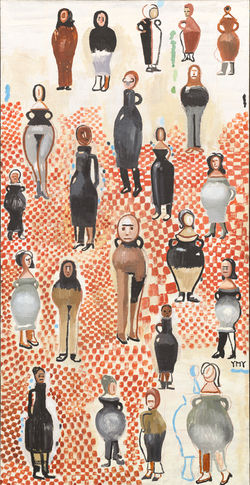
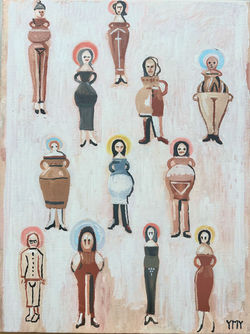
Through years of walking and looking, Yang has gathered impressions of historic monuments, ruins, folk patterns, clothing, everyday objects, and even local dialects from different regions, gradually transforming them into details that later surface in his work. Close attention to his figuration—especially in the Pot People series—reveals that these figures do not form a community bound by kinship or ethnicity. They differ in form, dress, hairstyle, skin color, and facial features. Some retain the simplified faces of ancient figurines, their humanity made legible only through the eyes, mouth, and contour. Others bear traces of regional dress and lived experience, their bodies enveloped in garments of varying forms. Still others gradually approach the shape of vessels, their bodily contours compressed into pot-like structures. Arranged in orderly sequences, these Pot People are at once records of travel and condensations of artistic language, ultimately forming a visual field situated somewhere between figure, artifact, and sign. It is through this accumulation and transformation of experience that we arrive at the exhibition’s second thread: the unforeseen encounter between archaeological remains and pictorial conventions.


In the early 1990s, Yang traveled deep into the wilderness surrounding Lop Nur, an expedition that became a crucial starting point for his observation of land, history, and traces of human presence. This journey not only inaugurated his early explorations in sculpture and land art, but also gradually brought ancient ruins, prehistoric imagery, and historical modes of human figuration into his artistic field of vision. Beginning with his first carved work in 1994 and continuing through the later Face series, archaic figurines, clay, circular structures, and bodily forms have remained latent within different phases of his practice. His sustained interest in ancient imagery is inseparable from his long-standing engagement with Loulan and the civilizations of Central Asia—a land where cultures have continually converged, overlaid one another, and disappeared. Different dynasties, peoples, and religions encountered one another there; Christian sculpture, Buddhist icons, and Islamic patterns exerted mutual influence, producing over long stretches of time a complex and distinctive visual character.


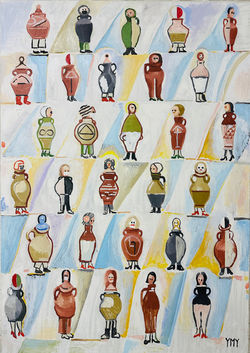
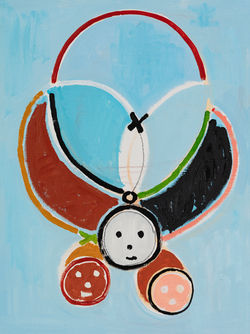
If the Face series bears traces of the interpenetration of Eastern and Western civilizations, the Balloon Man series is more concerned with how the human form comes into being as a sign. Several millennia ago, human beings were already representing the “human” in the simplest possible terms: two eyes, a nose, and a mouth. This highly condensed human sign has crossed regions and civilizations and endures to this day. Yang develops this premise in the Balloon Man series. His figures are further reduced to bodily structures composed of circles, arcs, and blocks of color, while the proportions of the head, limbs, and torso are reorganized to produce a sense of inflation and buoyancy. Although these figures share similar bodily structures, differences emerge through color, proportion, and localized details. The quasi-circular bodies, simplified faces, and flattened color preserve the most elementary cues by which a human figure is recognized, while dissolving any indication of specific identity. Yang does not replicate historical images. Rather, he responds to these early signs at a more fundamental level, transforming their most primordial structures of human form into a contemporary painterly language. On the surface, these figures appear lighthearted, childlike, and at times humorous; beneath that surface lies a sustained inquiry into identity, time, memory, and the question of how the human becomes human.


The third thread—the unforeseen encounter between the color temperature of sunlight and painterly color—returns us to the language of Yang’s practice itself. From his early investigations into light, color temperature, and chromatic variation to the formation of a distinct color language in painting, Yang has consistently attended to how light shapes visual experience. Over a period of three years, he recorded changes in light at different moments of the day, treating its movement and transitions, together with the color relations embedded within them, as an ongoing study of the chromatic spectrum. This record of light’s rhythms did not remain at the level of visual observation; it gradually became a foundation for the organization of color in his painting. During his travels, he has likewise remained attentive to the color cultures of everyday life in different regions: the green wall skirts of houses in northeastern China, the blue tonalities of Xinjiang, and the regionally distinctive colors found across Central Asia, India, and Mexico. These colors are not merely visual elements. They are local memories formed through particular conditions of light, environment, and lived experience, and they ultimately enter his paintings. In Center of Asia No. 1, for example, expanses of white, blue, red, and yellow are not simply regional colors; they appear to have been abstracted from a particular experience of light. The blocks of color evoke architecture and terrain, while also resembling visual afterimages left by light.

Although this exhibition presents only one facet of Yang Maoyuan’s artistic practice, it makes visible the way of seeing and the working state he has developed over many years. He never attempts to fix the boundary between abstraction and figuration in advance. Instead, as a painting develops, he waits for an as-yet-undefined experience to emerge—something that cannot be summarized, yet can be perceived. It is precisely within this interval between likeness and unlikeness that painting exceeds a single artistic form and becomes a way of understanding the world. Unforeseen Encounters likewise shifts from a state of artistic production into Yang’s attitude toward the world. He does not strictly follow the logic of art history or the movements of his time; he is more concerned with direct and concrete relations between people and the world. As he has said: “Art is not the most important thing. It may be more interesting to understand people through art. I do not think much about the logic of art history; I think about the logic of human beings—my own logic.” Perhaps the logic Yang insists upon is precisely this: through sustained looking and sustained work, to preserve the possibility of encounter between the human being and the world. Painting thus becomes a continually unfolding experience—one that enables us, even as time passes, to rediscover the connections between ourselves and the world.

Works

EXHIBITING WORKS

Yang Maoyuan

Yang Maoyuan

Asian Center Oil on canvas 360 × 190 cm (Triptych) 2024

Yang Maoyuan

Yang Maoyuan

Background with Parallel Lines Oil on canvas 200 × 140 cm 2024

Yang Maoyuan

Yang Maoyuan

Xingxingxia Pass Oil on canvas 200 × 140 cm 2024

Yang Maoyuan

Yang Maoyuan

Pot People (Blue) Oil on canvas 200 × 280 cm (Diptych) 2026

Yang Maoyuan

Yang Maoyuan

Pot People Oil on canvas 200 × 227.3 cm 2026

Yang Maoyuan

Yang Maoyuan

Center of Asia No.1 Oil on canvas 213 × 160 cm 2025

Yang Maoyuan

Yang Maoyuan

Border No.2 Oil on canvas 100 × 200 cm 2025

Yang Maoyuan

Yang Maoyuan

Untitled (Melon) Oil on canvas 287 × 215 cm 2026

Yang Maoyuan

Yang Maoyuan

Untitled (Pot People with Colored Background) Oil on canvas 140 × 110 cm 2025

Yang Maoyuan

Yang Maoyuan

Untitled (6 Balloon Men) Oil on canvas 160 × 100cm 2023

Yang Maoyuan

Yang Maoyuan

Untitled (7 Balloon Men) Oil on canvas 160 × 100cm 2023

Yang Maoyuan

Yang Maoyuan

2024.5.20 Oil on canvas 120 × 80.2 cm 2024

Yang Maoyuan

Yang Maoyuan

Pot People with Checked Background Oil on canvas 153 × 77.6cm 2025

Yang Maoyuan

Yang Maoyuan

Pot People in 6 Rows No.1 Oil on canvas 141.5 × 99.6 cm 2026

Yang Maoyuan

Yang Maoyuan

Untitled (Curly Hair) Marble 27 × 19 × 23 cm 2020

Yang Maoyuan

Yang Maoyuan

Pot People in 7 Rows Oil on canvas 141.8 × 99.8 cm 2025

Yang Maoyuan

Yang Maoyuan

Infinite Growth No.3 Titanium-plated stainless steel, resin paint 198 × 68 cm 2022

Yang Maoyuan

Yang Maoyuan

Pot People Oil on canvas 80 × 60 cm 2026

Yang Maoyuan

Yang Maoyuan

Pot People Oil on canvas 80 × 60 cm 2026

Yang Maoyuan

Yang Maoyuan

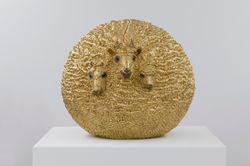
Sheep Bronze, crystal, gold leaf 65 × 65 × 83 cm 2020

Yang Maoyuan

Yang Maoyuan

Pot People Oil on canvas 80 × 60 cm 2026

Yang Maoyuan

Yang Maoyuan

Angel 1 Marble 31 × 21 × 21 cm 2020

Yang Maoyuan

Yang Maoyuan

Pot People Oil on canvas 80 × 60 cm 2026

Yang Maoyuan

Yang Maoyuan

Untitled (3 Balloon Men) Oil on canvas 60 × 40 cm 2022

Yang Maoyuan

Yang Maoyuan

Face Black marble 23.5 × 18.5 × 43 cm 2008

Yang Maoyuan

Yang Maoyuan

Untitled (3 Balloon Men) Oil on canvas 60 × 45 cm 2022

Yang Maoyuan

Yang Maoyuan

Face Marble 23 × 21 × 52 cm 2010

Yang Maoyuan

Yang Maoyuan

Untitled (Border) Oil on canvas 30 × 40 cm 2025

Yang Maoyuan

Yang Maoyuan

Later Venus Marble 26.5 × 20 × 53 cm 2009

Yang Maoyuan

Yang Maoyuan

Untitled (With Lights and Shadows) Oil on canvas 200 × 140 cm 2025

Artist
Artist
Image_20260805122945_182_132.jpg

Yang Maoyuan

b. 1966, Dalian, China

Born in Dalian, China, in 1966, Yang Maoyuan now lives and works in Beijing. He graduated from the Printmaking Department of the Central Academy of Fine Arts in 1989 and took part in the China/Avant-Garde exhibition that same year. In 2002, he received the CCAA Chinese Contemporary Art Award.


The historical remnants of Chinese culture and philosophy have long served as a wellspring of inspiration for Yang. His works are, at their core, articulations of cultural roots and the meaning of existence; he is concerned with how art generates a spiritual force that answers to its time, and with the means by which that force is conveyed — an attempt to establish an ontological cultural attitude. His practice spans painting, sculpture, installation, photography, and other media.Yang has held major exhibitions in Berlin, London, Florence, Genoa, Shanghai, and Beijing.


His museum exhibitions include the National Museum in Warsaw, the Centre Pompidou in Paris, Hellerau – European Centre for the Arts in Dresden, the Martin-Gropius-Bau in Berlin, the Villa Breda Museum in Padua, the Palazzo Medici Riccardi in Florence, the Ordos Art Museum, and the Today Art Museum in Beijing. In 2011, he was among the artists representing China at the 54th Venice Biennale.His works are held in public collections including the Oriental Museum, Durham University, Durham, UK; the Ministry of Culture of Saudi Arabia, Riyadh; White Rabbit Gallery, Sydney; Hunan Museum, Changsha; M+, Hong Kong; Jinling Art Museum, Nanjing; Today Art Museum, Beijing; CAFA Art Museum, Beijing; and the Ordos Art Museum.


His recent exhibitions include: 2026 Dance of the Inner Asian Highway, Song Art Museum, Beijing, China; 2026 The Delay of Meaning, East Gallery, Nanjing, China; 2025 The Distant Realm, Triumph Gallery, Beijing, China; 2024 Launching a New Era: Body and Language as Manifesto, Yuan Art Museum, Beijing, China, etc.

Inquire

Subscribe to our Newsletter | 订阅我们的简讯

Inquire for information  |  查询更多资讯

Career Opportunities |  职位空缺

Follow us  |  关注我们

  • Grey Facebook Icon
  • chn_wechat
  • Grey Instagram Icon
  • Artsy_logo.svg copy
  • Grey YouTube Icon
  • Grey Vimeo Icon
  • Ocula symbol 2
  • LinkedIn
  • XiaohongshuLOGO

Copyright ©1997- 2026 Tang Contemporary Art; All rights reserved.

bottom of page