


The title We Paint What You Might See reflects a shared impulse among Ben Ashton, Jochen Mühlenbrink and Ivan Pokidyshev: to treat painting not as a transparent record of the visible world, but as a deliberate reshaping of its surface. Each artist works from a position of technical mastery, yet none allows that mastery to settle into simple representation. Instead, they place both the physical act of seeing and the psychological process of perception under quiet pressure, opening a space where what appears is never exactly what is there.
At the heart of their practices lies a philosophical tension between the physical and the perceived. The eye registers colour, form, texture and light. The mind, however, constantly interprets, completes and sometimes resists what it receives. These three artists play deliberately in that gap. They remind us that seeing is never purely optical. It is also psychological, shaped by expectation, memory, trust and doubt.
Ben Ashton draws on the authoritative language of classical portraiture, its confident postures, refined surfaces and historical weight, only to fracture it. Having long studied the Old Masters, he introduces digital style glitches and formal ruptures that unsettle the very qualities of power, self assurance and historical certainty those images once sought to fix. The figures remain recognisable, yet the authority they project is compromised. Physically, the surface of the painting is disrupted. Psychologically, our confidence in the image begins to slip. What we thought we knew becomes provisional.
This disruption of visual certainty finds a different expression in the work of Jochen Mühlenbrink. Working in the tradition of trompe l’œil, he turns fogged glass, condensation, residual marks and the reflective plane of the mirror into sites of hyperreal illusion. Through varnish, resin and acrylic on mirror glass, he constructs surfaces so convincing that the eye momentarily accepts them as physical rather than painted. Reality and representation collapse into one another. Here the physical surface becomes a psychological trap. We are left uncertain whether we are looking at an intervention on glass or a painting of one, and by extension whether any surface can be fully trusted.
Ivan Pokidyshev extends the inquiry further still. Drawing on the logic of infrared thermography, he translates human warmth, vital energy and inner light into visible radiance against darkness. Figures glow from within, their presence rendered as light. What cannot ordinarily be seen, connection, solitude, the quiet force of living energy, becomes the primary subject. The painted surface no longer simply describes an outer form. It becomes a threshold through which the unseen is invited into visibility.
Across these three practices, a deeper philosophical thread emerges. As Maurice Merleau-Ponty suggested, and as Paul Klee famously put it, painting does not merely reproduce the visible. It makes the invisible visible. Ashton makes the invisible instability of power legible within the classical image. Mühlenbrink makes the invisible conditions of perception, our reliance on surfaces and the fragility of visual trust, suddenly apparent. Pokidyshev most literally makes the invisible forces of warmth and connection luminous. In each case, the physical surface of the painting becomes a site where psychological and philosophical questions about seeing are brought into view.
Though their methods differ, the three artists converge on a shared concern. Each refuses the idea of painting as neutral documentation. Ashton disrupts the historical image of power, Mühlenbrink questions the reliability of the material surface, and Pokidyshev reveals the invisible energy that underlies ordinary perception. In each case, exceptional technique is redirected toward uncertainty, revelation or emotional truth. What they paint is never simply what is present. It is what might be seen once the surface has been altered, inviting us into a more attentive, more open mode of looking.
EXHIBITING WORKS
 Hello Sailor89 x 70 cm Oil On Panel 2025 | 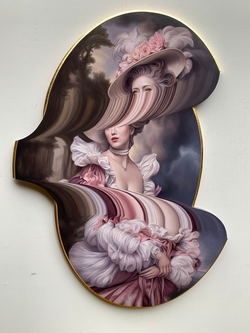 Exercise in Futility105 x 78 cm Oil on panel 2025 | 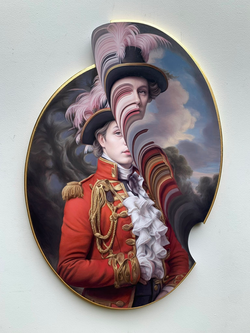 Planned Obsolescence85 x 60 cm Oil on Panel 2025 |
|---|---|---|
 Sliding Inertia97 x 84cm Oil on panel 2025 | 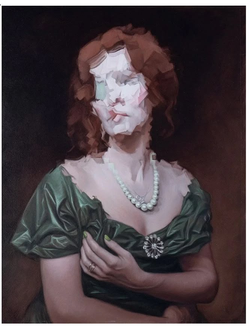 The Mews61 x 51 cm Mixed Media on Paper 2025 | 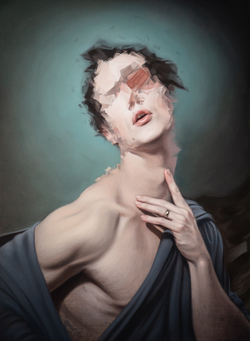 So Dramatic61 x 51 cm Mixed Media on Paper 2025 |
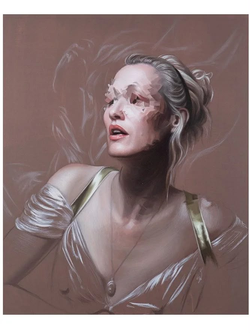 Figurehead61 x 51 cm Mixed Media on Paper 2025 |  Carefree strolls at the edge of the night85 x 190 cm Tempera on canvas 2026 |  High Hope70 x 70 cm Oil on Canvas 2025 |
 Lost in the night110 x 110 cm Oil on canvas 2026 |  A Receding Sea110 x 110 cm Oil on canvas 2026 |  The ocean of warmth110 x 110 cm Oil on canvas 2026 |
 Serenity90 x 140 cm Acrylic on Canvas 2023 | 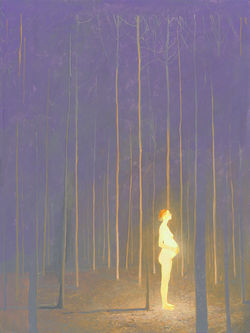 Inner Light80 x 60 cm Acrylic on Canvas 2025 | 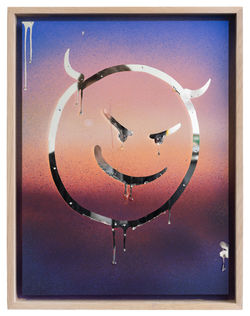 Devil44 x 34 cm Acrylics and resin on mirror glass 2026 |
 Angel44 x 34 cm Acrylics and resin on mirror glass 2026 |  Now54 x 44 cm Varnish and resin on mirror glass 2026 |  Tutto Passa54 x 44 cm Varnish and resin on mirror glass 2026 |
Artists
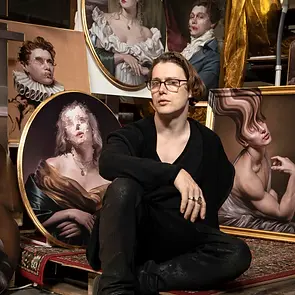
BEN ASHTON
b. 1983, London, U.K
Currently lives and works in London
MA at the Slade School of Fine Art in London
Ben Ashton is a master of subversion. His art is both beautiful and challenging; a clash of past and future that merges classic techniques with new ideas. He has achieved a style that is at once instantly recognisable, universally relevant and completely personal.
Ashton has spent his life studying the Old Masters - he is unrelenting in his efforts to reach the pinnacle of his craft, painting each and every day, with the intent then to distort or even shatter something that has been perfected. Many of Ashton’s paintings criticize self-aggrandizing accounts of British history and contemporary nationalism by distorting formal Regency era portraits.
Reflecting on his oeuvre, Ashton sees it as a personal narrative, a visual chronicle of his life and the lives of those around him. He muses that a posthumous retrospective of his work would unveil his entire life journey through painting, witnessing the passage of time - “You'd see someone grow old” he says, adding of his love for the resilience of portraiture “it has a strange lineage; it's been a part of humanity's means of expression for centuries.
Ashton’s paintings were considered for the 2012 and 2014 BP Portrait Awards at London’s National Portrait Gallery, and have been exhibited across the United States and at numerous galleries in London.

JOCHEN MÜHLENBRINK
b. 1980, Freiburg im Breisgau, Germany
Currently lives and works in Düsseldorf and Oldenburg, Germany
Jochen studied painting at the Kunstakademie Düsseldorf, 2001–2007, and graduated in 2007 as a Meisterschüler (master student) of Markus Lüpertz. His artistic language is rooted in trompe-l'œil, the technique of painting illusions so precise that the eye briefly mistakes them for reality. Working in oil, he renders overlooked materials — masking tape, condensation on glass, torn posters, fogged windows — with a exactness that hides every trace of the brush, so that what first reads as a photograph or a real object reveals itself, on closer look, to be entirely painted.
Behind this technical precision lies an inquiry into perception itself. Mühlenbrink often stages his subjects before painting them — taping paper to walls, misting glass, arranging light — then photographs these constructed scenes as reference. This act of building an illusion in order to paint one lets him probe the gap between seeing and believing, using windows, mirrors, and translucent surfaces as recurring thresholds between the real and the represented.
Exhibiting internationally since 2006, his work has been presented in a solo exhibition at Kunstmuseum Solingen and included in group shows at Museum Kunstpalast Düsseldorf and Tang Contemporary Art, Hong Kong, alongside gallery presentations in Amsterdam, New York, Copenhagen, and Singapore. His recent series continue this study of surface and illusion, examining windows and reflection as places where vision itself begins to falter.

IVAN POKIDYSHEV
b. 1993, Saint Petersburg, Russia
Graduated from the Repin St. Petersburg State Academic Institute of Fine Arts in 2017
Joined the Saint Petersburg Union of Artists in 2018
Teaching in the preparatory department at the Repin St. Petersburg State Academic Institute of Fine Arts since 2018
Pokidyshev's artistic language is rooted in infrared thermography (IRT), a technique that captures images using infrared rays detectable by thermal cameras. Any object above absolute zero emits infrared light, with warmer objects appearing brighter on thermograms, as if they are shining from within. This unique approach allows him to craft artworks that resonate deeply with viewers, illuminating the world with a radiant glow of warmth and light, and fostering a profound sense of connection and understanding.
Reflecting on his creative period from 2017 to 2021, Pokidyshev describes these works as a “mosaic self-portrait” of his worldview at that time. Elements of this mosaic often belong to different and contradictory images of the world, yet they somehow harmonized in his mind. This period in his art manifests his depth in conveying complex themes and emotions, delving into themes of power, futility, and heroism, using dramatic lighting and bold compositions. He celebrates strength and grace, weaving narratives that not only captivate the eye but also touch the soul.
A significant turning point in Pokidyshev’s artistic journey occurred in February 2022, coinciding with a time of global upheaval and conflict. He realized that there was already too much iniquity and grief in the world to amplify images of pain and despair through his art. Since then, most of his works have been dedicated to themes of light, life, and love. Looking to the future, Pokidyshev plans to continue exploring these inspiring themes, further developing his symphony that radiates warmth and hope.