


Tang Contemporary Art Hong Kong is pleased to present “Crab”, a solo exhibition by renowned Chinese artist Yue Minjun. The exhibition traces back his artistic journey over the past three decades, systematically showcasing his major series, while unveiling new works that expand his distinctive visual language. Yue Minjun’s artistic practice does not follow a linear path; instead, it moves sideways like a crab — shifting across mediums, repeatedly returning to specific motifs, when maintaining tension among multiple directions. The exhibition “Crab” names this nonlinear, non-unidirectional creative structure, metaphorising how the artist “walks on multiple legs” to break free from a singular perspective, thus, examining artistic creation and social reality through multidimensional exploration.
Since the early 1990s, Yue Minjun has established a highly recognisable visual language through his exaggerated, yet closed laughing figures. This “laugh” has been reproduced and interpreted continuously in the global context, nearly becoming his personal signature. However, focusing solely on the smiling face risks overlooking a more crucial structural trait in his work: a flow of thinking that rejects linear progression and travels sideways like a crab. The logic of multipedal and lateral-propulsion movement defines the true trajectory of Yue Minjun’s decades-long career — he has never adhered to one style, but traverses oil, acrylic, sculpture, printmaking, and other spheres, pacing back and forth between series which form unique rhythm.
The “Manipulation Series”, introduced in 1996, represents one of the starting points for this approach. Yue Minjun takes familiar classical images as prototypes, revealing tensions between historical symbols and contemporary interpretations by visual and conceptual dissection. In this exhibition, the “Manipulation Series” extends into more collectively oriented “Crowd Series”. Through dense-arranged figures, the artist constructs an allegory of satire and reflection: individual smiling faces are no longer isolated, but intertwined with countless similar persona, implying the intricate relationship between individuals and collectives. Within symbolization and absurdity lies sustained reflection on group psychology and political imagery — both a disenchantment of the sacredness of images, and a transferral of the right to view.
Under Yue Minjun’s artistic treatment, the figure in “Sudden Awakening” has been captured in a moment of compelled backward gazing. This twisting motion occupies a unique place in his oeuvre: unlike the direct gaze of his early “Laughing Face Series” or the deconstruction and reconstruction of classical imagery in “Manipulation Series”, “Sudden Awakening” embodies a historical attitude through bodily language.
The sharp twist of the neck mirrors the temporal fragmentation of contemporary individuals: we can neither fully turn our backs on the past nor completely face the future, only looking back repeatedly as we move forward. This posture suggests a way of engagement with history — not surging linearly forward, but being forced to turn back at certain points to cast a gaze upon what has occurred.
The “Flower Series”, begun in 2020, shifts this approach to a more intimate dimension. Inspired by garden landscapes in Yunnan, Yue Minjun replaces human faces with blooming or wilting flowers — expressions are obscured, identities concealed. Flowers become new faces, while the original countenances recede into the background. This concealment is not avoidance, but the artist’s choice to substitute human expressions with botanical metaphors of life.
The “Stack Series” further directs attention to the ontology of painting. From the “Luo Series” to the “Stack Series”, unnecessary backgrounds gradually stripped away, figures are driven to the centre, while compositions incline to minimal. This is both an engagement with minimalism and an inquiry into the essence of painting. “Marvelous Kung Fu” continues the artist’s fascination with exaggerated gestures. In contrast to the collective revelry of his early works, the lone figure in this piece performs an unwatched act in emptiness. This contrast heightens the work’s sense of isolation: any “Marvelous Kung Fu” ultimately remains as a monologue.
The question of “Multifacetedness” raised in multiplicity touches directly on human subjectivity. Humans are never a single-faceted being; “two sides” are merely a simplification of “multi-sides”. Through the splitting and juxtaposition of images, the artist reveals how identity constantly shifts between reality and performance. The motif of “Flight” — from ancient mythology to modern aviation — represents a longed-for ideal. Under Yue Minjun’s pen, “Flight” is no longer a symbol of lightness, ascent, and freedom, but a state of suspension. This may well capture the spiritual condition of contemporary individuals: we yearn to transcend, yet our bodies remain bound by gravity.
Of particular note is the artist’s cross-temporal artistic dialogue with Pablo Picasso. His 2022 work “Guernica: The Grin of War” directly responds to Picasso’s masterpiece “Guernica”. Yue’s iconic laughing figures replace the original imagery, translating Cubism into an eerie and absurd scene. War is no longer purely a historical event, but a persistent shadow of reality. Through mockery, the artist dissolves fear, turning suffering into a bizarre farce, while warning viewers to remain vigilant in the face of catastrophe.
Taken as a whole, the exhibition juxtaposes “Manipulation” and "Crowd”, runs “Flower” alongside “Picasso”, and unfolds “Stack” and “Multiface” simultaneously. This parallel structure is exactly the movement of the crab: moving non-linear, holding tension across multiple directions. Yue Minjun’s art grows and intertwines across dimensions, explores the individual and the collective consistently, history and reality, and the politics of the visual. In this sense, “Crab” is more than an exhibition title — it is a description of Yue’s artistic methodology. As viewers weave between series, they encounter not a repetitively grinning face, but a constantly branching, sideways-shifting intellectual trajectory: one that reveals the complexity of humanity and the era between the bizarre and the truth. This, perhaps, is where Yue Minjun’s true contemporaneity lies.
EXHIBITING WORKS
 Guernica: The Grin of WarOil on canvas 300 x 740 cm (300 x 370 cm x 2) 2022 |  The Red PVC PipeAcrylic on canvas 250 x 200 cm 2023 |  HermitOil on canvas 264 x 220 cm 2009 |
|---|---|---|
 ChrysanthemumOil on canvas 150 x 120 cm 2020 | 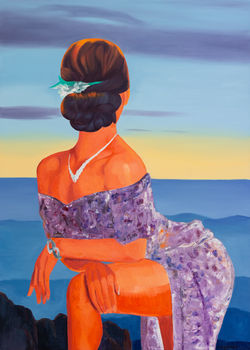 Sudden AwakeningOil on canvas 140 x 100 cm 2022 |  LiliesOil on canvas 76 x 110 cm 2022 |
 Marvelous Kung FuOil on canvas 60 x 50 cm 2023 |  MultifacetednessOil on canvas 50 x 40 cm 2025 |  Picasso and IAcrylic on canvas 130 x 110 cm 2025 |
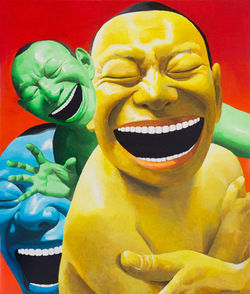 Stack Series No.1Acrylic on canvas 130 x 110 cm 2025 |  FlightAcrylic on canvas 110 x 90 cm 2024 |  The CrowdAcrylic on canvas 50 x 40 cm 2025 |
 The CrowdAcrylic on canvas 50 x 40 cm 2025 |  The CrowdAcrylic on canvas 50 x 40 cm 2025 |  The CrowdAcrylic on canvas 50 x 40 cm 2025 |
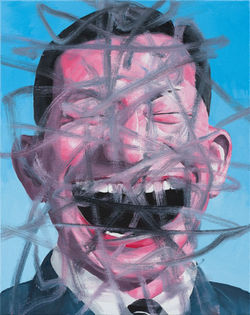 The CrowdAcrylic on canvas 50 x 40 cm 2025 |  The CrowdAcrylic on canvas 50 x 40 cm 2025 |  The CrowdAcrylic on canvas 50 x 40 cm 2025 |
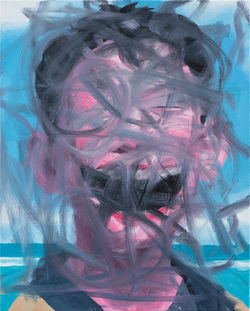 The CrowdAcrylic on canvas 50 x 40 cm 2025 |  The CrowdAcrylic on canvas 50 x 40 cm 2025 |  The CrowdAcrylic on canvas 50 x 40 cm 2025 |
 The CrowdAcrylic on canvas 50 x 40 cm 2025 |  The CrowdAcrylic on canvas 50 x 40 cm 2025 | 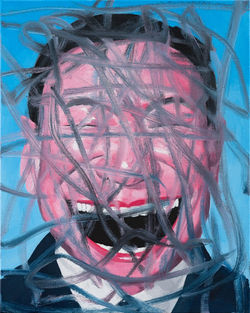 The CrowdAcrylic on canvas 50 x 40 cm 2025 |
 The CrowdAcrylic on canvas 50 x 40 cm 2025 |  The CrowdAcrylic on canvas 50 x 40 cm 2025 | 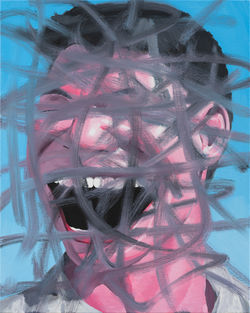 The CrowdAcrylic on canvas 50 x 40 cm 2025 |
Artist

YUE MINJUN
b. 1962, Heilongjiang, China
Currently lives and works in Beijing, China
Yue Minjun is one of the leading figures of Chinese contemporary art and an internationally renowned artist. Having graduated from Hebei Normal University in 1983 with a major in oil painting, he currently lives and works in Beijing, China. Yue Minjun has been creating this exaggerated “Self-image” since the beginning of the 1990s. In recent years, this image has expanded further into the field of sculpture and printmaking. Sometimes the “laughing man” appears independently, or collectively in depictions of daily life. Through the “laughing man”, who squints his eyes, laughing and grinning exaggeratedly with dramatic gestures, Yue interrogates social phenomena in an ironic and cynical manner.