


Tang Contemporary Art is proud to present Temple of Matter, the first solo exhibition in Singapore by Zhu Jinshi, a pioneering abstract and installation artist in the Chinese contemporary art sphere. During the exhibition period, audiences will have a rare opportunity to encounter the practice that has redefined painting as a question of material, structure, and physical experience rather than image or narrative.
Temple of Matter is Zhu Jinshi’s largest painting exhibition outside China and the first to present three major triptych works together, highlighting both continuity and variation in his approach to accumulation and structure. Shown in Singapore, a city shaped by the intersection of East Asian thought, Southeast Asian realities, and Western art histories, the exhibition underscores painting as a physical and spatial practice. Rather than offering fixed interpretations, it foregrounds material conditions and process, inviting viewers to encounter meaning through direct engagement with matter itself.
Zhu Jinshi emerged at a formative moment in China’s contemporary art history as part of China’s first avant-garde exhibition, the Stars group exhibition in 1979, which challenged existing aesthetic systems and institutional frameworks. Since then, his practice has spanned painting, installation, performance, and photography, while maintaining a sustained focus on the behaviour of materials.
In Zhu’s thick paintings, he often uses palettes, wall trowels, wooden shovels, and wide brushes to apply dense layers of paints on the canvas. This approach, which has become his iconic style, defines his art as a sustained investigation into paint as matter rather than image. The canvas serves as a structural support for accumulated, compressed material, giving the works a sculptural presence shaped by weight, pressure, and process.
The title Temple of Matter draws from the concept of 寺 (si) within Chinese Buddhism, particularly Chan thought. Here, a temple is not a place that affirms fixed meaning, but one that holds it in suspension, allowing direct experience to take precedence over interpretation. In this context, matter is neither symbolic nor functional. It is encountered through its physical presence and conditions.
EXHIBITING WORKS
 Zhu JinshiThe Gilded Cascade of Ten Dimensions (Left) Oil on canvas 70 x 60 cm x2 2024 |  Zhu JinshiThe Gilded Cascade of Ten Dimensions (Right) Oil on canvas 70 x 60 cm (2 panels) 2024 |  Zhu JinshiMediterranean Sea Oil on canvas 180 x 480 cm 2017 |
|---|---|---|
 Zhu JinshiWhere the Wu River Brought an End Oil on canvas 160 x 180cm 2007 |  Zhu JinshiThe Hexagonal Sea-Breeze on a Crimson Steed Oil on canvas 70 x 60 cm 2024 |  Zhu JinshiFragrant Hill -3 Oil on canvas 160 x 140 cm 2022 |
 Zhu JinshiValley in the Mirror -3 Oil on canvas 180 x 160 cm 2023 |  Zhu JinshiCarriage Oil on canvas 160 x 180 cm 2023 | 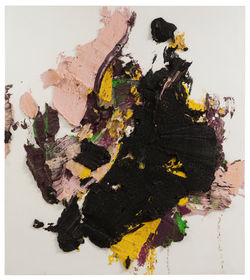 Zhu JinshiWind from Western Suburbs Oil on canvas 180 x 160 cm 2012 |
 Zhu JinshiBloom Oil on canvas 45 x 40 cm 2024 |  Zhu JinshiClouds from the Western Hills drift into the view Oil on canvas 180 x 480 cm 2024 |  Zhu JinshiA Boundless Drizzle Adrift in Time (Right) Oil on canvas 70 x60cm x2 2024 |
 Zhu JinshiA Boundless Drizzle Adrift in Time (Left) Oil on canvas 70 x60cm x2 2024 |  Zhu JinshiSir Granule Oil on canvas 180 x 160 cm 2025 |  Zhu JinshiSplashed Rainbow (Right) Oil on canvas 180 x160cm x2 2019 |
 Zhu JinshiSplashed Rainbow (Left) Oil on canvas 180 x160cm x2 2019 |  Zhu JinshiWhite Brushstroke Oil on linen 100 x 70 cm 2012 |  Zhu JinshiTemple of Matter Oil on canvas 180 x 160 cm 2025 |
 Zhu JinshiPirate Singer -1 Oil on canvas 180 x 160 cm 2018 |  Zhu JinshiApril Clear -1 Oil on canvas 45 x 40 cm 2024 |  Zhu JinshiApril Clear -3 Oil on canvas 45 x 40 cm 2024 |
 Zhu JinshiDu Fu Tower -1 Oil on canvas 180 x 160 cm 2023 |  Zhu JinshiThe Rainstorm Turned the Scene into a River Oil on canvas 180 x 480 cm 2025 |  Zhu JinshiPalm Oil on canvas 160 x 180 cm 2023 |
 Zhu JinshiMountain Woods Oil on canvas 100 x 140 cm 1986 |  Zhu JinshiTemple at the End of Heat Oil on canvas 180 x 160 cm 2018 |  Zhu JinshiIn Dialogue with Spring -4 Oil on canvas 45 x 40 cm 2024 |
 Zhu JinshiIn Dialogue with Spring -2 Oil on canvas 45 x 40 cm 2024 |  Zhu JinshiClouds in Bloom -2 Oil on canvas 45 x 40 cm 2024 | 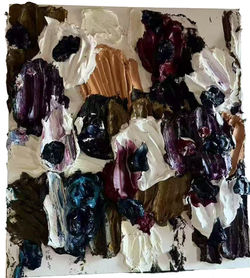 Zhu JinshiThe Northern Wei Temple Oil on canvas 180 x 160 cm 2025 |
 Zhu Jinshi2018·6·4 Oil on canvas 180 x 160 cm 2018 |  Zhu JinshiClouds in Bloom -1 Oil on canvas 45 x 40 cm 2024 |  Zhu JinshiPing-Pong Story Oil on canvas 180 x 160 cm 2010 |
 Zhu JinshiMarch 2025’s Grief and Hope -4 Oil on canvas 45 x 40 cm 2025 |  Zhu JinshiSun Oil on canvas 180 x 320 cm 2017 |
Artists

Zhu Jinshi
b. 1954, Beijing, China
Zhu Jinshi is a pioneer of Chinese abstract art and installation art. At present, he lives and works in Beijing. As an important Asian contemporary art practitioner who rose to prominence in the second half of the 20th century, Zhu Jinshi has experimented with a wide range of mediums and methods. Amidst the historic Eastern and Western cultural currents of the Cold War, he tirelessly promoted the Asian experience. In 1979, Zhu participated in the “Stars,” China’s first contemporary art movement, and in the 1980s, he explored abstract painting and “apartment exhibitions.” In 1986, he moved to Berlin Germany, and witnessed the fall of the Berlin Wall. In the 1990s, he started his installation practice, and after the year 2000, he engaged with Chinese abstract neo-expressionist painting and large-scale installation.
Abstract painting has always been a focal point in Zhu’s practice, but he has engaged with the aesthetic fissures and tectonic shifts between the many different artistic mediums and movements that emerged in the postwar period. While reconciling and resisting abstraction, orientalism, installation art, conceptual art, and land art, he holistically considered ways in which painting could be contemporary. Zhu Jinshi is not a conceptual artist; he is an inventor of formal aesthetics. The seams, the thickness, the viewing perspective, the fluidity, the compression, the materiality and spatiality of the paint, and other visual forms have shaped his distinctive painting style. Zhu constantly seeks out new visual frontiers and creates accidental aesthetics.
Zhu Jinshi produces abstract paintings whose surfaces are built up with thick, near-sculptural layers of oil paint. Resembling colorful landscapes, Zhu’s images range in palette and scale, but the artist is known to always apply his oil paint with spatulas and shovels. Producing dense lashings of color, the artist’s method recalls the style and techniques espoused by the German Expressionists, whom Zhu was profoundly influenced by during his years living in Berlin. Zhu belonged to a group of Chinese avant-garde artists named the Stars, which was formed in 1979 to challenge aesthetic conventions and exhibit their work publicly.
Zhu Jinshi’s works have been collected internationally by notable public and private collections: Allison and Warren Kander, USA; Asian Art Museum of San Francisco, San Francisco, USA; Basma Al Sulaiman Museum of Contemporary Art, Saudi Arabia; Brooklyn Museum, New York, USA; Busan Museum of Art, South Korea; Dean Valentine Collection, USA; Delphine Arnault, France; Deutsche Bank, Germany; East West Bank, USA; Fubon Art Foundation, Taipei, Taiwan; Inside-Out Art Museum, Beijing, China; Mario Testino, UK; Minsheng Museum, Shanghai, China; M+ Museum for Visual Culture, Hong Kong, China; National Museum of Contemporary Art, Seoul, South Korea; Picasso Foundation, Málaga, Spain; Rubell Family Collection, Miami, USA; Song Museum, Beijing, China; The Guangdong Museum of Art, Guangzhou, China; The Schaufler Collection, Sindelfingen, Germany; The National Gallery of Victoria, Melbourne, Australia; Today Art Museum, Beijing, China; Vancouver Art Gallery, Vancouver, Canada; Wall Art Gallery, Beijing, China; White Rabbit Collection, Sydney, Australia.