


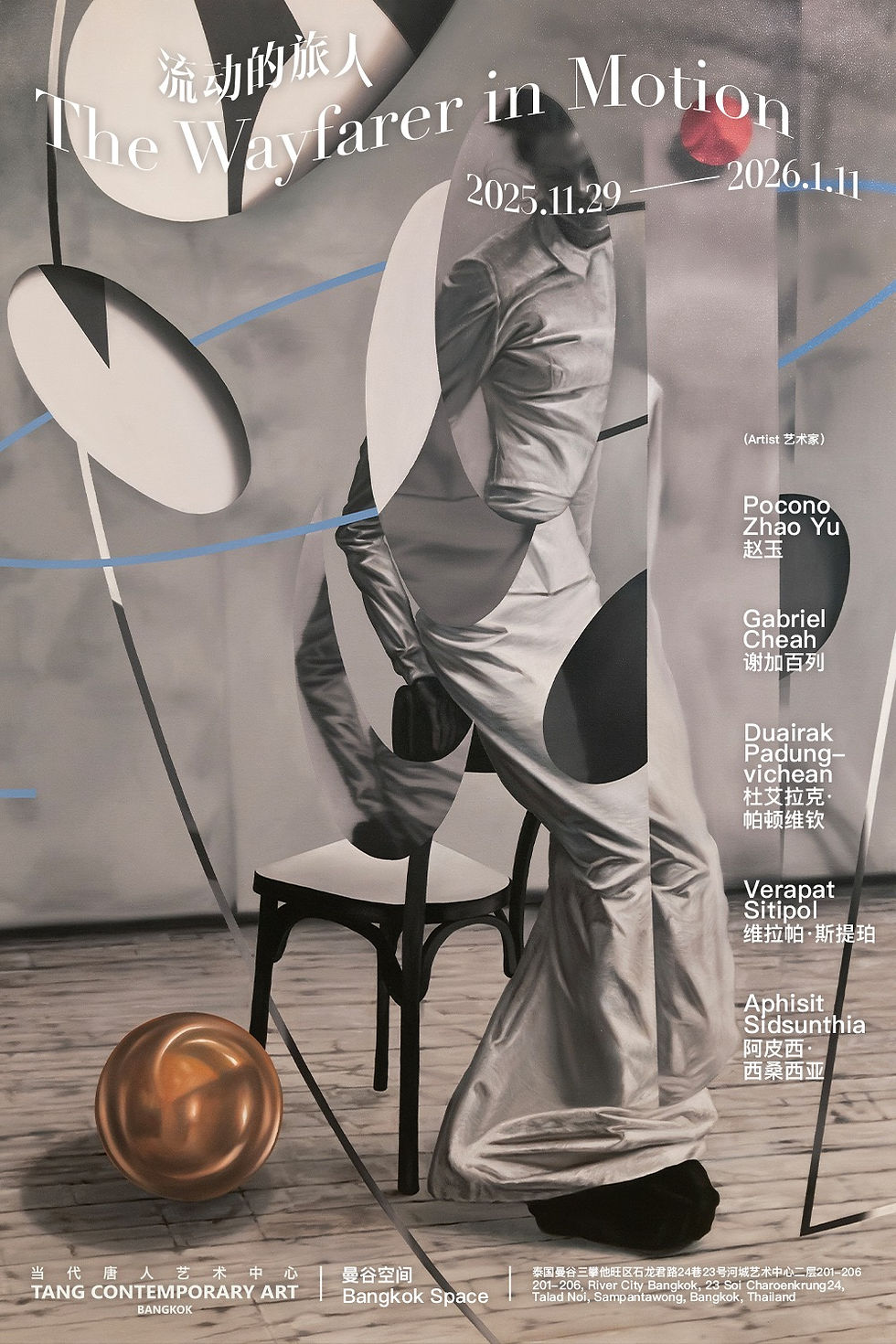
Humanity today resides within a torrent of information, capital, and digital currents. Familiar coordinates dissolve, stable forms are reconstructed, and individuals are cast into an ever-shifting, boundless field. It is as if we are in the midst of a vast and invisible migration, where the ground beneath us is no longer solid, but a quicksand of trends, fragmented identities, and fleeting points of attention. As the weight of existence lightens, what replaces it is a heightened sense of presence, one that signals a silent yet profound transformation in our connection to the real world.
This exhibition invites viewers on a journey of self-exploration that traverses both time and space. The five artists use images as vehicles for spiritual migration, attempting to reveal resilient forms of existence within the fluid and alienating landscapes of change. The nomadic subject has no fixed coordinates; in the ceaseless movement of the body and the constant breaking of boundaries, the subject must confront vulnerability and clarify its authentic self. The exhibition seeks to explore the question of “how to be in the world”: how can individuals, through artistic practice, find orientation and affirm their existence amid alienating internal and external terrains?
Pocono Zhao Yu employs the method of “archaeological notes,” juxtaposing symbolic images and text. Different cultural genes “hybridize,” generating new identities at the “interstices” and “boundaries.” Zhao Yu has long researched the “Sun God” as a core symbol carrying the cultural evolution of both East and West, sun worship represents humanity’s most primal impulse to journey: where the sun rises, humans explore the world and pursue inner desire. Its significance, evolving from a collective totem to a reflection of individual spirit, illustrates how humanity’s outward exploration ultimately returns to the self.
Aphisit Sidsunthia’s works question the notion of “completeness” by embracing the inevitable imperfections and ambiguities of existence. By challenging color theory and employing both manual and digital techniques to collage, remove, and distort images, the artist emphasizes “love” as an event that reshapes being. Fragments of subconscious memory are retrieved and overlapped with geometric forms, opening windows to alternate realities. These fragments become ghosts of resurrected past events, crossing through societal norms and time, suspended between the virtual and the real.
Gabriel Cheah’s Still Kind series highlights active choice within given environments, never abandoning the pursuit of inner light even during moments of heaviness or self-doubt. The artist embraces vulnerability and transforms it into an attitude of “self-will” and gentle resistance, thus defining the essence of selfhood and freedom.
Verapat Sitipol and Duairak Padungvichean’s works present natural landscapes brimming with joy and vitality. Sitipol’s paintings attempt to capture the energy of nature rather than merely its appearance, absorbing and transforming the external world to explore a more authentic and poetic mode of “dwelling.” Forest and mountain scenes, depicted with vibrant brushstrokes, resemble musical scores of natural symphonies, opening possibilities for interpreting musicality beyond painting. These lines recreate both the existence and disappearance of the landscape, capturing the fleeting reality and fragility of dynamic scenery.
Padungvichean’s dreamlike desert landscapes serve as metaphors for both external and internal worlds. The wondrous creatures in her works embark on unknown journeys in search of meaning. This non-purposeful migratory poetics evokes a nomadic attitude toward the land, not to possess, but to continually seek direction in unfamiliar environments, an “in-the-world” experience that redraws the map of the self through movement.
“On this desperate land returned to its primordial innocence, he, the traveler lost in an ancient world, rediscovered his connections.” From the symbol of the Sun God to the ghosts of hidden memories, from inner seekers to shifting terrains, the five artists reassemble memories in the gaps between history and the present, reconstructing narratives where nature and civilization converge. The “self” is shaped, tested, and deepened through encounters with different cultural symbols, others, and predicaments, within this nomadic journey of interwoven inner and outer worlds.
EXHIBITING WORKS
 Starry Pit and the Endless Journey Watercolor, color pencil, gouache on paper 100 x 120 cm 2025 |  River, Wetland, and the Leap of Faith Watercolor, color pencil, gouache on paper 80 x 100 cm 2025 |  Tiny Oasis for Thirsty Goat Watercolor, color pencil, gouache on paper 100 x 80 cm 2025 |
|---|---|---|
 Snorkeling Dog on a Search Watercolor, color pencil, gouache on paper 100 x 80 cm 2025 |  Strange Rock and Misfit Curious Fish Watercolor, color pencil, gouache on paper 100 x 80 cm 2025 |  Magic Mountain Oil on linen 150 x 190 cm 2025 |
 Sai Yok Timberline Oil on linen 188 x 138 cm 202ถ | 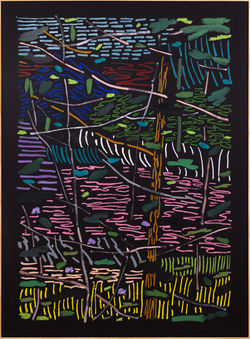 Wang Singh Night Oil on linen 188 x 138 cm 2025 |  Dreams of Sai Yok Oil on linen 170 x 220 cm 2025 |
 Outside to Inside Oil on linen 200 x 150 cm 2025 |  Another world Oil on linen 110 x 80 cm 2025 |  One another Oil on linen 110 x 100 cm 2025 |
 Each other Oil on linen 110 x 100 cm 2025 |  Surrounding the Sun God 2025 Mixed Media on Wood Panel and Canvas 30 x 20 cm x 4 2025 |  Newcomers, Messengers 18 Italian yellow marble, Acrylic painting, Photography, Mixed Media 37 x 29 x 6 cm 2025 |
 Keep My Own Sunshine Acrylic, European crystals, magnetic polymer clay flower on canvas 100 x 100 cm 2025 |  Kindness is My Rebellion Acrylic, European crystals, magnetic polymer clay flower on canvas 100 x 100 cm 2025 |  Inner Bloom I Acrylic, European crystals, magnetic polymer clay flower on canvas 100 x 100 cm 202 5 |
 I Choose Joy, Again and Again I Acrylic, European crystals on canvas 100 x 100 cm 202 5 |  Inner Bloom II Acrylic, high-fired ceramic, European crystals 38.5 (H) x 25 (W) x 20 (D) cm 202 5 | 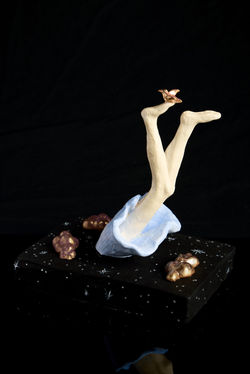 I Choose Joy, Again and Again II Acrylic, high-fired ceramic, European crystals 28 (H) x 25.35 (W) x 17.6 (D) cm 202 5 |
Artists

Duairak Padungvichean
b. 1997, Bangkok, Thailand
Duairak Padungvichean, also known as Lun, is a Thai artist and illustrator currently based in Bangkok, Thailand. She studied Illustration and graduated from the Rhode Island School of Design in 2020. Since graduation, she has created artworks and collaborated with 300 Entertainment, Crack Magazine, Delachaux et Niestle, Meitu, Central Group, Bangkok Bank, Grammy (Entertainment), among others.
Her works are colorful, whimsical, and dreamlike, often inspired by the forms of nature, her surroundings, and everyday life experiences. Duairak explores the relationship between imagination and reality through playful visual narratives, working across a variety of mediums including digital art, watercolor, tufted rugs, ceramics, and more.

Verapat Sitipol
b. 1980, Bangkok, Thailand
Verapat Sitipol is a Thai contemporary artist, who graduated with a Bachelor of Fine Arts (BFA) in Painting from Silpakorn University in Thailand, in 2004 and with a Master of Fine Arts (MFA) in Painting from Visva-Bharati University in Santiniketan, India in 2006.
The artist's abstract paintings explore the powerful relationship between line and color. Behind these paintings shows a fascination with nature’s structure and energy, distilling forests and mountain scenes down to bold strokes and patches of high-chroma color. Their process appears rooted in both abstraction and landscape painting, merging the two so that recognizable elements (trees, undergrowth, distant hills) remain clearly implied, yet the real “subjects” are the lively marks themselves. Each stroke carries the immediacy of drawing—part calligraphy, part painting—inviting the viewer to roam through fields of color and line as though exploring a musical score.
With this approach, he conveys a sense of wonder at the natural world without resorting to literal realism. Instead, they rely on pattern, repetition, and contrasting color values to convey depth and vitality. The result is a series of works that feel joyous and vibrant, each painting capturing the pulse of a landscape in motion.

Aphisit Sidsunthia
b. 1994, Thailand
Aphisit Sidsunthia is a Thai contemporary artist, who graduated with a Bachelor of Fine Arts Degree from Rajamangala University of Technology in 2015, and his Master of Arts Degree in Painting from the F acu lty of Pa i nti ng S cul ptur e a nd G rap hi c Arts , S il p ak orn University in 2019. In 2023, he was selected as one of the artists in residence at No Name Studio in Shanghai. He has won The 19th Panasonic Co ntempor ary Painting Co ntest 2017 and The 18th Panasonic Contemporary Painting Contest 2016.
Sidsunthia's work explores the interplay between visual representation and perception; societal norm and change; handicraft and technology. Much of his work references photographs and random images, representing the visual cultures of different times. Drawing inspiration from those images, his practice includes manipulating those images both manually and digitally by folding, collaging, removing and distorting. Referencing photographs from different time periods allows the overlapping and intersection of different ideologies. While his earlier work depicts a combination of various events in forms of collages, his more recent work usually centers on a singular event. The dimensional complexity then shifts to the lines, colors and planes that are artistically maneuvered to minimize or maximize certain perceptions. His work invites the audience to question the status quo through the overlaying of weirdly shaped planes, as if they were windows to different realities

Pocono Zhao Yu
b. 1990, Shanxi, China
Zhao Yu is a Chinese contemporary artist and writer, currently living and working between Shanghai and Paris. She holds a bachelor's degree (DNAP) and a master's degree (DNSAP) from the École Nationale Supérieure des Beaux-Arts in Paris, France.
Pocono Zhao Yu explores the ideas of mobility, identity, and cultural hybridity in her intermedia art practice encompassing image-making, videography, writing, and installation. Interweaving studio research with personal experiences, she fabricates narratives that reflect on the collective history of civilizations, reconstructing scenes recalled from her memories using elements borrowed from semiotics, literature, and sociology. In her works, Zhao adopts a decentralized perspective in examining our cultural history and relics, focusing on issues of territorial anxiety arising from globalization.
Her work primarily focuses on transforming "self-culture" into an "other-culture" perspective, placing it within the deep framework of time and space. She achieves this translation through various media, including image, video, writing, and installation. Drawing on her travels and personal experiences, she reconstructs scenes using elements from semiotics, literature, and related social sciences, thereby presenting the flow of civilizations and cultural changes worldwide. A "new" narrator emerges from this, posing as an "intruder" who questions the truth of history, exploring and responding to the complex connection between the original and the copy

Gabriel Cheah
b. 1998, Kuala Kangsar, Malaysia
Gabriel Cheah is a Malaysian-born contemporary visual artist, ceramicist, and sculptor based in Kuala Lumpur, who uses art as a tool of self-expression and escapism. He graduated from the Malaysian Institute of Art, Kuala Lumpur, in 2021. His work has received recognition, including being named in Prestige 40 under 40 (PRESTIGE Malaysia, 2024) and The Z List 2023 (Lifestyle Asia, 2023).
As an artist, he aims to create hopeful pieces that radiate positive energy and joy.
His deep connection to Perak, a state in northwest of Peninsular Malaysia, means that elements of his diverse cultural background are always present throughout his whimsical artworks - be it a painting or sculpture. His artwork is influenced by the environment where he grew up; from the production of Labu Sayong, to the golden elements, and the beautiful and classical architecture found in Kuala Kangsar itself. His sculptures are created using clay originating from his birthplace - the royal town of Kuala Kangsar, Perak. Gabriel's works also combine various mediums, including acrylic, clay, plaster, European crystal, and 24K gold leaf.