
Hong Kong Dual-Space 10th Anniversary Group Exhibition
Decade One: Chronolect
Jonas Burgert, Cai Lei, Jigger Cruz, Heri Dono, Huang Yongping, Leng Guangmin, Edgar Plans, Qin Qi, Wang Du, Xiyao Wang, Wu Yi, Yue Minjun, Yang Jiechang, Zhao Zhao, Zhu Jinshi
Hong Kong Central Space
2025.12.18 - 2026.1.31


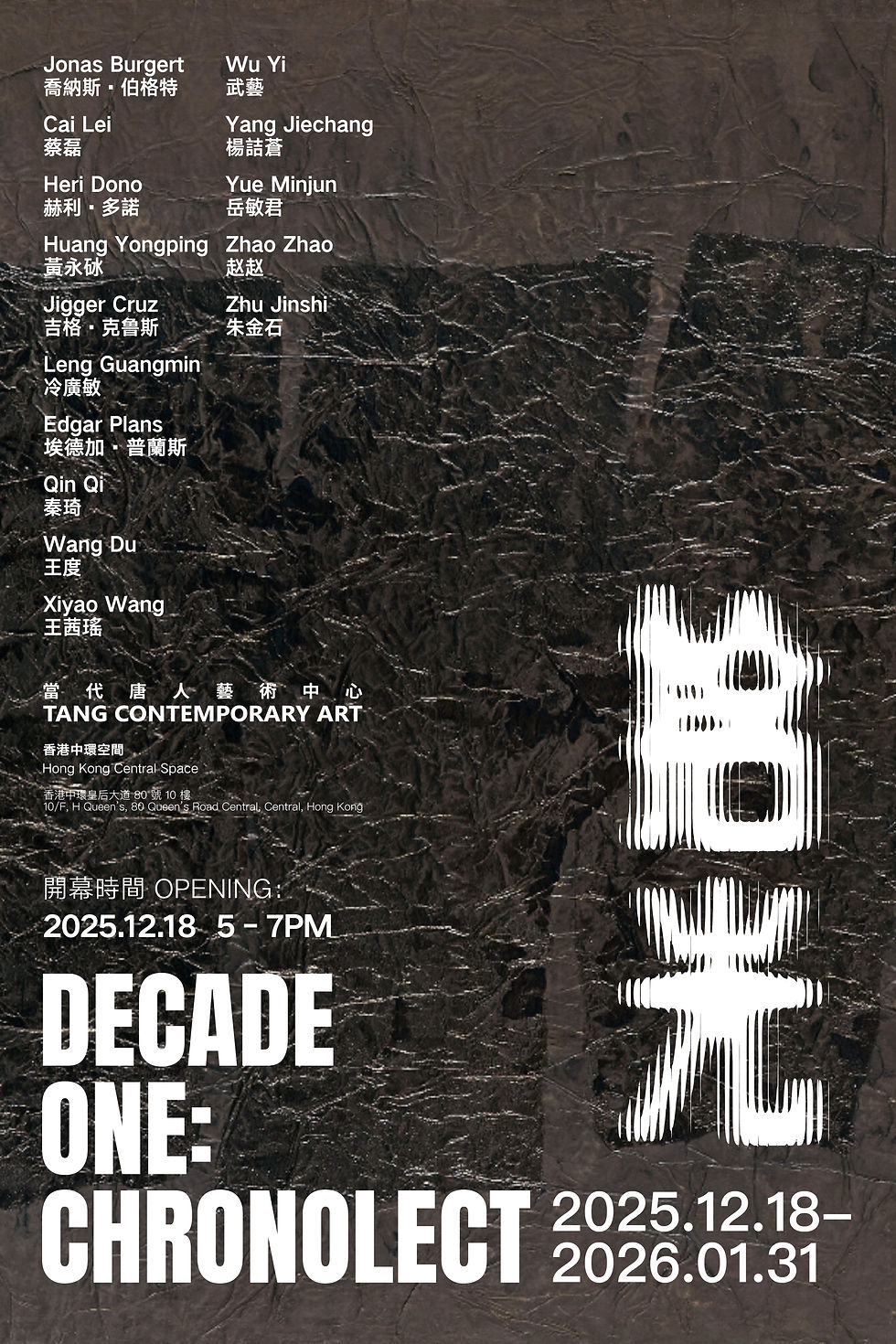
Tang Contemporary Art is proud to announce to celebrate the tenth anniversary of our Hong Kong space, we are presenting a large-scale group exhibition "Decade One: Chronolect" from December 18, 2025, to January 31, 2026, at both of our Central and Wong Chuk Hang spaces. The exhibition's title, "Chronolect" – a lexicon of time – captures the distinct artistic language developed over this inaugural decade. The exhibition aims to focus on the most precious gains in artistic practice—namely, "accumulation and growth"—connecting the iterative evolution of the artists' works, the gallery's and collectors' explorations within the industry, and the unwavering adherence to their original aspirations.
Since taking root in Central in 2015, the space has borne the academic accumulation of nearly 100 exhibitions, becoming a vital bridge connecting Chinese contemporary art with global dialogue. The second Hong Kong space was established in Wong Chuk Hang in 2023, focusing primarily on pan-international projects with young artists, interspersed with group and solo exhibitions featuring artists from Europe, America, Southeast Asia, and Japan.
This "Decade One: Chronolect" exhibition stands as a milestone connecting past and future. The Central space will bring together fifteen artists of international influence, using diverse media to outline the ecosystem of contemporary art. The participating lineup spans creative lineages across multiple generations: from internationally renowned pioneers such as Yue Minjun, Huang Yongping, Yang Jiechang, and Zhu Jinshi, to mid-career representatives including Qin Qi, Cai Lei, Wu Yi, Wang Du, and Zhao Zhao, and further to the highly anticipated emerging forces Xiyao Wang and Leng Guangmin. The selection also encompasses international artists who transcend cultural boundaries—from Jonas Burgert, a profound thinker of German contemporary painting, and Spanish conceptual realist Edgar Plans, to Filipino cross-cultural practitioner Jigger Cruz and one of Indonesia’s most internationally acclaimed contemporary artists, Heri Dono. The juxtaposition of these fifteen artists gives form to the "Chronolect" – a unique vocabulary of time shaped by a decade of practice. We are not only gathering the artistic brilliance of the past decade but also converging a stellar spectrum that crosses geography and generations. The exhibition is not merely a retrospective of past achievements but hopes, through these powerful works, to reflect a facet of the development of contemporary art from both Hong Kong and a global perspective, heralding a prospective view of the next artistic decade.
Jonas Burgert, with his epic, grand scenes, is dedicated to constructing a profound theater of the human psyche. Over the past decade, his paintings have continually gathered fragments of existence—pain, longing, and life itself—solidifying them into moments filled with drama. His works contribute a profound syntax to the "Chronolect," acting like searchlights, guiding the viewer to the sublime spiritual dimensions that art can reach in the digital age.
Cai Lei has deeply cultivated the boundary between two and three dimensions for a decade with his minimalist geometric language. He gathers space and light themselves as materials, transforming cold plaster and pigment into tactile poetry. Each seemingly minor advancement redefines the dimensions of perception, embodying a profound academic trajectory accumulated through focused exploration and adding a unique grammatical structure to the exhibition's temporal lexicon.
Jigger Cruz deconstructs and reshapes art historical classics with a ferocious yet precise painterliness. He "gathers" the dialectic of destruction and creation through the layering of pigment, showcasing a unique growth trajectory that transcends cultural barriers and introduces a bold, textured vocabulary into the "Chronolect."
Heri Dono is known for his uniquely contemporary, Javanese style inspired by traditional Wayang Kulit (puppet theatre). Through his construction of thoughtful layers in his work, he is able to emphasize the more serious, underlying reflections on and criticisms of social and political issues such as military intervention, political corruption, and environmental destruction, allowing easier engagement with often difficult concepts.
Huang Yongping is one of the indispensable figures in the Chinese avant-garde art movement of the early 1980s. In 1986, he co-founded "Xiamen Dada." In 1989, he traveled to France to participate in the landmark exhibition Les Magiciens de la Terre at the Centre Pompidou, after which he lived and worked in France. The collision of multiple identities and cultural differences led him to develop an approach in his work that "uses the East to challenge the West and the West to challenge the East."
Leng Guangmin calmly gathers the readymades and artificial textures of the consumer era, translating them with exquisite skill into ambiguous painted objects. Beneath their smooth, jade-like surfaces, his works conceal profound questioning of material culture and nihilistic aesthetics. Over this decade, he has continuously refined his unique, cool aesthetic, contributing a tone of critical reflection to the decade's evolving language.
Edgar Plans's "little heroes," with their innocence and imagination, confront the complexity and norms of the adult world. His creation consistently gathers and guards that initial childlike wonder and courage; this unchanging original heart has become the warmest beacon on his artistic growth path. His works contribute a universal dialect of pure emotion to the "Chronolect," proving to be the best bridge connecting different cultures.
Qin Qi's canvases resemble an ever-expanding museum of styles. Over ten years, he has freely gathered fragments of art history, everyday objects, and personal memory, reassembling them into spectacular scenes filled with dramatic tension. His creative journey itself is an unceasing experiment and iteration, his eclectic style forming a crucial and expansive chapter in the exhibition's narrative of time.
Wang Du works in a range of media, including installation, sculpture, photography, and multi-media. His statement, “I am media, I am reality, I am image,” could be seen as an interpretation of the concepts behind his work. He believes that “the completely digital third reality is constructing a contemporary society and culture that needs to be constantly redefined.”
Xiyao Wang's canvases are direct manifestations of flowing emotions and inner landscapes. Her vibrant brushstrokes gather every moment of intuition, struggle, and ecstasy from the creative process. As a highly-touted emerging artist, her practice iterates rapidly, growing naturally like an organism. She speaks the "Chronolect" with a raw and vital accent, recording the most precious original aspirations and burgeoning creativity of a young artist.
Wu Yi's works have been exhibited in National Art museum of China (“Experiment of tension--Exhibition of Expressive Ink-wash Painting”, 1994), Pace Gallery (Beijing), Museum of Contemporary Art in Zagreb, Crotia (“Golden Harvest:China Modern Art Exhibition”, 2002), Malaysia National Art Gallery (“Spot, Radiation and Penetration: Visual Transmission from Brush and Ink”, 2004) and other important art institutions in China and abroad.
Yang Jiechang's artistic practice as a calligrapher-painter turned global social actor inverts the contemporary Chinese art world norm of using Western avant-garde forms to critique contemporary Chinese society. He accomplishes this by adopting the performative expressivity of the traditional brush and the paradoxical dialectics of pre-modern Daoist skeptics to expose the underlying social and cultural forces that shape our contemporary global reality.
Yue Minjun, a pioneer of Chinese contemporary art, has seen his iconic laughing images become cultural symbols of an era. In the flowing light of the past decade, his works, like never-eroding mirrors, continuously reflect individual anxiety and social reality beneath collective revelry. This presentation secures his legacy within the "Chronolect", not only gathering a segment of glorious historical light but also bearing witness to the precipitation and reverberation of his critical spirit through the long river of time.
Zhao Zhao engages with real subjects in multiple mediums and plays with art forms, emphasizing an exploration of the relationship between the individual and the rest of society. His work is developed around the subtle emotional changes that take place as we are confronted with diverse cultural influences. He brings together the expressive methods of contemporary art and traditional culture to create metaphors for people's living circumstances and modern society's real conditions in a globalized world.
Zhu Jinshi produces abstract paintings whose surfaces are built up with thick, near-sculptural layers of oil paint. Resembling colorful landscapes, Zhu’s images range in palette and scale, but the artist is known to always apply his oil paint with spatulas and shovels. Producing dense lashings of color, the artist’s method recalls the style and techniques espoused by the German Expressionists, whom Zhu was profoundly influenced by during his years living in Berlin.
EXHIBITING WORKS
 Edgar PlansTech Family 5G portrait Mixed media on canvas 100 x 100 cm 2025 |  Edgar PlansHeaven Mixed media on wood 115 x 130 cm 2025 |  Jonas Burgertkein Einst Oil on canvas 240 x 180 cm 2025 |
|---|---|---|
 Jonas BurgertGlutschicht Oil on canvas 260 x 180 cm 2020/2025 |  Xiyao WangWeekend Walks in the Forest No.1 Charcoal on canvas 200 x 190 cm 2024 |  Leng GuangminPlayground 40 x 50 cm 2025 |
 Yue MinjunStamen or Pistil Oil on canvas 120 x 100 cm 2020 |  Yue MinjunSelf-portrait Oil on canvas 91.5 x 61.5 cm 2014 |  Yue MinjunHermit Oil on canvas 264 x 200 cm 2009 |
 Cai Lei0102# Acrylic on canvas 180 x 152 cm 2020 |  Cai LeiBlock 20211027 Bronze 291 x 50 x 62 cm 2021 |  Heri DonoTrump vs the Dragon Arcrylic on canvas 150 x 150 cm 2017 |
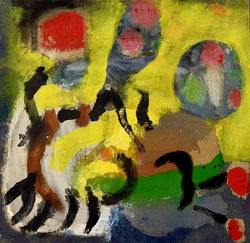 Huang YongpingUntitled Oil on canvas 80 x 76 cm 1983 | 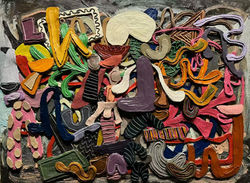 Jigger CruzSynthetic Portraits of The Flowers Oil on canvas 91.5 x 122 cm 2025 |  Leng GuangminOsprey Oil on canvas 100 x 100 cm 2016-2025 |
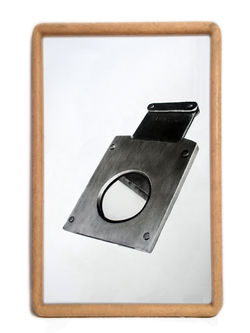 Wang DuObject No. 8 Silica gel frame with implanted hair, charcoal 160 x 110 x 12 cm 2015 |  Wu YiDucks Oil on canvas 100 x 80 cm 2006 |  Yang JiechangOne Hundred Layers of ink Ink on paper 131 x 188 cm 1994 |
 Zhu JinshiPeony Pavilion No.1 Oil on canvas 180 x 160 cm 2019 |  Zhao ZhaoMouse Dropping 65 Oil on canvas 200 x 200 cm 2015 |
Artists
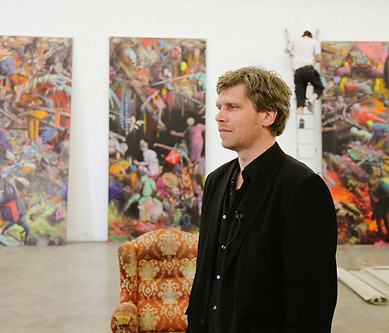
JONAS BURGERT
b. 1969, Berlin, Germany
Lives and works in Berlin, Germany
Jonas Burgert graduated from the Academy of Fine Arts, Berlin, in 1996 and consecutively studied for a postgraduate title (Meisterschueler) under Professor Dieter Hacker in Berlin. Jonas Burgert paints a stage every time that he lifts his brush: with every stroke, with every composition. His works depict the inexhaustible theatre play that Burgert considers to be the meaning of human existence: man’s need to make sense of his purpose in life. It is a quest that seems inconclusive, but which opens doors to every sphere of reasoning, imagination, and desire. Oversized canvases are crowded with fantastical costumed figures intertwined with organic forms of various proportions, illustrated with bold colors, draping a trace of unspoken emotions among viewers.
Selected Solo Exhibitions include “sinnwild,” Tang Contemporary Art, Seoul, (South Korea, 2024); “Stirn sticht,” DSC Gallery, Prague, (Czech Republic, 2023); “ein Dorn weich: Recent Drawings,” Stephen Ongpin Fine Art, London (UK, 2022); “raub und bleib,” Produzentengalerie, Hamburg (Germany, 2022); “blüht und lügt” , Long Museum West Bund, Shanghai (China, 2021); “Blindstich”, etc.

CAI LEI
b. 1983, Changchun, China
Cai Lei graduated in 2015 with a Master’s Degree in Sculpture at the China Central Academy of Fine Arts (CAFA) in Beijing. An award-winning young artist from the 80s generation. He has exhibited internationally including the Yangtze Art Museum (Chongqing), Foundation Taylor (Paris), Kuandu Museum of Fine Arts (Taiwan), CAFA Museum (Beijing), Poly Art Museum (Beijing), Jacksonville Museum of Contemporary Art (USA), Today Art Museum (Beijing), and Museum of Contemporary Art Bonn (Germany).
Recent solo exhibitions include: “Invisible Spaces,” ICICLE Cultural Space, Paris (France, 2025) “Constructing Void,” Tang Contemporary Art, Hong Kong (China, 2025); “Space of Space,” ART Yang Yun, Shanghai, (China, 2024); “Supremacist Space”, Tang Contemporary Art, Seoul (Korea, 2022);

JIGGER CRUZ
b. 1984, Phillipines
Jigger Cruz graduated with a Bachelor of Fine Arts at the Far Eastern University, Manila and also trained at the De La Salle College of Saint Benilde before pursuing a full-time career as a painter. The artist has been listed in international auction houses around the world, and has exhibited in both solo and group shows locally and internationally, from the Philippines to Thailand, Indonesia, Singapore, Japan, Germany, Switzerland, France, Italy, Austria, and the United States. His work can be found in multiple public collections, including: The Dikeou Collection, Denver, CO, USA; Guggenheim Museum, NY, USA; Saatchi Collection, London, UK; and Zabludowicz Collection, London, UK.
Selected exhibition include: “Resembling Utopia,” Tang Contemporary Art, Hong Kong, (China, 2023); “Paradigmal Traps,” Tang Contemporary Art, Bangkok, (Thailand, 2021); “In the Landscape of Narratives and False Monuments,” Artinformal Gallery, Manila, (Philippines, 2021), etc.

HERI DONO
b.1960, Jakarta, Indonesia
For almost forty years, Heri Dono has developed a fantastical world of dichotomies in his paintings. Humorously juxtaposing reality with imagination, folk with contemporary art, politics with fiction, the tension between these opposing forces create narratives that cut across a complex, multi-layered system of ideologies. Having lived through the struggle against oppression by the Indonesian regime in the 1980s, and later the ‘reformasi’ in 1998 that spawned from the end of Suharto’s regime and developed into the neo-liberal globalization of Indonesia as it is today, Heri Dono’s artistic methodology re-examines power structures through satirical illustrations of humans versus the Other, man versus machine, offering a kind of passage for others to survive real life transitions during challenging times.
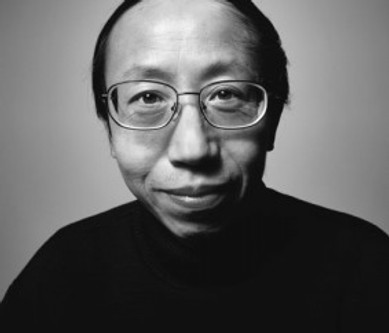
HUANG YONGPING
1954-2019
Born in Xiamen, China, in 1954 and based in Paris since 1989, and passed away in France in 2019.
Huang Yongping was an indispensable figure in China’s avant-garde art movements in the early 1980s. In 1986, he and several friends established “Xiamen Dada”, and in 1989, he went to France to participate in “Magiciens de la Terre,” a major exhibition at the Centre Pompidou. Huang has lived in France for many years, and due to his status as an immigrant and the cultural differences and collisions he has experienced, he “takes on the East with the West and takes on the West with the East” in his work.
Huang Yong Ping’s recent solo exhibitions include “Huang Yong Ping”, Gladstone Gallery, New York (USA, 2018); “Bâton Serpent III: Spur Track to the Left”, Power Station of Art, Shanghai (China, 2016); “Wolfgang Hahn Prize”, Museum Ludwig, Cologne (Germany, 2016); “Empires”, Monumenta, Le Grand Palais, Paris (France, 2016), etc.
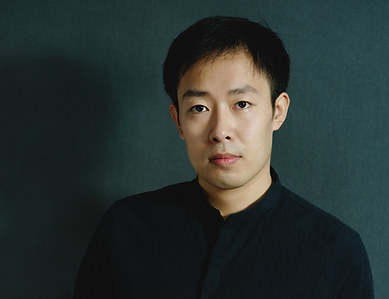
LENG GUANGMIN
b. 1986, Qingzhou, Shandong Province, China
Leng Guangmin was born in Qingzhou, Shandong, in 1986. During studies in the department of oil paintings at Tianjin Academy of Fine Arts, Leng spontaneously explored his path to break the traditional paradigm of oil painting creation and became one of the most significant painting artists of the 80s generation. In contrast to accumulated paints and strokes, he chose to open a brand-new physical space in the image with the movement of slicing. Slicing is not only his creative method but also his attitude toward art, which is keen, determined, and resolute. With relatively consistent painting skills, the artist keeps dissecting materials and images guided by some clues but has no clear themes. The ubiquitous tension formed by confrontations, the opposing but complementary colors, the level and scraped materials, the hard-edged and gradient textures, and the conformal and negative structures are the incomparable attractions of his paintings. They enable the artist to refine the inner order behind the numerous and complicated objects, which can be manifested with images only in a highly abstract and endlessly changing state.
His critical solo exhibitions include: “Leng Guangmin: Figure Wound,” Tang Contemporary Art, Beijing (China, 2024); “Shell, like the wings of a cicada,” MAHO KUBOTA GALLERY, Tokyo (Japan, 2023); Personal Project at West Bund Art & Design Fair, Shanghai (China, 2019), etc.
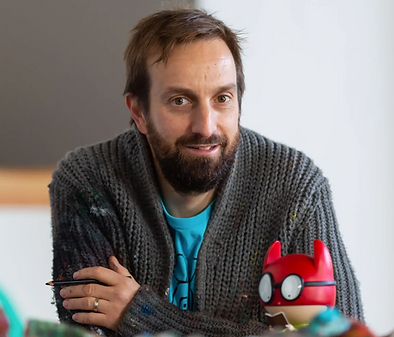
EDGAR PLANS
b. 1977, Madrid, Spain
Lives and works in Gijón, Spain
Edgar Plans categorized as the most popular Spanish contemporary artist, grew up and is now based with his family in the northern Spanish town of Gijón. After earning a degree in Art History from the University of Oviedo, Plans started to participate in small exhibitions in local galleries. As of today, his works have been exhibited in Museums such as the MMOMA Museum in Moscow, Russia, and the Xiao Museum in Rizhao, China.
Edgar Plans names graffiti, street art, comic books, illustrations, and animated films as major influences. Yet it is really his characters, which Plans describes as “Hero Animals,” which have helped the artist win popularity and a number of gallery shows around Spain. His work has found high demand on the secondary market in which his paintings have sold for six figures. Despite their vibrant color palette and cartoon-indebted aesthetics, Plans’s paintings tackle serious subject matter: with his animal heroes he intends to criticize gender violence, racism, and envy.

QIN QI
b. 1975, Xi’ an, China
Qin Qi graduated from the Department of Oil Painting at the Lu Xun Academy in Shenyang in 1999. He received his Master Degree from Lu Xun Academy in 2002 and teaches at Lu Xun Academy since 2002. Now He works and lives in Shenyang.
His works are characterized by a surreal dimension, through which he strives to depict things taken from a familiar context and represented with a reconfiguration of their concepts. His compositions are characterized by still life, real landscapes, dream-like situations and sketches from nature, all different elements that he has rationally chosen to assemble together in order to prove the coexistence of many different worlds. Qin Qi is a visual thinker and his compositions, no matter often permeated by a sense of ambiguity; appear as subtle representations of a consciousness that goes beyond forms to reach their more remote meanings.

WANG DU
b.1956 Wuhan, China
Currently lives and works in Paris, France
Wang Du has taught in the art department at the University of Paris VIII and the École supérieure d'art de Brest. Wang Du works in a range of media, including installation, sculpture, photography, and multi-media. His statement, “I am media, I am reality, I am image,” could be seen as an interpretation of the concepts behind his work. He believes that “the completely digital third reality is constructing a contemporary society and culture that needs to be constantly redefined.” Thus, his work redefines a series of concepts within reality from different perspectives, which is also the statement he has made since he declared, “I am the spokesperson for reality and the masses.”
Wang’s art has been disseminated widely in art criticism, documentaries, contemporary artist dictionaries, and art books. His work has also been covered by many international magazines, newspapers, and TV and radio stations.

WU YI
b. 1966, Changchun City, China
Since 1994, Wu Yi’s works have been exhibited in National Art museum of China (“Experiment of tension--Exhibition of Expressive Ink-wash Painting”, 1994), Pace Gallery (Beijing), Museum of Contemporary Art in Zagreb, Crotia (“Golden Harvest:China Modern Art Exhibition”, 2002), Malaysia National Art Gallery (“Spot, Radiation and Penetration: Visual Transmission from Brush and Ink”, 2004), Fukuoka Asian Art Museum ( “19th Asia International Art Exhibition”, 2004), National Gallery Singapore (“21st Asia International Art Exhibition”, 2006), Tokyo University of Art (“Ink-Wash Painting · Unicolor World”, 2007), Hongkong museum of Art, National Gallery Berlin, Staatliche Kunstsammlungen Dresden (“The New Context of Ink and Wash--Chinese Contemporary Ink Art”, 2008), Hamburg Kunsthalle (“Modern Ink Painting Show of China”, 2012), Musée du Louvre (“Century of Chinese Ink Painting—the Invitational Exhibition in Carrousel”, 2012), Saatchi Gallery, UK (“Chinese Modern Art Show”, 2012), Torrance Art Museum, USA (“Chinese Modern Art Exhibition", 2014), Gottingen Museum ( “More Than 10 Feasibilities of Ink”, 2018), Tang Contemporary Art Hong Kong (“Wu Yi: A Snap of Life”, 2021), Song Art Museum (“Prague”, 2021), Tang Contemporary Art Beijing (“Love in Midsummer”, 2025)and other important art institutions in China and abroad.

XIYAO WANG
b. 1992, Chongqing, China
Lives and works in Berlin, Germany
Xiyao Wang’s abstract painting can best be described as movement captured on canvas, as expressing a feeling of boundlessness and unbridled life energy. She combines various techniques such as oil and acrylic paint, chalk, graphite, and oil sticks, because she sees different materials as being like different people, each with its own personality and its own character. Her works have the ability to sweep the viewer along, allowing a journey into the depths of the picture. Contrasting starkly with European abstract art, Wang’s lines are loaded with positive energy. In the Chinese artistic tradition, she admits the beauty and joie de vivre which Western art has long since consciously encased in bitterness. Her paintings are a delicate, semi-conscious dance that inspires a feeling of happiness in the viewer, like being touched by nature, akin to how one might feel in springtime.
Selected solo exhibitions include “Wingless Shadow,” Tang Contemporary Art, Seoul (Korea, 2025); “Lightly Floats and drifts the boat” Konig Galerie (Mexico City, Mexico 2024); “Before the Sun Goes Down,” Tang Contemporary Art, Bangkok (Thailand, 2024), etc.

YUE MINJUN
b. 1962, Heilongjiang, China
Currently lives and works in Beijing, China
Yue Minjun is one of the leading figures of Chinese contemporary art and an internationally renowned artist. Having graduated from Hebei Normal University in 1983 with a major in oil painting, he currently lives and works in Beijing, China. Yue Minjun has been creating this exaggerated “Self-image” since the beginning of the 1990s. In recent years, this image has expanded further into the field of sculpture and printmaking. Sometimes the “laughing man” appears independently, or collectively in depictions of daily life. Through the “laughing man”, who squints his eyes, laughing and grinning exaggeratedly with dramatic gestures, Yue interrogates social phenomena in an ironic and cynical manner.
Yue’s artworks have been widely collected by various domestic and foreign art institutions, galleries, and museums. This includes the San Francisco Museum of Modern Art, the Denver Art Museum, the Culture Centre of Francois Mitterrand, the Busan Museum of Art, the Guangdong Museum of Art, the Shenzhen Art Museum, amongst other important institutions.
YANG JIECHANG
b. 1956 in Foshan, Guangdong, China
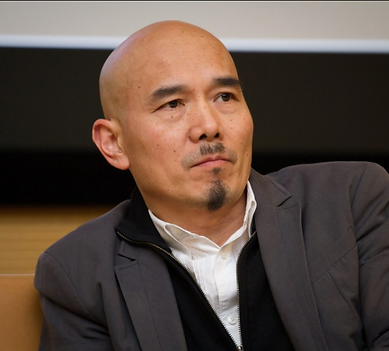
Yang Jiechang’s artistic practice as a calligrapher-painter turned global social actor inverts the contemporary Chinese art world norm of using Western avant-garde forms to critique contemporary Chinese society. He accomplishes this by adopting the performative expressivity of the traditional brush and the paradoxical dialectics of pre-modern Daoist skeptics to expose the underlying social and cultural forces that shape our contemporary global reality. Starting with his censored Massacre series in which he confronts the human toll of politically-violent authoritarian government, and continuing with his Crying Landscape series which he created for the 2003 Venice Biennale, Yang has made the critique of power, wealth, violence and terror central concerns of his artistic practice.
ZHAO ZHAO
b.1982, Xinjiang, China
Lives and works in Beijing, China
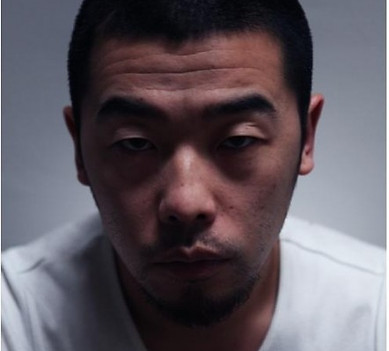
Zhao Zhao is a significant figure among the young Post-80s generation of contemporary Chinese artists. Zhao’s work is often associated with anti-authoritarian or non-conformist tendencies, renowned for confronting existing ideological structures and exercising the power of individual free will in his work. Zhao engages with real subjects in multiple mediums and plays with art forms, emphasizing an exploration of the relationship between the individual and the rest of society. His work is developed around the subtle emotional changes that take place as we are confronted with diverse cultural influences. He brings together the expressive methods of contemporary art and traditional culture to create metaphors for people’s living circumstances and modern society's real conditions in a globalized world. His works also reflect his attitudes toward the coexistence of collective and individual ideals.

ZHU JINSHI
b.1954, Beijing, China
Lives and works in Beijing, China
Zhu Jinshi is a pioneer of Chinese abstract art and installation art. At present, he lives and works in Beijing. As an important Asian contemporary art practitioner who rose to prominence in the second half of the 20th century, Zhu Jinshi has experimented with a wide range of mediums and methods. Amidst the historic Eastern and Western cultural currents of the Cold War, he tirelessly promoted the Asian experience. In 1979, Zhu participated in the “Stars,” China’s first contemporary art movement, and in the 1980s, he explored abstract painting and “apartment exhibitions.” In 1986, he moved to Berlin Germany, and witnessed the fall of the Berlin Wall. In the 1990s, he started his installation practice, and after the year 2000, he engaged with Chinese abstract neo-expressionist painting and large-scale installation.